How to Run Senior Center Group Activities That Keep People Coming
It depends on the room, not the idea. Senior center group activities work when the leader plans the pace, seats people so everyone can hear, and gives each person a part to play. Forty-five minutes with a clear start beats a longer session.
On this page (8 sections)
- Quick recap
- What makes a senior center group activity work
- How to run senior center group activities that fill the room
- Set the room before anyone sits down
- Mix abilities without singling anyone out
- Handle the hard moments: quiet rooms, walk-outs and one loud voice
- Keep regulars coming back week after week
- Still wondering?
Part of our guide on creative ideas for nursing homes
Key figures
- Session length
- Plan for 45 to 60 minutes
- Change gear
- Every 15 minutes
- Arrive early
- 15 minutes before
- Warm-up
- 2 minutes, one question
- Close early
- 5 minutes before the end
Quick recap
- Start on time every week. The regulars plan their day around that hour.
- Change gear every 15 minutes. Talk, then do, then share.
- Seat people in a curve so everyone can see each other's faces.
- Give regulars real jobs. Owners show up; watchers drift away.
- End while the energy is high. People return to a good feeling.
What makes a senior center group activity work
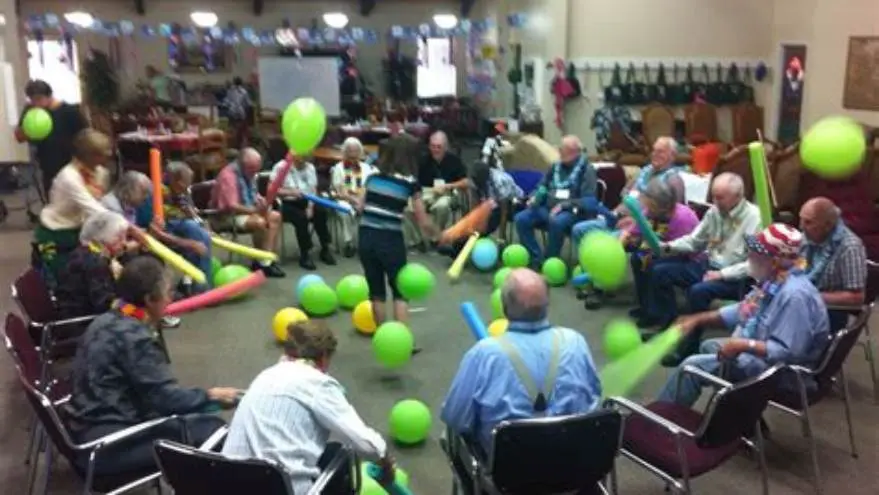
Good sessions start before anyone arrives. The leader knows the plan, the materials are laid out, and the room is set so latecomers can slip in without a fuss. People relax when they can see what will happen next. Five minutes of welcome, a clear first step, and a job for every pair of hands set the tone. Ideas matter less than that opening. Warmth in a plain quiz beats a clever theme run in a rush.
Watch the clock from the chair, not from the plan. Many leaders find energy dips somewhere around the 45-minute mark. Energy dips, talk drifts, and chairs start to scrape. Sessions that change gear every 15 minutes hold people longer than one long stretch of the same task. Talk, then do, then share. That rhythm gives quiet people a way in and gives lively people a place to spend their energy. It also gives the leader a natural point to check the room.
Leading means minding the room, not the material. Handouts, props, and music are tools. Real work means watching faces, hearing who has gone quiet, and drawing out the person who has not spoken yet. Reading the room lets a leader slow a round down, skip a question that lands badly, or stretch a good discussion by five minutes. That judgment comes from paying attention, not from a script. Keep the plan in your pocket and the people in front of you.
How to run senior center group activities that fill the room
Start with a start time people can trust. Put the session on the calendar at the same hour every week and begin on time, even if only four people are seated. The regulars plan their day around that hour. Starting ten minutes late every week trains people to arrive ten minutes late. Five minutes of welcome and a quick question everyone can answer gets the room warm. Then move straight into the main activity while energy is high. It helps to understand nursing home activities for men before going further.
One simple structure carries the whole hour. Open with something easy, build to the part that takes thought, and close with something light. Trivia fits that shape well. Easy questions first, harder ones in the middle, and a fun final round to end on a high note. Our Big Print Trivia for Seniors comes with a host kit and score sheets, which takes the prep off your plate. Quiz rounds are all it covers, so pair it with a craft or a singalong for a full week. Writing ten of your own questions works too, and costs nothing.
Wrap up while the room is still warm. Finishing while people are still smiling leaves them wanting the next one. Dragging on until the room empties teaches people to leave early next time. Watch for the signs: answers slow down, side talk grows, and people start checking the clock. Take that as your cue to wrap up with a thank-you and a look at next week. Ten minutes of good feeling beats ten minutes of overtime.
- Welcome everyone by name and state the plan in one sentence.
- Run a two-minute warm-up question every person can answer.
- Move to the main activity while energy is high.
- Change gear after 15 minutes: talk, then do, then share.
- Close five minutes early with a thank-you and next week's teaser.
Set the room before anyone sits down
Arrive 15 minutes early and walk the room as a guest would. Sit in the back chairs and check what you can see and hear from there. Print that looks fine from the front often turns to grey at the back. Move a lamp, open a curtain, or shift the chairs closer until the back row can read the page. Light matters more than decoration. Bright light and plain chairs beat a pretty room where half the group squints.
Seat people in a curve, not in rows. Curved seating lets everyone see each other's faces, and faces carry half the conversation. Leave a wide gap at the end for wheelchairs and walkers so nobody has to squeeze past knees. Put the quietest people near you, not at the far end, so you can hear them without asking them to shout. Background music and hallway noise make it harder for people with hearing aids to follow conversation, so keep both down.
Lay out materials before the first person arrives. Count the handouts, sharpen the pencils, and test the speaker before anyone is watching. Fumbling with a cable for five minutes loses the room before the session starts. Keep a spare set of everything within reach: extra sheets, a second pen for each table, and a backup plan if the sound fails. Preparation is invisible when it works and obvious when it does not.
Mix abilities without singling anyone out
Every group holds a wide range of abilities, and the range is the point. Quickest and slowest in the room both came for the same reason: an hour with other people. Your task is to give each of them a part that fits. Offer the same activity at two levels and let people choose their own. Harder and easier sheets on the same table let nobody be sorted in public. Choice protects dignity better than any speech about it.
Teams do the mixing for you. Pair a confident person with a quieter one and give the pair one shared task, not two separate ones. Sharing one sheet means the faster person helps instead of finishing first and waiting. Rotate the pairs every few weeks so no one is always the helper and no one is always helped. Fondness grows through small shared jobs. Such fondness brings them back.
Notice the person who stops coming to the hard parts. Maybe they need a simpler sheet, a seat nearer the front, or a partner who reads the questions aloud. Offer the change as a choice, never as a fix. Let them pick: the larger print today, or the regular one. Small offers like that keep a person in the room. Feeling singled out makes a person stop coming. Looked-after people bring a friend. For people living with memory changes, keep the routine the same each week and hand them the simpler sheet without a fuss.
- Name tags: first names in large print, so newcomers feel known fast.
- Spare seats: leave one chair open at each table for a late arrival.
- Print size: handouts in large, clear print, checked from the back row.
Handle the hard moments: quiet rooms, walk-outs and one loud voice
Silence meets every leader sooner or later. Questions land, nobody answers, and the quiet stretches. Wait it out. Count to ten in your head before you rescue the group with the answer. Silence feels longer to the leader than to the room. Often one person is still thinking, and your patience gives them the floor. If the silence holds, answer your own question lightly and move on. Never shame a quiet room.
A loud voice can take over a group in a week. Somebody answers every question, talks over others, and the quiet ones stop trying. Do not fight them in front of the room. Give them a job that uses the energy: scorekeeper, reader, or greeter at the door. Jobs like that turn a dominator into a helper. If the talking still crowds others out, speak to them alone after the session, kindly and plainly. Most people do not know they are doing it.
People leave mid-session, and it is rarely about you. Aches, tiredness, and appointments pull people away. Let them go with a smile and a word about next week. Chasing them or calling attention to the exit embarrasses everyone. Leave the door easy to reach and the welcome easy to return to. Leaving early and being greeted warmly next week brings a person back. Being made to feel guilty keeps a person away.
| Format | Best group size | Prep time | Watch out for |
|---|---|---|---|
| Trivia round | 8 to 20 people | 15 minutes | One voice taking over |
| Craft table | 6 to 12 people | 30 minutes | Messy setup and cleanup |
| Discussion circle | 6 to 10 people | 10 minutes | Quiet members staying silent |
Keep regulars coming back week after week
Regulars return for people, not for programs. They come back because someone saved them a seat, asked about their week, and missed them when they were away. Build that into the routine. Greet people by name at the door. Notice an absence and mention it warmly the next time you see them. Groups that feel like clubs keep their members. Groups that feel like classes lose people to the next thing on the calendar.
Give regulars real jobs and the group becomes theirs. Set up a welcome committee to greet newcomers. Regulars take turns reading the questions aloud. Another keeps score. Jobs turn watchers into owners, and owners show up. Rotate the jobs so the same three people do not carry the whole session. Ask the group what they want next month and put one of their ideas on the calendar. They return to a group they helped shape.
Small rituals hold a group together. Ask the same opening question each week. Sing a birthday song at the first session of the month. Pin photos and clippings to a notice board. These cost nothing and take minutes, yet they are what people mention when they tell a friend about the group. Change the activity, keep the rituals. Familiar starts make a new activity feel safe to try.
A steady weekly rhythm with a clear arc beats a clever one-off event.
Still wondering?
How long should a senior center group activity last?
Plan for 45 to 60 minutes, including the welcome and the close. Energy dips after about 45 minutes of one task, so a session that changes gear holds attention longer. Shorter sessions that end on a high note beat long ones that empty the room.
What if only a few people show up?
Run the session anyway, and run it well. With few people in the room, you get time to learn names, hear quiet voices, and try something new. In our experience, four happy regulars bring friends faster than a poster does.
How do I handle someone who talks over everyone else?
Stay calm and give the floor back to the group. Invite answers from people who have not spoken yet, and move on briskly when one voice takes over. A private word after the session, kindly and plainly, works better than a public correction.
Do I need special training to lead group activities?
No certificate is needed to run a warm, well-planned session. Preparation, a clear plan, and attention to the room matter more than formal training. Short courses for activity leaders exist through local volunteer programs if you want to build your skills.
Ready to try it? A ready-made trivia round with a host kit gives a new leader a session that runs itself while they learn the room.
See the trivia host kit