How to Choose a Large Print Word Search Book as a Gift
Choosing a large print word search book as a gift starts with the person, not the print. Good gift books have letters big enough to read at arm's length, words the person knows, and a readable answer key. Check the listing first.
On this page (8 sections)
Part of our guide on printable birthday cards for seniors large print
Key figures
- First check
- The person, not the print
- Large-print body text
- 18 point, per the ACB
- Grid letters
- Near 18 point, bold black
- Answer key
- Same size as the puzzles
- Best binding
- Spiral or lay-flat
- Paper
- Matte white, no glare
Quick recap
- A look-inside preview tells you more than the cover or the title.
- Spiral binding matters as much as print size for a book read on a lap.
- A book with themes the person loves gets finished; a generic one gathers dust.
- Write the date inside the cover, so the gift remembers the day.
- Keep the receipt: a wrong-level book is an easy exchange, not a wasted gift.
How to choose a large print word search book as a gift
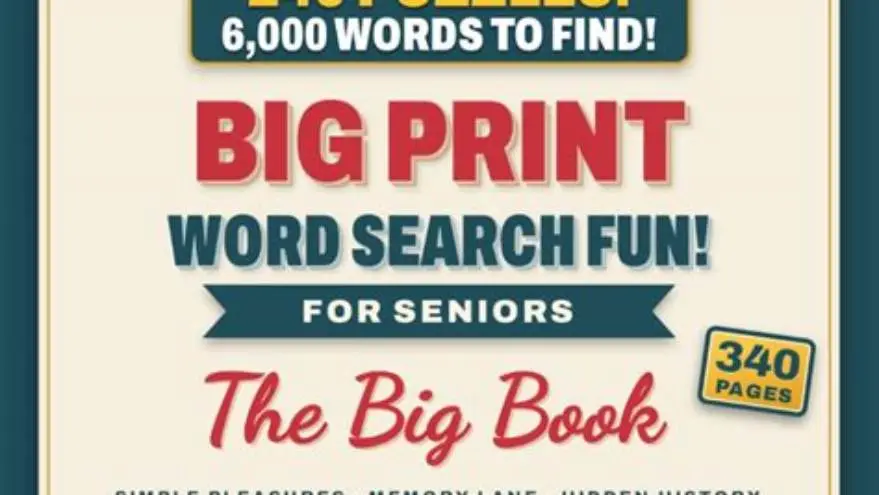
One rule decides the gift. Choose for the person, not for the idea of a gift. Books that suit the solver get finished, and books that suit the giver's taste sit on a shelf. Think about who will hold it: their eyesight, their puzzle habit, and the themes they love. Chosen for the solver, it is a gift. Chosen for the shelf, it is clutter.
Five checks decide whether the book will get finished, and all five can be done from the listing before you order. Print size comes first, then the binding, the paper, the grid and the answers. Listings that hide all five are listings to skip. Those checks take a few minutes and save a wasted gift. A gift chosen this way gets opened twice: once at the party, and once at the kitchen table. The right book earns its shelf space in the first week. Person first, print second, and the gift takes care of itself.
Order early, so the book arrives with time to spare. Checked gifts carry no surprises. Early orders leave room for a swap.
What does the person actually solve?
Habit decides difficulty. Daily solvers want a book that lasts the month, with puzzles that grow harder as the pages turn. An occasional solver wants a gentle book that never frustrates. New solvers want easy grids with words that run across and down only. Ask what they solve now, and buy the next step up, not three steps up. Level labels, easy to hard, let you buy the right step. A book that grows with the solver lasts longer than one that stays easy. The other half of this decision is word search book for senior centers.
Eyesight decides print. Readers with low vision need the biggest letters and the widest spacing. Readers with good eyes and tired hands need a clear grid more than a huge one. Watch how they read: do they hold the page close, or do they read at arm's length? That answer tells you how big the print must be. Watch their hands as well as their eyes: stiff fingers need wide spacing too. Tired eyes need a book that rests easily in the hand, not just big letters.
Themes decide whether the book gets opened. Gardeners open garden books, travelers open places books, and cooks open food books. Generic themes suit nobody in particular. Listen for the theme they mention twice, and buy that one.
How do you read a listing before you buy?
Look-inside previews are the gift buyer's best friend. Read a puzzle page in the preview the way the solver will: at arm's length, in normal light. Compare the grid letters with the page number and the copyright line, which are almost never enlarged. If the letters look the same size as the page number, the book is not large print, whatever the cover says. Previews that show only the cover tell you nothing at all.
Size claims need reading, not trusting. Listings that name a point size give you something to check, and listings that never name one give you nothing. Words like large, jumbo and extra-large mean nothing on their own, because no rule fixes what they must measure. Trust the number, not the adjective. Adjectives sell books; numbers describe them. Previews without a stated size still help: read a puzzle page at arm's length in the preview, and judge the letters yourself.
Answer keys deserve the same look. Turn the preview to the answers and check whether they print at the same size as the puzzles. Tiny answers show a book was not designed for the solver. Readable answers show a book designed all the way through.
| Check | What to look for | Walk away if |
|---|---|---|
| Print size | A point size stated in the listing | No size is named anywhere |
| Binding | Spiral or lay-flat, opens flat | Springs shut on a lap |
| Paper | Matte or uncoated white, low glare | High-gloss stock that throws lamp light back at the page |
| Grid | One puzzle per page, bold letters | Two grids share one page |
| Answers | Same size as the puzzles | Tiny answers at the back |
What do the numbers on the listing mean?
Eighteen point is the number to know. The American Council of the Blind's large-print guidelines put body text at 18 point. Grid letters need at least as much, because a single letter has no surrounding words to help the eye guess it. Numbers matter more than the words on the cover. Listings that state 18 point for the grid have passed the first test.
Fourteen point is where the shelf disagrees with the standard. Plenty of books labelled large print set their grids at 14 point, which is a help, not a solution, for low vision. Read the listing's number against the person, not against a rule.
Grid size moves the letters, and the two cannot be judged apart. Small grids on a full page leave room for big letters, while large grids on the same page squeeze them small. Count the squares across before you trust the point size, because the grid fixes the letter size for the whole page. Crowded grids ask the eye to work twice as hard for half the fun. Readers who need more than 18 point can pair the book with a magnifier, or look for single-column grids with wider letter spacing.
How do you wrap it so it gets used?
Slip a pencil into the wrapping, not a ribbon. Soft pencils and big erasers turn a wrapped book into an invitation to start now. Tuck a bookmark in the first puzzle. Write a short note on the inside cover: a line about why you picked this book for them. That note matters more than the paper. Shared first puzzles are the real gift.
Share the first puzzle on the day, if you can. Solve it side by side, and let the birthday person find the first word. Gifts opened together get used the same day, while gifts opened alone wait for a quiet moment that may never come.
Pair the book with a second gift when the budget allows. Our own Big Print Trivia book makes a good companion for someone who finishes word searches fast. It holds 400 multiple-choice questions in 20 themed rounds, with answers after each round. It is questions, not word searches, so it only fits a person who likes being asked things. Free printable word searches tucked inside the book cost nothing and make the gift personal. That personal touch costs nothing and means the most.
What if the book doesn't suit them?
Returns are part of gift buying, not a failure of it. Keep the receipt and the wrapping, and check the shop's return window before the birthday, not after. Wrong-level books are easy exchanges, and the right level is worth the trip back to the shop. Exchangeable gifts carry no risk. Exchanges beat apologies every time.
Swap the book before you give it, if you can. Try a puzzle first, and judge it by the solver's eyes, not yours. Books that feel too easy to you may be exactly right for them, and books that feel right to you may tire them. Trust the test page over your own taste.
Free printables cover the gap while the exchange goes through. Print a few large-print word searches from a free maker, one puzzle per page, and the birthday person has puzzles to solve on the day. Late gifts are forgiven when puzzles arrive on time.
Ask the shop what happens if the book arrives damaged. A good shop replaces it without fuss, and a damaged book is not the gift you meant to give. Keep the box until the birthday, so a return stays simple.
A book matched to the solver's eyes, habit and themes is the gift worth giving.
Still wondering?
What size print should I look for in a word search book?
Look for a listing that states its point size, and check the number against the person. Stated sizes are promises you can hold the seller to. Listings with no number ask you to trust the cover.
Is a spiral binding worth paying more for?
For a book read on a lap, yes. Spiral bindings lie flat and fold back on themselves, so both hands stay free for the puzzle. Glued spines need one hand to hold the book open. Check the binding in the listing before the print size, if the solver reads on a lap.
How many puzzles should a gift book have?
Enough to last a month of steady solving, and no more than the solver will finish. Thick books suit daily solvers, while slim books suit occasional ones. Weight matters too: a heavy book stays on a table, and a light one travels in a tote bag. Daily solvers work through a book faster than occasional ones, so match the page count to the habit, not the shelf.
What if I don't know their puzzle level?
Buy the easier book. Too-easy puzzles still get finished with a smile, while too-hard ones get put aside. An easy book can be followed by a harder one at the next birthday.
Should I write in the book before I give it?
Write a short note on the inside cover, not in the puzzles. Lines about why you picked this book turn a shop-bought gift into a personal one. Leave the grids blank, so the first puzzle is theirs to solve.
Ready to try it? A book of large-print trivia rounds pairs with a word search book as a second gift for someone who finishes puzzles fast.
Add a trivia book to the gift