A Nursing Home Activity Participation Log That Holds Up
A nursing home activity participation log is a short record of who came to each activity, how they joined in, and what happened. Finish it while the session is still fresh in mind. One page per session, with a simple scale, shows what residents actually enjoy.
On this page (8 sections)
Part of our guide on activity ideas for nursing homes
Key figures
- Time to log
- About 5 minutes
- Entries per session
- One page
- Engagement scale
- 1 to 4
- Review cycle
- Monthly
- Keep declines
- Yes, always
Quick recap
- Write it up while faces and moments are still fresh.
- Count heads before anyone leaves the room.
- Score engagement on a simple 1 to 4 scale, the same way every time.
- Read a month of logs before changing the calendar, not one bad day.
What a Nursing Home Activity Participation Log Records
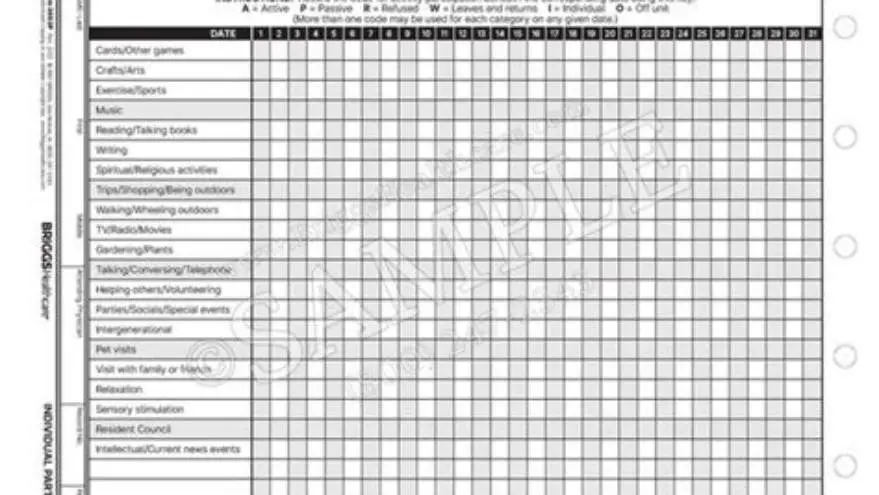
Picture a single sheet that answers three questions about every activity: who was invited, who came, and how they joined in. It is not a care plan and it is not an incident report. Working records like this, kept session by session, show the team what residents actually do instead of guessing from the calendar.
This log earns its keep in three places. At handover, it tells the next shift who was engaged and who needs a check-in. At care planning, it gives the team real examples of what a resident enjoys instead of a blank line that says they like music. At review time, it shows which activities draw a crowd and which ones run for an audience of two.
For MDS Section F, the part of the assessment that covers activity preferences, a log like this can support your notes. The log itself does not complete that assessment, and it never replaces a clinical note. It simply gives the team dated, observed examples to draw on, which is more useful than memory. Check your facility's own rules before relying on any form for a formal record.
The Fields Every Entry Needs
Good entries start with the session itself: the date, the start time, the activity name, where it ran, and who led it. Those five facts let anyone find the entry later and tell one session from another. Music on Tuesday, written down as just that, helps nobody a month later, when Tuesday's music and Thursday's music have blurred into one. It helps to understand men's activities in nursing homes before going further.
Next comes the people. List who was invited, who attended, who declined, and who could not attend, with a short reason for the last two. Someone who declined three weeks running is telling you something. So is a resident who could not attend because the room was too far away. The log catches both patterns only when someone writes them down. Group activities with a clear structure make this list easy to fill in. A quiz with printed answer cards gives every resident a visible way to join in. Trivia suits residents who enjoy questions, so keep a quieter activity on the same calendar too. Hand-written quizzes on a large card work just as well for free.
Most logs skip the last field: what actually happened. Two lines about the mood in the room, who lit up, who left early, and what ran short. That line is what turns a headcount into a record worth reading, and it is the line a future planner will thank you for. Keep it to what you saw, not what you guessed about why.
- Date and time: when the session ran, and how long it actually lasted.
- Activity and leader: the name on the calendar, and who ran it.
- Invited and attended: a headcount for each, plus the names that matter.
- Declined and unable: who said no, and who could not get there.
- Engagement score: one number per resident, on the scale below.
- Follow-up: who needs a visit, a different activity, or a word with the nurse.
| Field | Example entry |
|---|---|
| Date and time | Tuesday 10:30, 40 minutes |
| Activity | Music and singing, lounge |
| Invited and attended | 12 invited, 9 attended |
| Declined and unable | 2 declined, 1 could not get there |
| Engagement | Mostly 3s, two 4s |
| One-line note | Room sang along to the last three songs |
How to Score Engagement Without Guessing
Numbers mean nothing unless everyone scores the same way. Pick one scale, write it on the log itself, and use it for every session. Here is a simple scale you can adopt. It works because it describes what you can see, not what you think a resident felt. Print the scale at the top of every sheet. Before you commit to anything, it is worth looking at activities using dry erase pockets.
Score what happened in the room, not what you hoped would happen. Sitting through the whole session without joining in still counts. One point says they were present, and presence is information. Singing along, asking questions or helping a neighbor earns a 4, and that 4 tells the next planner to run that activity again.
Two people scoring the same session will still disagree now and then, and that is fine. The log is a working tool, not a test. What matters is that the same person scores the same way week to week. Then a change in the numbers means a change in the room, not a change in the scorer. When two staff score together, compare notes after the first week and agree on the borderline cases.
| Score | What you see | What it means |
|---|---|---|
| 4 | Active and enthusiastic | Joining in, talking, helping |
| 3 | Engaged and responsive | Watching, smiling, answering |
| 2 | Present, little interaction | Sitting in, watching quietly |
| 1 | Present, no interaction | There, but not joining in |
Filling the Log in Five Minutes After Each Session
Logs that take twenty minutes will not get filled in. Five minutes fits between the end of one session and the start of the next, so a log that quick will get filled in. Finish it before you pack the room away, while the faces are still fresh and the details have not blurred into the next activity. For a one-to-one visit, log the resident, the activity, and the response the same way, with no headcount.
Keep the log where the activity happens, not in an office down the hall. Clipboards on the trolley, folders on the shelf by the door, or a single sheet tucked into the activity box all work. A form within reach gets filled in; a form in another room does not. Fetching it later means filling it in tomorrow, from memory, badly. Tie a pen to the clipboard with string, so it stays with the log.
Fill it in the same order every time and the five minutes will shrink to three. Headcount first, then names, then scores, then the one-line note about what happened. Routines you can do half-asleep survive a busy day, a short-staffed afternoon, and a session that ran over by ten minutes.
- Count heads as the session ends, before anyone leaves the room.
- Mark each invited resident present or absent, with a short reason.
- Give each attendee a score from 1 to 4, using the scale on the sheet.
- Write one line about what happened: the mood, the moment, the surprise.
- Note any follow-up, sign it, and file it before the next session.
Turning a Month of Logs Into a Better Calendar
One log tells you about one afternoon. Thirty days of logs tell you about your program. Sit down with the month's sheets and count. Which activities filled the room? Which ones lost people halfway through? Which residents never appear at all?
Look for the patterns that a single day hides. Craft sessions that draw eight people on Tuesdays and two on Fridays may be fighting the hairdresser, not failing as an activity. Someone who declines every morning session but joins every afternoon one is not refusing activities: they are refusing mornings. Patterns like these show in the log; the calendar is where you fix them.
Change one thing at a time and watch the next month's logs for the result. Move the quiet session to the afternoon, swap the room, or shorten the long one by fifteen minutes. Calendars built from a month of real numbers earn their keep, and the next month's logs will tell you whether the change worked. That loop is the whole point of keeping the record. Small changes are easier to read than big ones.
Mistakes That Make a Log Useless
Logging from memory at the end of the week is one mistake. By Friday, Tuesday's session has blurred into Thursday's, and the log fills up with guesses dressed as facts. Memory-written logs are worse than no log at all, because they look like evidence and they are not. Do it at the session, or do not do it at all.
Another mistake is recording only the good news. Logs that show every session full and every resident delighted fool nobody, including the person who wrote them. Declines, empty chairs and sessions that fell flat are the entries that teach you something, so write them down plainly and without apology. Honest entries make the next calendar better.
Collecting the log and never reading it is the last mistake. Folders of unread sheets are filing, not learning. Set one morning a month to read the month's logs with a cup of tea and a pencil. Let what you find change the next month's calendar. Start with the sheets from last month, not last year. That hour repays itself many times over, in sessions residents actually want to attend.
Still wondering?
Should the log be paper or digital?
Paper works best for most teams, because it sits where the activity happens and needs no login. Spreadsheets suit a team that already shares one and wants to sort by resident or activity. Pick the form your team will actually fill in after every session, and stay with it.
Who should fill in the log?
Whoever ran the session, or the aide who sat through it. Keep one recorder per session, so the entries stay consistent, and have that person sign each sheet. Have a second pair of eyes check the scores once a week until the team agrees on the scale.
Do families ever see the log?
Working records stay with the care team; they are not reports for families. When a family asks how their relative is doing, the team can share what the log shows in plain words, without handing over the sheets. Check your facility's own rules about sharing records.
How long should we keep old logs?
Hold them at least as long as your facility keeps other activity records, and ask your manager if you are unsure. Old logs help at care reviews, and they show how a resident's interests changed over time. Do not throw them away in a hurry.
What if a resident refuses to be logged?
Record the refusal itself and move on. Write down that they declined, not their words about why, and never name another resident's behaviour in the note. Declining still gives you information, and the log should show the decline, not the person.