Printable Large Print Birthday Word Search for a Special Day
About a dozen familiar words in a small grid make the best printable large print birthday word search. Print it big enough to read at arm's length. Use the birthday person's own words: names, favorite foods, places and songs. Print one puzzle per page.
On this page (8 sections)
Part of our guide on memory care thanksgiving printables
Key figures
- Words in the puzzle
- A short list of familiar ones
- Grid size
- Small, so letters stay big
- Word directions
- Across and down only
- Puzzles per page
- One
- Answer page
- Separate, kept by the host
- Best moment to play
- While guests arrive
Quick recap
- Print on card stock if the puzzle will sit on a party table all afternoon.
- Let grandchildren circle the words they find and sign the sheet.
- Fewer words still make a full puzzle: stop the list when the words run out, not when the grid is full.
- Hand out answers only when the table asks, not with the puzzle.
- One puzzle per guest beats one puzzle shared between two.
Printable large print birthday word search: what makes one work
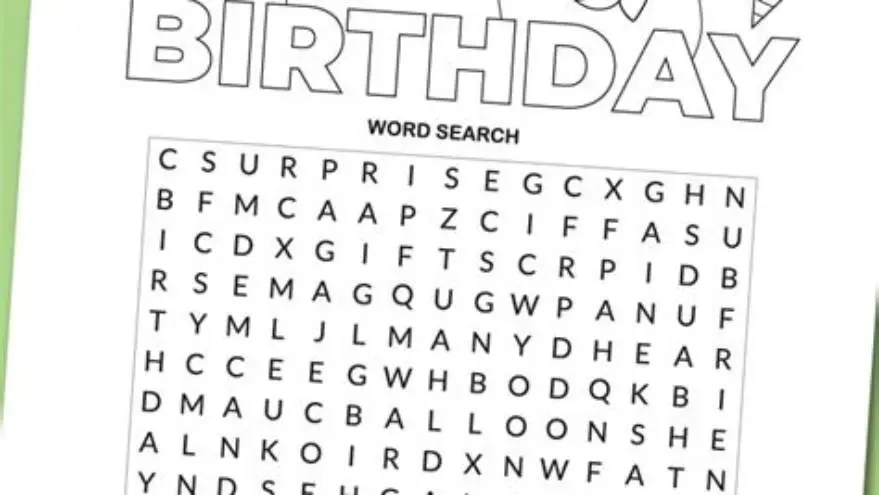
Small grids make big letters. With a short list, a birthday puzzle fits a small grid. That grid leaves room for letters big enough to read at arm's length. Trim the list on purpose. White space around the letters is what tired eyes need most. Finished puzzles beat impressive-looking ones.
One puzzle per page, with the word list beside it in bold letters. Two puzzles on a page crowd the sheet and shrink the print, which defeats the point. Every letter should read clearly without leaning in, and the word list should read just as clearly as the grid. Bold letters and plain paper do more for readability than any fancy design.
Words run across and down only. Diagonals and backwards words turn a gentle party puzzle into a hunt, and a birthday is not the day for a hunt. Save the hard directions for a puzzle book. Party puzzles should end with a finished grid and a smile, not a word nobody can find. Finished grids feel like small wins, and birthdays run on small wins. Guests remember the win long after the cake is gone.
Which words belong in a birthday puzzle?
Names first, because a name is the easiest word to find and the most pleasing to spot. Put in the birthday person's name, the names of grandchildren and close friends, and the family name if it fits. Real names make a puzzle feel made for one person, and that is the whole point of a birthday puzzle. Ask the birthday person for a few favorites, and the puzzle nearly writes itself. Before you commit to anything, it is worth looking at printable valentine word search large print.
Favorite things fill the rest of the list. Add the foods they love, the place they grew up, a song they hum, and the hobby that fills their afternoons. Short words work best, and familiar words work better than clever ones. Words the birthday person knows at once are words they find with pleasure. Long words look grand on the page and hide badly in a small grid.
Birthdays carry their own words too. Cake, candles, balloons, presents, party, friends, family, wishes, cards, ice cream, cupcakes, frosting, celebrate and games all belong. Birthstone words add a personal touch. Mix the party words with the personal words, so the grid holds both the day and the person.
How big should the letters be?
Arm's length is the test, not a number on a box. Hold the printed page at arm's length and read the grid. If every letter reads clearly, the size is right. If you lean in or squint, print bigger. Print size is a choice you test, not a figure you trust. No single size suits every reader, so the test page matters more than any figure a listing quotes. People in this spot often ask about large print new year word search as well.
Grid size decides letter size, and the two move together. Small grids on a full page leave room for big letters, while large grids on the same page squeeze them small. This is why a birthday puzzle keeps its word list short. Fewer words mean a smaller grid, and a smaller grid means bigger letters. Short lists are the quiet trick behind every readable birthday puzzle.
Paper and ink decide the rest. Use solid black ink on plain white paper, and skip glossy sheets that throw lamp glare back at the reader. Bold word lists beside the grid help more than fancy fonts. Plain pages stay readable. Matte paper beats glossy paper under a reading lamp. Leave clear space between rows, so a finger can follow one line without slipping to the next.
How do you use the puzzle at the party?
Place settings turn the puzzle into a welcome. Put one puzzle at each place with a pencil, so guests sit down to something to do while the room fills. Keep the answer page with the host, so guests ask instead of peeking. That puzzle fills the quiet minutes before the cake appears. Guests who arrive early never sit idle, and guests who arrive late catch up fast.
Table games turn the puzzle into company. Solve one big puzzle together, with the birthday person calling out words as guests find them. Wall-sized prints work for a group, and a pencil passed around the table keeps everyone in the game. Talk grows around a shared puzzle in a way it never grows around small talk.
Gift tags turn the puzzle into a keepsake. Tuck a small puzzle into the birthday card, with the birthday person's name hidden in the grid. Grandchildren love finding their own name among the words. It costs nothing but a sheet of paper, and it is the part of the gift that gets kept. Sign the back of the puzzle like a card, and the keepsake is complete.
| Moment | How it works | Copies to print |
|---|---|---|
| Place setting | One puzzle at each place | One per guest |
| Table game | One big puzzle solved together | One for the wall |
| Gift tag | Small puzzle tucked in the card | One, for the birthday person |
How do you make one with the birthday person's own words?
List the words before you touch a maker. Paper lists beat lists in your head, because paper shows the gaps. Write down the names, the favorite foods, the places and the songs, then count them. Short lists are right for a party puzzle. Cut the list to the words that matter most, and save the rest for next year's puzzle.
Type the list into a free word search maker and print the puzzle it builds, with an answer page on a separate sheet. Set the words to run across and down only, and check the print before you print copies for the whole table. Print on Letter or A4, whichever the printer holds. Makers do the hiding; your words do the meaning. Fresh eyes catch what yours miss.
Check the finished puzzle the way a guest would. Solve it once yourself, slowly, and watch for words that cross in confusing ways or hide too well. Words that take you minutes to find will take a guest longer. Swap it for a plainer word and print again. That trial run is what keeps the puzzle a pleasure instead of a chore.
- Write down the birthday person's names, foods, places and songs.
- Trim the list to its best words.
- Enter the words in a free word search maker.
- Solve one copy yourself before you print the rest.
- Make a copy for each guest, with answers separate.
What if the puzzle is too hard or too easy?
Too hard shows itself fast. Guests stop, pencils rest, and talk drifts away from the table. Step in with a hint, not an answer: point at the row where a word hides, or read the first letter aloud. Give hints, not answers, and the game stays alive. Narrow the search to one row or one corner, and let the guest do the finding.
Easy is a smaller problem. Early finishers can help a neighbor, or take the answer page and check the table's work. Have a spare puzzle ready, a little longer and with one diagonal, for anyone who finishes early. Praise the last finisher as much as the first, and the table relaxes. Nobody minds an easy puzzle at a party. Everyone minds a puzzle they cannot finish.
Tired eyes need a shorter puzzle, not a lecture. Offer the easy grid, or solve it together, one row at a time. Birthday puzzles are a kindness first and a puzzle second. Tired guests forgive a short puzzle and remember a kind host. If the room is tired, put the puzzles aside and bring out the cake. Puzzles will wait, and the party will not.
A small grid, a dozen personal words and big clear letters make the birthday puzzle worth printing.
Still wondering?
Can I print the same puzzle for a whole table?
Yes, one file prints as many copies as the table needs. Keep the answer page separate, so only the host holds the solutions. Home printers cover a small table, and copy shops cover a big one.
How many words should a birthday word search have?
Short lists suit a party puzzle, because the grid stays small and the letters stay big. Longer lists mean bigger grids and smaller letters, which is the wrong trade. Save extra words for a second puzzle or next year's party.
Where do I print the puzzle?
Any home printer will do, on plain white paper at actual size. Libraries and copy shops print the same file for a group that needs many copies.
Can the puzzle be a gift on its own?
Personal words make the puzzle a gift in itself. Grids built from the birthday person's own names and memories cost a sheet of paper. Frame it, or tuck it into a card with a pencil, and it becomes a keepsake.
What if guests finish at different speeds?
Fast finishers can wait with a cup of tea while the table catches up. Party puzzles are not a race. Puzzles that end together feel better than ones that end in a race.
Ready to try it? It turns the birthday person's own words into a large-print puzzle with an answer page, free.
Make your birthday word search free