Printable Valentine Word Search in Large Print That Reads Clearly
Printable Valentine word searches in large print give an older adult a ready February puzzle with letters big enough to read at arm's length. Look for grid letters of 18 points or more and a grid of 15 by 15 or smaller.
On this page (8 sections)
Part of our guide on large print birthday word search
Key figures
- Large print starts at
- 18 points or larger
- Grid letters to aim for
- 20 points or more
- Grid size
- 15 by 15 or smaller
- Words per puzzle
- 12 to 20 words
- Valentine's Day
- February 14 each year
Quick recap
- Judge a puzzle by its letter size, not by the label on the cover.
- Keep the grid to 15 by 15 or smaller, and the list to 12 to 20 familiar words.
- Print at 100 percent, single-sided, black ink on plain white paper.
- Match the puzzle to the solver: familiar words, mixed lengths, no lookalikes.
- Keep the answers close by but out of sight while solving.
Where to Find a Printable Valentine Word Search in Large Print
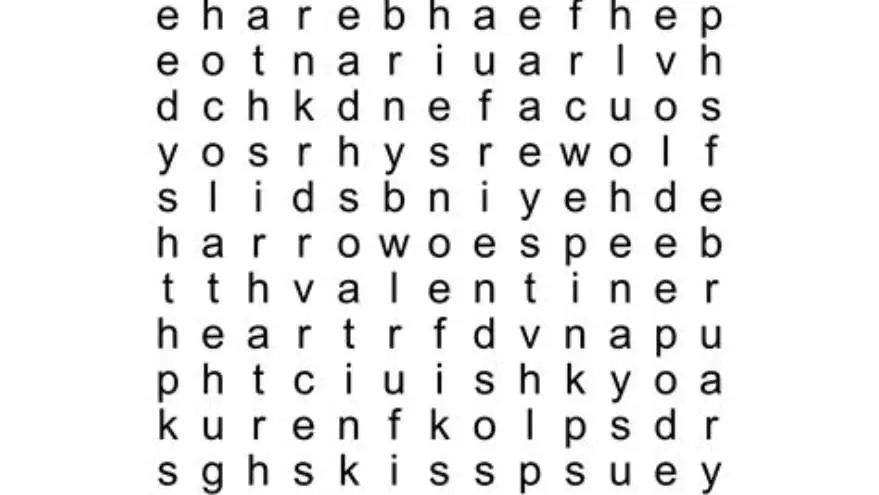
Valentine word searches in large print are easy to find and hard to judge. Most free pages hand you a PDF and stop there. They do not say how big the letters are, or how many words hide in the grid. Nothing says who the puzzle suits. It still needs to work on paper, at arm's length, under ordinary lamplight. That is the test this page uses.
Start with printables made for low vision, not with children's pages relabelled as large print. Classroom puzzles often use 12-point letters and a 20 by 20 grid. Letters look small on the page, and the grid crowds them together. Puzzles built for older adults keep the grid to 15 by 15 or smaller and set the letters at 18 points or more. Lists sit in the same large type, so the solver reads the words and the grid without a magnifier.
Free printable sites are the fastest route. Look for a page that lists the grid size, the letter size and the word count before you print. If a site hides those details, treat its 'large print' label as a guess. Best free pages state their specs plainly and print cleanly on Letter and A4 at 100 percent.
What Counts as Large Print on a Word Search?
Labels mean less than the numbers behind them. Per the American Printing House definition of large print, a document counts as large print only at 18 points or larger. Large-print books most often run from 16 to 18 points, the National Library Service notes. Grid letters need more size than body text does, because single letters carry no context. Aim for grid letters of 20 points or more, with the word list at 18 points or larger. We cover enjoy countdown themed word search in its own article.
Point size is a setting, not a measurement of the letter you see. Same point size looks bigger in some typefaces than in others, so a ruler settles the question in seconds. Run a sample page at 100 percent, then measure one capital letter in the grid. As a quick check, a capital about 4 millimetres tall works out to roughly 18 to 20 points. Closer to 3 millimetres, and the print is enlarged, not large, so the solver works harder than the puzzle asks.
Our free Large Print Word Search Maker builds a puzzle from your own word list at a size you choose, with an answer page included. It suits a carer who wants one puzzle for one person, not a book of fifty. Its limit is plain: it makes word searches, and only word searches. For a mixed book of puzzles, a printed puzzle book serves better. Hand-drawn grids on graph paper work too, and cost nothing but time.
How to Pick Words That Suit the Solver
Good Valentine words are ones the solver already knows. HEART, ROSES, CUPID, CANDY, CARDS, KISSES and SWEETHEART need no explaining. Grid letters run in capitals, which keeps each letter distinct at large sizes. Longer words such as SWEETHEART and VALENTINE slow a solver down in a good way: they stretch across the grid and stand out once found. Short words such as LOVE and JOY hide well, but a list of only short ones turns into a hunt for three-letter strings. Mix the lengths, and keep the total between 12 and 20 words. People in this spot often ask about make word searches with your words as well.
Skip words that look alike at a glance. ROSE and ROSES, HEART and HEARTS, or LOVE and LOVER all sit near each other in the grid and confuse the eye. Pick one form and drop the other. Skip words with doubled letters that repeat across the list, such as SWEET and GREETING side by side, unless the solver enjoys a harder puzzle. Lists that read cleanly on their own read cleanly in the grid too.
Word direction sets the difficulty more than word count does. Words that run left to right and top to bottom suit a first puzzle, or a solver who tires quickly. Diagonal and backwards words suit a solver who wants a longer sit. A full grid in all eight directions asks for a long, unhurried sit. Smaller grids with only two directions ask for far less time. Choose the version that ends with the solver smiling, not stuck.
- Classic words: HEART, ROSES, CUPID, CANDY, CARDS, KISSES, SWEETHEART, LOVE
- February words: FEBRUARY, FLOWERS, CHOCOLATES, VALENTINE, DOILY, PETALS
- Gentle words: HUGS, POEMS, DEVOTION, FRIENDSHIP, CHERISH, ADORE
Print It So It Reads Clearly
Even a good puzzle can still print badly. Scaling is the most common fault: a printer set to 'fit to page' shrinks the letters below the size the puzzle was built for. Paper is the second fault: thin copy paper lets ink show through from the other side, and the grid doubles up. Both faults are easy to stop before the puzzle reaches the solver. Start with one copy and check it at arm's length.
Black ink on plain white paper gives the strongest contrast. Coloured paper looks festive, but pink or red paper swallows the grid lines. Matt paper beats glossy stock, since glare off a shiny page tires the eyes before the puzzle does. Thick felt-tip pens or soft pencils suit large letters better than a fine ballpoint, which skips on big squares. Hold the puzzle flat while solving: a clipboard or a firm book under the page stops the sheet sliding. Light from a lamp at the solver's shoulder beats a ceiling light across the room.
Paper weight is worth a thought when you print for a group. Standard copy paper runs about 20 pounds, and a pencil can show through it. Heavier paper, 24 pounds or more, holds the ink on one side and stays flat in the hand. Run one spare copy for the helper, so checking the answers never means taking the puzzle away.
- Open the PDF and choose print, not save, so the printer reads the file as it stands.
- Set the scale to 100 percent and turn off 'fit to page'.
- Choose Letter or A4 to match the paper in the tray.
- Print one copy, single-sided, and read the smallest letter at arm's length.
- Letters that look small call for one more print at 100 percent on a fresh sheet before anything else changes.
Make Your Own Valentine Word Search in Minutes
Ready-made printables suit most days, but a puzzle built around one person lands differently. Use words from their own February: the name of a spouse, a favourite flower, the town where they met, a song they hum. Twelve words fill a 12 by 12 grid neatly, and the puzzle takes shape in minutes. Solvers find their own words first, and the rest of the grid feels like a bonus.
Begin with the word list, then set the size. Write the words in capitals, one per line, and check each one twice: a misspelled word never gets found, and the solver blames their eyes. Keep every word to 12 letters or fewer, so none of them crowds the grid. Our free Large Print Word Search Maker turns a list like this into a large-print PDF with an answer page. Layout work falls to the tool, and the puzzle still carries your words.
When no printer is near, a hand-drawn grid works. Rule a square grid on graph paper, write the words in first, then fill the empty squares with random letters. Drawing takes longer, and the letters will not be as even, but a puzzle drawn for one person carries a warmth no printout matches. Hold the grid to 12 by 12 and the words to 10, so the drawing stays a pleasure and not a chore.
Ways to Use the Puzzle on Valentine's Day
How the puzzle is used decides its worth, not how it looks. On its own, it fills a quiet half hour before lunch, with a cup of tea and no rush. With family, it starts talk. Someone reads the word list aloud while another circles the words. Names on the list bring up stories. In a group, it opens the session, so everyone has something in hand while the room settles. One puzzle serves all three settings, and the setting decides the pace.
Pair the puzzle with something small and the morning becomes an occasion. One rose in a glass, a card the solver can keep, or a favourite song playing low all cost little and lift the hour. Centre stage belongs to the puzzle: it gives the hands something to do while the talk wanders. Put the puzzle out early, before the day's plans crowd it out. Handed over at the last minute, a puzzle reads as an afterthought, and the solver feels it.
Keep the answer key close, not hidden. Solvers who stall on the last word need the key more than they need another hint. Some solvers like to check each word as they go; others like to finish the grid and check once. Both ways work, and the key serves both. Fold it behind the puzzle page until wanted. Puzzles end well when the last word is found, not when the page is put aside unfinished.
| Setting | Words | Time | Best for |
|---|---|---|---|
| On your own | 12 words | 10 to 15 minutes | A quiet morning |
| With family | 15 words | 15 to 20 minutes | Talk and shared solving |
| In a group | 15 to 20 words | 20 to 30 minutes | Opening a session |
Still wondering?
Where can I print a Valentine word search in large print for free?
Printable sites that list their specs are the best place to start. Pick one that states the grid size, the letter size and the word count. Sites that hide those details offer only a guess in their large print label.
What font size should a large print word search use?
See the numbers in the section above, then test them: print one page at 100 percent and read it at arm's length. If the letters strain your eyes on the test copy, the puzzle is too small, whatever the label says.
How many words should a Valentine word search have?
Twelve to 20 words suits most solvers. Fewer than 12 ends too fast, and more than 20 crowds the grid and tires the eye. More words and more directions take longer; a small grid with few words takes far less time. Match the count to the solver: fewer and easier for a first puzzle, more for a longer sit.
Can I make my own Valentine word search?
Yes. Write 12 to 20 words in capitals, keep each one to 12 letters or fewer, and check the spelling twice. Free word search makers turn a list into a large-print PDF with an answer page. Hand-drawn grids on graph paper work too, when no printer is near.
Ready to try it? It turns the reader's own Valentine word list into a large-print PDF with an answer page, at the size they choose.
Make your Valentine word search