Chair Exercises for Seniors: A Printable 15-Minute Routine
For seniors, a printable chair exercise sheet works best as one page in large print. Nine seated moves, the reps beside each one and a tick box for the day. About 15 minutes covers the routine, and the plan below sets out the week.
On this page (8 sections)
Part of our guide on activities for seniors large print printable
Key figures
- Routine length
- 15 minutes
- Moves
- 9 seated exercises
- Strength days
- 2 days a week
- Print size
- 18 pt or larger
- Weekly aerobic
- 150 minutes
Quick recap
- A page at 18 pt, one move per line, with the reps and a tick box.
- Use a sturdy chair without wheels, with both feet flat on the floor.
- Follow the weekly plan for strength days.
- Seated work builds strength; add standing practice for balance.
Chair Exercises for Seniors Printable: What the Sheet Should Show
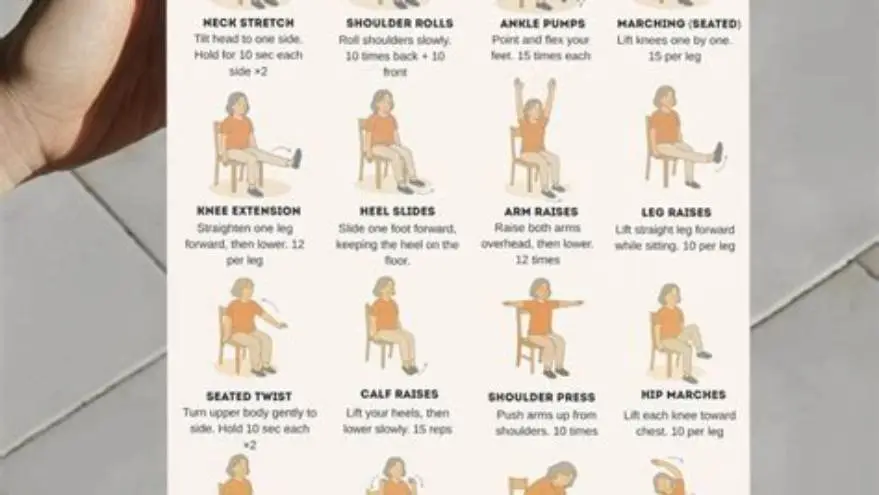
Most free chair exercise printables fail at the printer, not in the gym. They hide behind an email form, print in small grey type, or spread nine moves across five pages. One that needs a magnifier or a stapler will sit in a drawer. Look for a sheet that fits on one page, reads at arm's length, and tells the reader exactly how many times to do each move.
Set the type at 18 pt or larger, in black on white, with one move on each line. Put the reps beside the move, not in a note at the bottom. Leave a tick box beside each day of the week, so the sheet doubles as a record. Short lines in plain words beat long paragraphs nobody reads twice.
Set the printer to one page per sheet and check the preview before you print. If a move spills onto page two, cut words until it fits, and keep the type big. Keep a second copy by the chair to save a walk to the printer each morning. Keep the spare in a folder, not folded in a pocket, so it stays flat and readable. Nine moves in the routine below make up the sheet itself: copy them onto one page, with the reps beside each move.
- Type size:
18 ptor larger, black on white, so it reads at arm's length. - Each line: name, reps and a tick box, nothing else on the line.
- Single page: the whole routine, so nothing gets lost between pages.
- Tick boxes: one for each day, so the sheet records the week.
How Often to Do the Routine, and How to Plan the Week
Adults 65 and older need muscle-strengthening activity on at least two days a week, says the CDC in the Physical Activity Guidelines for Americans. Cover the legs, hips, back, abdomen, chest, shoulders and arms. Two days is a floor, not a target to beat in the first week. Rest a day between strength days to let muscles recover. One set per move is enough to start. Before you commit to anything, it is worth looking at cream paper for large print puzzles at home.
Three sessions a week suits most people who are starting out. Monday, Wednesday and Friday work well, with gentle stretching on the days between. Fix the routine to the same time each day, after breakfast or before the evening news, so it becomes a habit rather than a decision. Tick the sheet after each session, and the week builds up in front of you. Missed days happen, and one missed day is not a reason to stop.
Carers who plan the week for someone living with memory loss can write the routine into a day plan beside meals, walks and puzzles. Handwrite the same nine moves on a card, and it works just as well for the planning. Our Gentle Minds Activity Kit, which we make, has daily planning pages and puzzles for the rest of the day, but no exercise routines.
| Day | Focus | Minutes |
|---|---|---|
| Monday | Full routine | 15 |
| Tuesday | Gentle stretch | 10 |
| Wednesday | Full routine | 15 |
| Thursday | Rest day | 0 |
| Friday | Full routine | 15 |
| Saturday | Gentle stretch | 10 |
| Sunday | Rest day | 0 |
Check the Chair Before You Start
Safety starts with the chair, not the exercises. Use a sturdy chair with no wheels and no swivel, on a floor that does not slide. Sit so both feet rest flat on the floor with knees bent at about a right angle, as the NHS describes. Arms on the chair give a handhold for standing up. Without arms, the chair gives more room for arm moves. If that sounds like your situation, read up on senior indoor activities at home next.
Clear the floor around the chair before you begin. Move rugs that slide, cords, and anything you could trip on when you stand. Put a glass of water within reach and wear shoes with a grip, not socks on a smooth floor. Sit near a wall or a counter if standing up feels unsteady, so a handhold is always close.
Ask their doctor before starting if the person has a heart condition, low blood pressure, recent surgery, or a fall in the last year. That check costs one phone call and it settles the question for the whole routine. Pain is a stop sign, not a challenge: sharp pain, chest pain or dizziness means stop and rest. Soreness the next day is normal after a first session; pain during a move is not.
The 15-Minute Chair Routine, Move by Move
Do the moves in order, once through, and breathe normally all the way. Warm up first because cold muscles complain, and stretch last because warm muscles let go. Each strength move uses one set, at the count printed beside it below. The march and shoulder rolls warm the body up, and the hamstring stretch at the end cools it down. If a move hurts, skip it and come back to it another day. Before you commit to anything, it is worth looking at activities that keep seniors engaged.
Fifteen minutes covers the whole routine, including short rests between moves. Rest up to a minute between strength moves, and less between stretches. Strength moves are the knee extension, knee lift, arm raises and sit to stand. Everything else warms the body up or stretches it out. Speed does not help here: slow and controlled beats fast and sloppy, and the last two repetitions should feel hard. Leave the sheet where you can see it, and tick each move off as you finish it.
Watch the clock, not the mirror, while you work through the routine from start to finish. Time the session with a kitchen timer or a phone alarm, and fifteen minutes passes faster than it sounds. Slow down for the last move and let the stretch take its full thirty seconds. Sheets like this earn their keep when the routine fits into a normal morning, not when it needs a special occasion.
- March in place, 1 minute. Lift one knee, then the other, and swing your arms gently.
- Shoulder rolls, 10 each way. Roll both shoulders back in slow circles, then forward.
- Ankle pumps, 2 sets of 5 each foot. Point the toes away, then pull them back toward you.
- Knee extension, 8 to 12 each leg. Straighten one knee, hold 2 to 3 seconds, lower slowly.
- Knee lift, 8 to 12 each side. Raise one thigh off the seat, hold 2 seconds, lower with control.
- Arm raises, 8 to 12. Both arms go overhead, then lower slowly to your sides.
- Twist, 5 each side. Turn gently to one side, hold 3 seconds, then turn the other way.
- Stand up and sit down, 8 to 10. Stand up slowly using the chair arms, then sit back down with control.
- Hamstring stretch, 30 seconds each leg. Straighten one leg, lean forward gently, and breathe.
Making the Routine Harder, or Easier
When 12 repetitions feel easy, the routine needs more work, not more moves. Add a second set before you add new exercises, and rest a minute between sets. Try a tin of beans in each hand, about 400 g, to add weight to arm raises without buying anything. Filled water bottles work the same way, and they cost nothing if the cupboard already holds them. If that sounds like your situation, read up on name that tune for seniors next.
Feeling stuck on a move means cutting the count in half and building back up over two weeks. Do six repetitions this week, eight next week, and ten the week after. Skip the sit to stand if standing feels unsteady, and do the seated moves only. Shorter routines done twice a week beat a full routine done once and then dropped.
Progress shows up in daily life before it shows in a mirror. Standing up from a low chair gets easier, and carrying a shopping bag feels lighter. Write the date you add a second set on the sheet, so the change is visible. Routines that grow a little each month are the ones that last.
- Harder: add a second set, then a light weight in each hand.
- Easier: halve the reps, skip the sit to stand, rest longer.
- Steadier: hold the chair arms during every standing move.
What the Sheet Can't Do, and What to Add
Seated work builds leg and arm strength, and that strength shows in standing up, climbing stairs and carrying bags. Balance is not what it builds on its own. Anyone who can stand safely should add standing practice over time, a little at a time. The CDC lists balance activities, such as standing on one leg or walking heel to toe, beside strength work for adults 65 and older. If that sounds like your situation, read up on conversation starters for seniors next.
Walking is the simplest addition, and it needs no sheet at all. Walk after lunch, even for ten minutes, to add the aerobic minutes the CDC asks for alongside strength work. CDC guidance puts the weekly figure at 150 minutes of moderate activity, built up slowly. Pair the walk with the chair routine on different days, and the week covers strength, balance and stamina without a gym.
Be honest about what the sheet is: general information, not medical advice. Anyone with a new pain, a recent fall or a heart condition should get medical advice before starting. That answer beats anything on a printable. Fit the routine to the person in front of you, not to everyone in theory. Try it for two weeks, and change what does not suit.
Still wondering?
Can I do chair exercises every day?
Gentle stretches and ankle pumps are fine every day. Strength moves need a rest day between sessions. Stretch daily, and do strength on alternate days, for a good mix.
Do I need weights for chair exercises?
No. Body weight is enough for the first few weeks, and one set needs no weight at all. When that feels easy, a tin of beans in each hand adds a little load.
What if standing up from the chair alone is not possible?
Skip the sit to stand and do the eight seated moves only. Chair arms give extra support. A physiotherapist can show the safest way to practise standing.
Will chair exercises improve my balance?
Not much on their own. Add a standing move to the week, such as holding the chair back and standing on one leg, once standing feels safe. Get help from a physiotherapist first if standing feels unsteady.
How do I print the routine in large print?
Choose 18 pt or larger and print one page per sheet, then check the preview before you print. Shorten the lines and keep the type big when a move spills onto a second page.