Name that tune for seniors: 25 songs with answers, and how to hum them
Name That Tune for seniors works best when you hum four bars of the melody, then pause and count silently to eight. If nobody answers, hum another four bars. For players with dementia, switch to multiple-choice answers or let them sing the line back instead of naming the song.
On this page (9 sections)
- Quick recap
- The 25-song list, ordered easy to hard with the answers in order
- How many bars to hum before you give the answer
- The hum test you can do tonight
- What changes when some players have dementia
- Why big band and crooners beat 1970s rock for the oldest players
- Running it one-to-one at home versus a care home group
- Where to get free printable answer sheets and lyric cards
- Still wondering?
Part of our guide on activities for seniors with low vision
Key figures
- Songs in the list
- 25, easy to hard
- Era covered
- 1950s to 1970s
- Bars before answering
- 4 for verses, 8 for choruses
- Print size
- 18-20 pt minimum
- Best game length
- 20-30 minutes
- Group size
- 4-8 players, teams of two
Quick recap
- Songs from 1945-1965 land best for players over 75, because those tunes stuck during their teens and twenties.
- Four bars is the standard window, but choruses need eight; verses usually get nothing.
- For memory loss, multiple-choice answers and singing the line both work when a straight question does not.
- One song per sheet beats a full list for anyone who gets overwhelmed by a page of text.
- Print at 18-20 pt or larger: anything smaller won't be read from across a table.
The 25-song list, ordered easy to hard with the answers in order
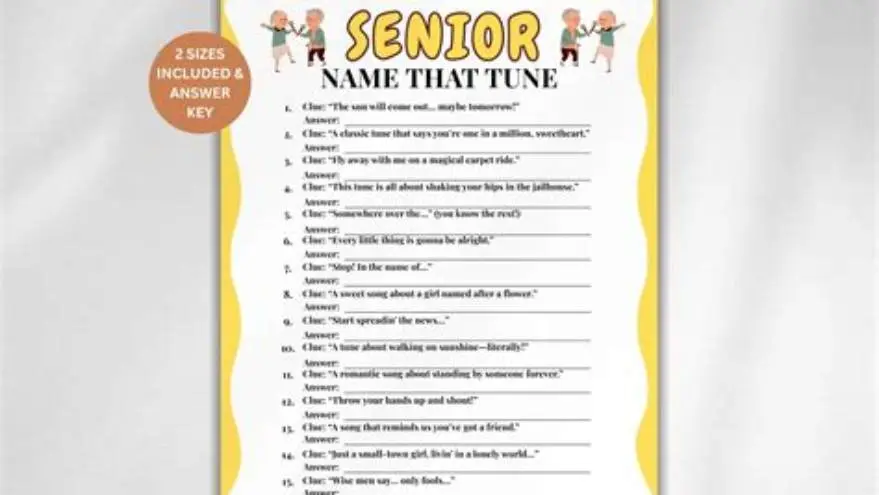
The list below runs from songs almost everybody knows to songs that need a real music fan. Each row gives the tune, the artist, and the era, so a host who has never heard the song can still run the round. Print it big, or read it off a phone at the table.
Draw your first songs from rows 1 to 10. That's where a mixed-memory group gets its wins. Rows 11 to 18 work for a group that meets weekly and knows the format. Save rows 19 to 25 for a music-themed quiz night or a player who keeps asking for harder ones.
If you want a ready-made version of this rather than a DIY list, our Big Print Trivia for Seniors is a printable large-print trivia book with 400 multiple-choice questions in 20 themed rounds, answers after every round, score cards and a host kit. It is not a name-that-tune game on its own, so you would still hum the melodies yourself. It just removes the writing and the small type.
One thing the list does not do is tell you how each group will respond. That depends on who's in the room and what decade they were teenagers in. Before you commit to anything, it is worth looking at this or that for seniors.
| # | Song | Artist | Era | Start humming at |
|---|---|---|---|---|
| 1 | You Are My Sunshine | Jimmie Davis | 1940 | Verse 1, bar 1 |
| 2 | Que Sera, Sera | Doris Day | 1956 | Chorus, bar 1 |
| 3 | Somewhere Over the Rainbow | Judy Garland | 1939 | Verse 1, bar 1 |
| 4 | Blue Moon | The Marcels | 1961 | Chorus, bar 1 |
| 5 | Singin' in the Rain | Gene Kelly | 1952 | Verse 1, bar 1 |
| 6 | Release Me | Engelbert Humperdinck | 1967 | Chorus, bar 1 |
| 7 | Unchained Melody | The Righteous Brothers | 1965 | Verse 1, bar 1 |
| 8 | Moon River | Andy Williams | 1962 | Verse 1, bar 1 |
| 9 | Can't Help Falling in Love | Elvis Presley | 1961 | Chorus, bar 1 |
| 10 | What a Wonderful World | Louis Armstrong | 1967 | Verse 1, bar 1 |
| 11 | White Christmas | Bing Crosby | 1942 | Chorus, bar 1 |
| 12 | Fly Me to the Moon | Frank Sinatra | 1964 | Verse 1, bar 1 |
| 13 | Stand By Me | Ben E. King | 1961 | Verse 1, bar 1 |
| 14 | My Way | Frank Sinatra | 1969 | Verse 1, bar 1 |
| 15 | Blue Suede Shoes | Carl Perkins | 1956 | Chorus, bar 1 |
| 16 | At Last | Etta James | 1960 | Verse 1, bar 1 |
| 17 | I Left My Heart in San Francisco | Tony Bennett | 1962 | Verse 1, bar 1 |
| 18 | Sway | Dean Martin | 1954 | Verse 1, bar 1 |
| 19 | Beyond the Sea | Bobby Darin | 1959 | Verse 1, bar 1 |
| 20 | Crazy | Patsy Cline | 1961 | Verse 1, bar 1 |
| 21 | The Way You Look Tonight | Frank Sinatra | 1964 | Verse 1, bar 1 |
| 22 | When I Fall in Love | Nat King Cole | 1956 | Verse 1, bar 1 |
| 23 | Mack the Knife | Bobby Darin | 1959 | Chorus, bar 1 |
| 24 | Fever | Peggy Lee | 1958 | Verse 1, bar 1 |
| 25 | Come Fly with Me | Frank Sinatra | 1958 | Verse 1, bar 1 |
- 25 songs covers three decades and several genres
- Answers in order means a host can run it cold
- Easy-to-hard ordering lets you stop when the room tires
- Several songs repeat the same artist (Sinatra appears four times)
- Era mix leans 1950s-60s, lighter on 1970s rock
- Titles alone won't help a host who doesn't know the melody
How many bars to hum before you give the answer
Four bars is the standard window. That's long enough for the melody to register and short enough to be fair. Hum the first four bars of the verse, then stop, hold up one finger, and count to eight silently in your head. If nobody answers, hum the next four bars.
For choruses, go to eight bars. Choruses repeat the hook, so the extra length doubles the recognition without making it too easy. A verse, by contrast, is a trap: players who know a song will still be stuck on the second line and can't name it.
Don't hum the title lyric. If the song is You Are My Sunshine and you hum the words aloud, you've given the answer. Hum without opening your mouth, or use "la" and "da" sounds. The other half of this decision is memory puzzles for seniors printable.
If nobody answers after twelve bars total, the round is dying. Say one word from the title, or move to the next song. A flat round is harder to recover than a skipped one.
- Four bars fits the length of most people's working memory for a tune
- Counting to eight silently gives players a fair moment to think
- Long intros with no clear melody are unusable as a hum cue
- Songs that start with a spoken intro need a different starting bar
The hum test you can do tonight
Pick three songs from the top ten on the list. Hum four bars of each into your phone's voice memo. Play them back. If you wouldn't recognise your own hums, neither will a group. That's the catch: most hosts overestimate how clear their humming is.
What changes when some players have dementia
A straight question ("what song is this?") puts pressure on a person who may already be anxious about getting things wrong. Change the format and the pressure drops. Before you commit to anything, it is worth looking at 25x25 word search printable large letters.
Multiple-choice answers work better than open questions. Say three titles, one of which is right, and let the player point or nod. The person doesn't need to produce the words, which is often the actual block.
Singing the line works when naming doesn't. Ask the player to sing the next line of the song and the melody often pulls the words out without effort. Music memory survives longer than speech memory, which is the reason this works at all.
One song per sheet beats a list for any player who freezes at a wall of text. Hand over a single large-print card with the song title printed clearly and the answer options underneath. When it's done, ask if they want another. For the detail, see our notes on december arts and crafts for seniors.
- Multiple-choice gives a clean way to keep the game going without correcting anyone
- Singing bypasses the naming problem entirely
- One-per-sheet printing costs more paper than a shared list
- Multiple-choice can feel childish if the wrong options are too wrong
Why big band and crooners beat 1970s rock for the oldest players
Music tends to stick hardest from the teenage years and early twenties. A person born in 1940 was 15 to 25 between 1955 and 1965. That's the window where most of your songs should sit for a group whose average age is over 75.
That's why Frank Sinatra, Dean Martin, Doris Day and Nat King Cole land quickly with the oldest players. It's not taste. It's timing.
A group averaging 65 will answer Beatles and Elvis faster than Sinatra. The same list has to shift by a decade. Check the room before you print.
When the group is mixed across two generations, run two rounds. One round of crooner standards, one of early rock. Nobody feels tested by music they don't know.
- Songs matched to the room's teenage window draw the fastest answers
- Two-round format handles a mixed-age group without splitting it up
- A single list for everyone will feel too modern for the oldest and too old for the youngest
- Themes need to be set again if the group changes
Running it one-to-one at home versus a care home group
At home, go slower. Hum one song at a time, let the answer come, and stop when interest fades. There's no score and no time limit. A single-song session can still feel like a good afternoon.
In a group, run 20 to 30 minutes and stop while the room still wants more. Divide into pairs rather than singles: a pair can write together, and nobody sits alone with a blank answer sheet.
The order of play in a care home is the same as a quiz night. Read the round, hum four bars of each song, take answers on a sheet, then read the answers aloud at the end. That last step gives the whole room a chance to hear the winning names.
One thing the format changes between the two: at home the sheet can wait. In a group, hand out the sheet first and let the pairs write their names at the top. The ritual of writing settles the room faster than any instruction.
- Seat the group in pairs and hand out one large-print answer sheet per pair.
- Read the round number, then hum four bars of the first song.
- Count eight silently, take the answer or pass, then move on.
- After eight songs, read the answers aloud and let pairs score themselves.
- Stop at 20 minutes, even if the round isn't finished.
Where to get free printable answer sheets and lyric cards
You can build the whole kit yourself in an afternoon. Write the songs into a document at 20 pt, add a blank answer column, and print. That's the whole answer sheet. It isn't pretty and it works.
For a word-search or memory-themed warm-up to play before the music round, our free Large Print Word Search Maker takes your own song titles and prints them as a large-print puzzle with the answer page. It's a separate game, not the name-that-tune round itself, but it fills the first ten minutes while people arrive. You type the words, click print, and that's it.
Lyric cards follow the same principle. Type four lines of the song in 24 pt, cut the sheet into strips, and give one card to each pair. No special stock, no laminating, no software beyond a word processor.
If you want the whole activity set in one file, including music-themed rounds, conversation cards and daily planning pages at three difficulty levels, our Gentle Minds Activity Kit is a printable pack designed for adults living with memory loss. It does not hum the melodies for you, so you'll still need to know the tune. It just supplies the printed material and the guide for running it. We make it, so weigh that when you read the recommendation.
Any of these routes works. The songs, the bar count and the memory-loss adjustments do most of the work. The paper is the easy part.
- Answer sheet: song titles at 18-20 pt with a wide blank column for the answer.
- Lyric card: four lines at 24 pt, cut to a strip, one per pair.
- Song sheet for the host: the 25 rows from the table above, printed in one column.
- Multiple-choice card: one title at the top, three options underneath, one correct.
Four bars, three easy songs first, and one-song-per-sheet for the players with memory loss is the working formula.
Still wondering?
Do I have to know the songs myself to host this?
No, but you do need the melody. The list gives you the title, artist and where to start humming, so a host can read the answers off the page. If you've never heard a song, either learn it from a streaming service before the game or drop it and use another.
Can I play name that tune for seniors with just one person?
Yes. Hum one song at a time, allow as long as the answer needs, and stop when attention drops. Drop the answer sheet and keep score out of it. A session of five songs can still be a full activity.
What if a player names the wrong song but gets the artist right?
Count it as a half-point, or don't score it at all. The aim is participation, not accuracy. Correcting the title usually ends the turn, so confirm quietly with the correct name and move on.
Are there songs I should avoid?
Skip anything with a slow, unfamiliar intro or with a title that repeats in the first four bars. Happy Birthday and Auld Lang Syne are too well known to be useful: everyone answers them at once and there's no game left.
How many rounds can I run from one list?
Three or four short rounds of six to eight songs each. Beyond that, the room tires and the answers get louder rather than better. Save the harder rows for a second session on a different day.