Group Activities for Dementia Residents That Actually Work
The best group activities for dementia residents match the group's current stage, not a theme. Sorting, matching and simple conversation work for most groups. Word puzzles and memory games suit residents with milder impairment. Mixed-ability groups need three difficulty levels running at once.
On this page (9 sections)
- Quick recap
- Why do group activities for dementia residents fall flat so often?
- What group activities actually suit different stages of dementia?
- How do you run a mixed-ability group without losing half the room?
- How long should a group activity session actually run?
- What's a good weekly sequence of group activities for dementia residents?
- Should you make your own puzzles for dementia residents, or buy a kit?
- When is a group activity the wrong call entirely?
- Still wondering?
Part of our guide on printable activities for memory care units
Key figures
- Typical session length
- 15-20 min, shorter on bad days
- Typical group size (1 staff)
- 4-6 residents
- Best time of day
- mid-morning, before fatigue
- Difficulty levels needed
- usually 3
- Signs to stop early
- fidgeting, pushing materials away
Quick recap
- Sort residents by current ability before picking an activity, not by diagnosis or room number
- Short sessions, often 15 to 20 minutes, tend to hold attention better than hour-long programs, but watch the room, not the clock
- A failed activity usually means the task was pitched at the wrong difficulty, not that the resident "can't engage"
- Repetition across weeks builds comfort: residents often do better on the third run of an activity than the first
- A free word search maker lets you build a personalized, large-print puzzle in minutes, no software to buy
Why do group activities for dementia residents fall flat so often?
Group activities fail for one repeated reason. The task sits at a single difficulty level for a room full of different abilities. A resident with mild impairment finishes in two minutes and gets bored. A resident with advanced impairment never starts and gets anxious.
Directors often blame the resident: "she won't engage," "he's not interested anymore." Usually the problem is the match between task and ability, not motivation. A crossword that's too hard reads as refusal. A coloring sheet that's too simple reads as disrespect.
The fix is sorting by function, not by diagnosis. Two residents with the same dementia type can sit at wildly different ability levels. Group them by what they can currently do: follow a one-step instruction, hold a conversation thread, sort objects by color.
Getting this wrong costs more than a bad hour. Repeated failed activities train a resident to expect frustration from group time, and that association is hard to undo. Residents who stop coming to activities often stopped because the first few sessions didn't fit them. The other half of this decision is simple activities for dementia residents.
What group activities actually suit different stages of dementia?
Early-stage residents can usually follow multi-step instructions. They can hold a short conversation and finish puzzles that take real concentration. Word searches, large-print crosswords, trivia with open-ended answers and simplified card games like rummy all sit comfortably here.
Mid-stage residents do best with single steps, repeated cues and a visual anchor. Sorting tasks work well: buttons by color, photos by decade. So do matching games, simple sing-alongs with printed lyrics and guided conversation around an object. A short task paired with open talk holds attention longer than a task alone.
Late-stage residents respond to sensory and rhythmic activity more than task completion. Hand massage with scented lotion, passing a soft ball, listening to familiar music, looking through a photo book together all work. The goal shifts from finishing the puzzle to staying present and comfortable in the room. It helps to understand group activities for dementia residents before going further.
One room usually holds all three stages at once. That's the real planning problem for most directors, and it's covered in the next section.
- Early stage: word searches, crosswords, trivia, card games
- Mid stage: sorting, matching, sing-alongs with lyric sheets, guided object talk
- Late stage: hand massage, music, photo books, passing a soft object
| Stage | What they can usually do | Activity that fits |
|---|---|---|
| Early | Follow multi-step instructions, concentrate 20+ minutes | Crosswords, word searches, trivia |
| Mid | Follow one step at a time, need visual cues | Sorting, matching, guided conversation |
| Late | Respond to touch, sound, familiar faces | Music, hand massage, photo books |
How do you run a mixed-ability group without losing half the room?
Mixed-ability groups work when the activity has a built-in range: one theme, three versions of difficulty. A Halloween word search session can run a full crossword for one table, a simple word match for another, and a picture-and-word pairing for a third, all under one "fall activities" banner.
Sorting residents into a level takes a quick check, not a diagnosis. Ask three things: Can they follow a two-step instruction without a visual cue? Can they hold a conversation thread for more than one exchange? Can they finish a task alone, or do they need you sitting beside them the whole time? Three yeses usually means the top level fits. One or two means the middle level. None means the sensory, late-stage level. It helps to understand activities for dementia patients in memory care before going further.
A homemade kit works, but building three matched difficulty sheets for every theme, every week, is a lot of prep for one person. The Gentle Minds Activity Kit, which we make ourselves, is a printable set built around three levels called Gentle, Easy and Steady, plus conversation cards for the talking half of a session. It's one option if you'd rather print than build from scratch; a free word search maker, covered later in this article, is the option if you'd rather build your own at no cost.
The kit won't sort residents into a level for you. Someone still has to look at each resident and make that call, and the three-question check above works whether you're using a kit or your own materials. The kit also isn't therapy: it's built for enjoyment and connection, not for treating memory loss, and it won't suit every resident on every page.
- three difficulty levels in one kit
- conversation cards included for the talking half of a session
- reprintable for repeat use
- doesn't assess ability level for you
- not a therapy or treatment program
How long should a group activity session actually run?
In our own sessions with 6 to 8 mid-stage residents, focused task time often dropped off after about 15 minutes. That's an observed range, not a published guideline, and it moves with the day. A group that manages 25 minutes on Tuesday might manage 10 on Friday after a bad night's sleep.
Watch the room, not the clock. Fidgeting, pushing materials away, repeated questions about when the session ends, or standing up mid-task are the signals to wrap up. It doesn't matter how much time is left on paper.
A quick test: if two or more residents in a group of six show a stop signal within the same five minutes, the activity has run its course for the day. Pushing past that point usually breeds frustration, not more engagement.
Two shorter sessions, with a stretch or snack between, often beat one unbroken hour for total engaged minutes. Structure matters as much as content.
What's a good weekly sequence of group activities for dementia residents?
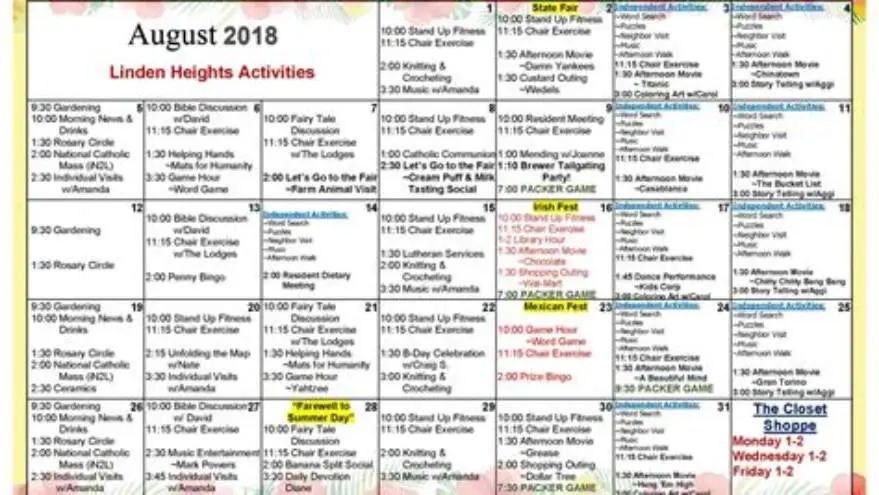
A repeating weekly structure beats a new theme every day. It cuts the planning load and gives residents the comfort of a recognizable pattern. Most activity calendars settle into four or five activity types rotating across the week.
A resident often does better on the third run of a sorting task than the first. The format becomes familiar even when the specific content changes. Directors who keep the task type stable, and rotate only the theme, tend to see steadier attendance.
Building this calendar by hand each week eats the most prep time. The hard part is matching three difficulty levels to five days of themes, not picking the themes themselves.
- Monday: conversation-based activity (photo talk, conversation cards, reminiscence)
- Tuesday: puzzle or sorting task at matched difficulty levels
- Wednesday: music or movement session
- Thursday: a repeat of Monday's format with new content
- Friday: lighter sensory or social activity before the weekend
Should you make your own puzzles for dementia residents, or buy a kit?
Making your own large-print puzzles is free if you have the time. A free word search maker lets you type in a resident's own words, grandchildren's names, hometown streets, old jobs, and generates a large-print PDF with an answer page. Try one like Puzzle-Maker.com or The Teachers Corner's word search tool, both free and no sign-up required for basic use.
A homemade puzzle built around someone's actual life history often lands better emotionally than a generic theme. But building one puzzle at a time for a full roster of residents isn't realistic on a weekly schedule.
A kit with pre-built difficulty levels saves that prep time but trades away the personal names and places. Many directors use both: a ready-made kit for the bulk of weekly sessions, and a personalized word search for birthdays or a resident having a hard week.
Neither approach is wrong. The real decision is how many hours a director has for prep that week, against how much personalization the group actually needs.
| Homemade (free word search maker) | Ready-made kit | |
|---|---|---|
| Prep time | Higher, one puzzle at a time | Lower, print and go |
| Personalization | High, uses resident's own names and places | Lower, general themes |
| Difficulty levels | One at a time, manually adjusted | Three built in |
| Cost | Free | One-time payment |
When is a group activity the wrong call entirely?
Group activities aren't the right tool for every resident or every moment. A resident who's actively agitated, in pain, or overstimulated needs one-on-one attention first, not a table of five other people.
Residents in very late-stage dementia, who no longer track a group or respond to peers, often do better with 1:1 sensory time: a hand massage, familiar music through headphones, a quiet voice. A crowded table adds noise they can't filter.
Shared materials need basic hygiene care. Wipe down puzzle pieces, cards and sorting objects between groups, and skip shared lotion bottles. Use individual portions instead to avoid passing infection between residents who touch their faces or mouths.
None of this is treatment. A group activity, or a kit built around one, is for enjoyment and connection. It isn't a substitute for occupational therapy, a doctor's care plan, or a trained response to a behavioral crisis.
Match the activity to the stage first and the theme second: that single change fixes most flat sessions.
Still wondering?
How many residents should be in one activity group?
With one staff member and no helper, 4 to 6 residents is a manageable range for most activity levels. Add a helper for larger groups, and go smaller if acuity is high or the room is tight.
What if a resident refuses to join the group activity?
Refusal often means the activity doesn't fit their current ability or mood that day, not that they dislike activities generally. A quieter one-on-one version of the same theme, like a photo card instead of a group discussion, sometimes gets a different result.
Can the same activity work for both early and late-stage residents?
Rarely as a single version. The same theme can work across stages if it's offered at three difficulty levels, with the late-stage version shifted toward sensory and conversational elements rather than task completion.
How do you handle a resident who gets agitated during a group activity?
Stop the task for that resident and offer a calmer alternative nearby, like a photo book or music. Agitation during a cognitive task usually signals it was too demanding for that moment, not a behavior to correct. If agitation is frequent or severe, flag it to a nurse or care plan lead rather than managing it through activity choice alone.
Do group activities need to change every week to stay interesting?
No. Keeping the task type stable while rotating the theme usually works better than changing everything weekly, since residents often perform better once a format feels familiar.
Can group activities replace one-on-one care or therapy?
No. Group activities support enjoyment and connection, not treatment. A resident who's agitated, in pain, or in very late-stage dementia needs 1:1 attention, and any activity kit is a supplement to a care plan, not a substitute for one.
Ready to try it? It gives one director three ready-made difficulty levels under a single theme, so a mixed-ability group can run from one printed kit instead of three separate programs.
Get the three-level kit