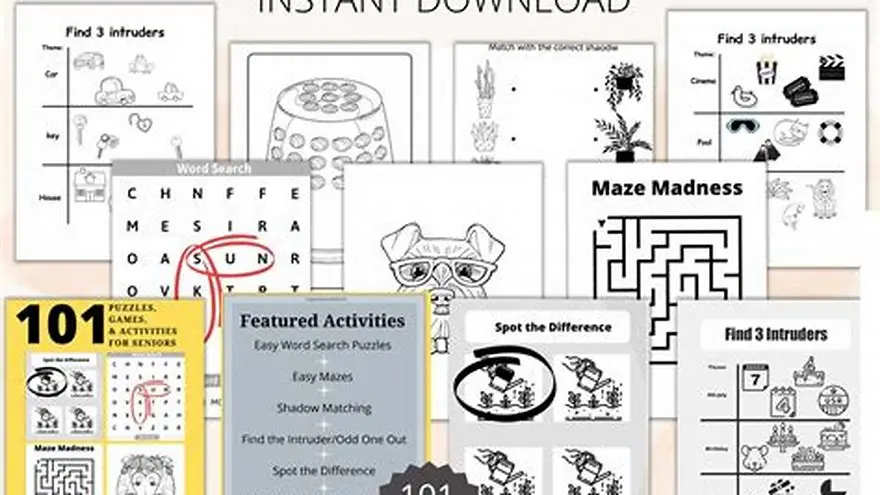
Printable memory care activities matched to cognitive levels and engagement
Printable activities for memory care units should fit residents’ cognitive levels, often grouped as low, mid, and high cognition, to keep them engaged without causing frustration or boredom. Multi-level printable activity kits provide several difficulty options, which helps staff plan effectively.
On this page (8 sections)
- Quick recap
- How to identify cognitive levels of residents
- Which printable activities suit specific cognitive stages
- How to adapt printables for varying abilities
- Examples of printable activities for different cognition levels
- Where to find printable activities for memory care units
- How to pick printable activities by cognitive level and engagement in memory care
- Still wondering?
Key figures
- Cognitive levels
- low, mid, high
- Activity pages
- Varies by kit, often 100+ pages
- Activity levels
- Multiple difficulty tiers
- Conversation cards
- Included in some kits
- Printable sizes
- Common sizes like US Letter and A4
- Download type
- Instant digital downloads common
- Cost
- Varies; free to moderate pricing
Quick recap
- Identify residents’ cognition to choose suitable activity difficulty.
- Print large, clear materials to accommodate vision and memory loss.
- Use multi-level kits for varied abilities in one group.
- Adapt printables by simplifying instructions or giving aids.
- Multi-level printable kits save time with structured, printable activities.
How to identify cognitive levels of residents

Cognitive levels in memory care residents generally range from low to high functioning. Low cognition means residents may have significant memory loss and difficulty following instructions. Mid cognition allows some independence with prompts. High cognition residents often engage in complex tasks but may have mild memory impairment.
Activity directors rely on observations: how well a resident follows multi-step tasks, remembers names, or communicates. Consult nursing staff or therapists for assessments if possible. Informal checks include watching residents perform routines or answer simple questions.
Identifying these levels helps avoid activities that cause anxiety or boredom. For example, a challenging crossword might frustrate someone with low cognition but stimulate a resident with higher function.
Which printable activities suit specific cognitive stages
Low cognition residents do best with simple, large-print matching games, basic word searches, and coloring sheets with minimal detail. These activities use repetition and gentle tasks that don’t require reading or complex decisions. It helps to understand large print activities for seniors free printable before going further.
Mid cognition residents can handle word searches with larger grids, simple crosswords with familiar words, and beginner sudoku puzzles with fewer numbers. These activities promote problem-solving and memory without overwhelming.
High cognition residents enjoy larger, more challenging printables like complex crosswords, full sudoku puzzles, and themed word games. These help maintain cognitive function and provide satisfaction from achievement.
Activities must be visually accessible, so large font size (often above 18 points) and clear contrast are vital. Printables designed for older adults and memory loss provide this clarity. If that sounds like your situation, read up on dementia patient christmas gifts next.
| Cognition Level | Recommended Activity Types | Key Features |
|---|---|---|
| Low | Coloring, simple word search, matching | Large print, minimal text, repetitive |
| Mid | Basic crossword, simple sudoku, themed word games | Moderate size print, familiar words |
| High | Complex crossword, full sudoku, challenging puzzles | Smaller print okay, multi-step tasks |
How to adapt printables for varying abilities
Simplify instructions and provide examples. Use thicker markers or crayons for easier handling. Limit choices for low cognition residents to reduce decision fatigue and offer step-by-step guidance.
Enlarge printables or use magnifiers if vision is poor. Encourage group work or pairing for mid-level residents to increase social interaction, which helps engagement. High-level residents may enjoy timed challenges or thematic activities connected to memories.
Repetition helps. Print multiple copies of favorite puzzles to reinforce skills and confidence. Conversation cards can prompt discussions related to the activity, adding social and memory-stimulating elements. The other half of this decision is engaging memory care residents.
- Simplify instructions to match understanding.
- Use large, clear print and high-contrast colors.
- Limit options for easier decision making.
- Encourage social interaction with group activities.
Examples of printable activities for different cognition levels
For low cognition, try large-print matching cards, simple mazes, or coloring pages with bold outlines. These engage attention without requiring memory recall.
Mid cognition residents respond well to themed word searches with familiar words, simple crossword puzzles with clues, and beginner sudoku puzzles with smaller grids and fewer rules.
High cognition individuals enjoy more complex sudoku, crosswords with layered clues, and word games involving synonyms or categories. Multi-step puzzles that encourage memory and reasoning suit them well. We cover activities that benefit dementia patients in its own article.
Multi-level printable activity kits offer a range of these activities. Kits often include puzzles, conversation cards to spark memories, and caregiver guides, which help save planning time.
- Covers all cognition levels
- Includes conversation prompts
- Printable in large sizes
- Not a substitute for medical therapy
- Requires caregiver involvement
- Some kits have a purchase cost
Where to find printable activities for memory care units
Choosing printable activities means matching cognitive levels, vision needs, and engagement preferences. Many care homes seek large-print materials that are neither childish nor too challenging.
Multi-level printable activity kits provide activities at several difficulty levels, letting staff and families select what fits a resident’s ability. Conversation cards often accompany these kits, promoting connection and memory sharing. If that sounds like your situation, read up on table activities for nursing home residents next.
Some kits offer instant digital downloads, so groups can have fresh materials regularly without extra sourcing effort. Caregiver guides help adapt activities and encourage positive approaches that reduce frustration.
Free printable resources also exist. Tools like Large Print Word Search Maker and puzzle design software such as BigPrint Puzzle Studio help create custom puzzles, though they require more time and effort.
- Multi-level kits fit varied cognitive needs
- Printable on demand for cost-effective use
- Conversation cards enhance engagement
- Free tools require more preparation
How to pick printable activities by cognitive level and engagement in memory care
Start with assessing residents’ cognitive ability through staff input or observation. Choose printables that match difficulty. Low cognition benefits from simple repetition, mid cognition handles moderate complexity, and high cognition can tackle challenging puzzles. We go through activity ideas for nursing homes step by step elsewhere on the site.
Consider visual and motor skills. Use large-print puzzles and simple layouts for those with vision or coordination difficulties. Engagement grows when activities connect to familiar themes or encourage social interaction.
Rotate activities to keep interest high. Use conversation cards and group discussion prompts to deepen engagement. Test printables beforehand to ensure they are readable and appropriate.
Activity directors can use multi-level printable kits to apply these principles quickly. Free printable generators and puzzle tools can create customized activities but require time and creativity.
- Assess residents’ cognitive levels with staff input.
- Choose printables that match difficulty and vision needs.
- Adapt instructions and materials for motor skills.
- Use conversation prompts to boost engagement.
- Rotate printables regularly to maintain interest.
Still wondering?
How do I tell if a printable activity is too hard or too easy for a resident?
If a resident shows frustration, confusion, or disengagement, the activity may be too hard. If they finish quickly and seem bored, it’s likely too easy. Watch and adjust difficulty accordingly.
Can printable activities really help with memory loss?
Printable activities support engagement and social interaction, which improve mood and quality of life. They do not treat memory loss medically but can stimulate cognitive function and reduce isolation.
How often should I change activities in a memory care group?
Changing activities weekly helps maintain interest. Some residents prefer repetition for comfort, so balance variety with familiarity based on feedback.
Are conversation cards necessary for these activities?
Conversation cards encourage discussion and memory sharing, enhancing social connection. They are not necessary but often increase engagement.
Can I print activities at home or do I need special equipment?
Most printable activities print well on standard home printers using common paper sizes like US Letter or A4.