Large Print Playing Cards: How to Pick a Deck You Can Read
Large print playing cards come in two kinds. Jumbo index decks keep the normal 2.5 by 3.5 inch card and print much bigger corner numbers. Oversized decks make the whole card bigger, often 5 by 7 inches. Pick jumbo index for normal play and oversized cards when reading across a table matters most.
On this page (8 sections)
Part of our guide on best fonts for older readers
Key figures
- Poker card size
- 2.5 by 3.5 inches
- Bridge card size
- 2.25 by 3.5 inches
- Common oversized size
- 5 by 7 inches
- Cards in a deck
- 52 plus 2 jokers
- Plastic cards
- Survive spills, wipe clean
Quick recap
- Jumbo index keeps normal card size and enlarges only the corner numbers.
- Oversized decks read across a table but need bigger hands and more table space.
- Measure the corner index on a card you own before ordering a second deck.
- Plastic cards survive spills and shuffle longer than coated paper.
- A wooden card rack holds a full hand when gripping gets tiring.
What makes large print playing cards easier to read?
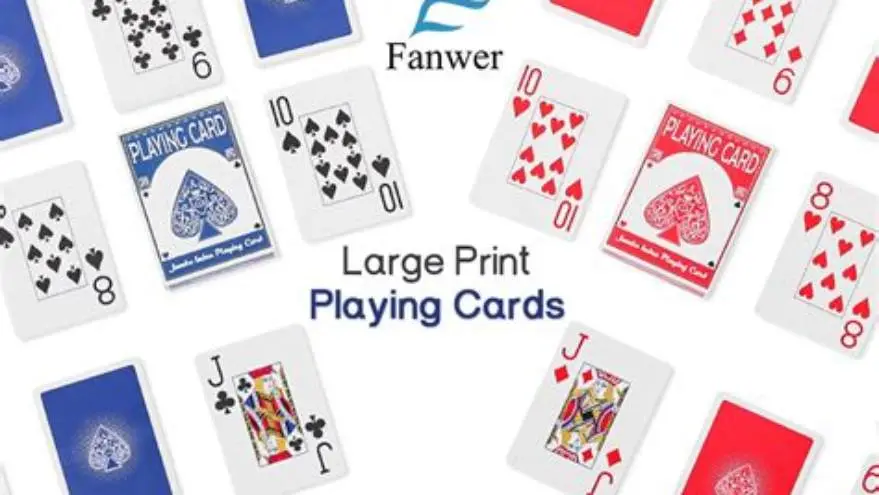
The phrase large print covers two different designs, and mixing them up is the usual mistake. A jumbo index deck is a normal poker-size card with much larger numbers and suit marks in the corners. The card itself stays the same size, so it shuffles and deals like any other deck. An oversized deck grows the whole card, often to 5 by 7 inches, with print to match. Both are sold as large print, and both help, but they help in different ways.
Players read the number and suit in the corner, not the big picture in the middle. A jumbo index fills much more of that corner, so the rank shows at arm's length and in dim light. The middle of the card can stay the same. That is why a jumbo index deck reads better even though the card has not grown. Check the listing photos and look at the corner, not the face.
Oversized cards solve a different problem. They help when the reader sits across a wide table. The trade-off is handling. One 5 by 7 inch card is twice as wide as a normal one. A hand of 13 bridge cards becomes a wide fan. Shuffling takes two hands and more table space.
Jumbo index or oversized: which size suits your table?
Start with the game, not the catalogue. Jumbo index decks fit every game a normal deck fits. They shuffle in one hand, stack in a normal box, and work with card holders made for poker-size cards. Oversized decks change the game itself. The cards take up more table, the shuffle is slower, and a full hand is heavy. That matters in bridge or canasta, where a player holds 13 cards at once. People in this spot often ask about font size easy to read seniors as well.
Table size decides a lot. Four players around a kitchen table sit close together, and a jumbo index deck reads fine from that distance. Players at a long dining table sit far apart, so bigger cards earn their keep. Measure the distance between players before you buy. Hold a normal card at that distance and see if the corner reads. If it does not, go one size up.
One more check is the shuffle. Oversized cards bend less easily and slip more in small hands. A deck that is hard to shuffle gets played less, no matter how clear the print is. If the group already finds shuffling a chore, a jumbo index deck plus a card holder beats an oversized deck. The best deck is the one that gets dealt.
| Deck type | Card size | Best for | Watch out for |
|---|---|---|---|
| Jumbo index | 2.5 by 3.5 inches | Normal games, small tables | Index size varies by brand |
| Oversized | 5 by 7 inches | Reading across a table, display and teaching | Harder to shuffle and hold |
How to test a deck before you buy a second one
Listings use words like jumbo and giant loosely, and two decks with the same label can print very differently. A quick test with one deck saves the cost of a second one that nobody wants to use. Run the test in the room where the group actually plays, under the same light. A deck that reads in a bright shop may fail in a living room at night. Search the listing for the card size in inches and the words jumbo index, and skip any listing that gives no size at all. People in this spot often ask about calendar for seniors with large print as well.
That test also settles the index question. Sellers rarely publish the height of the corner numbers, so there is no figure to compare. The only honest measure is the card in your hand. Compare the new deck against the old one side by side, at the distance players sit. Compare the corner in the listing photo with a deck you already own, shown at the same size on your screen. If the group cannot tell the difference, the new deck is not large enough.
Write down the result before you forget it. Note the deck name, the card size, and whether the weakest reader could name every card. That note saves a second round of guessing when the group wants another deck. A deck that passes the test is worth buying twice, once for the table and once as a spare.
- Deal a hand of seven cards and fan them the way players hold them.
- Read the corner of each card at arm's length, in the room's normal light.
- Ask the player with the weakest sight to name the rank and suit of each card.
- Shuffle the deck three times and check for bent corners or sticky cards.
- Play one full round and watch for squinting, leaning in, or cards held close to the face.
What are the cards made of, and why it matters
Most large print decks are printed on a stiff, heavy coated cardstock. The coating keeps the cards sliding past each other, which makes shuffling easier. Uncoated card sticks and wears fast. A linen or air-cushion finish adds a light texture that helps the cards separate. It also hides fingerprints, which matters when a deck is handled by many players. A heavy coated stock holds its shape through hundreds of shuffles. We go through set text to arial font step by step elsewhere on the site.
Plastic cards cost more and last far longer. One plastic deck survives spills, wipes clean, and keeps its shape after hundreds of games. Paper cards crease, and a creased card can be read from the back, which spoils a game. For a weekly group, plastic pays for itself in decks not replaced. For occasional play, coated paper is fine.
Check the edges before you buy a second deck. Rounded corners shuffle better and catch less on a tablecloth. Sharp corners fray and lift, and a lifted corner marks the card. Flex one card gently and let it snap back. It should return flat. Replace a deck once the backs show marks, because a marked deck is a spoiled game.
When hands tire before eyes do
Reading the cards is only half the game. Holding a full bridge hand in a fan for an hour asks a lot of stiff fingers, and shuffling a full deck asks more. Wooden or plastic racks hold the hand upright on the table, so nobody has to grip anything. The rack frees both hands for playing, eating, or scoring. Racks built for poker-size cards hold a full bridge hand with room to spare.
Automatic shufflers take over the other hard job. Battery shufflers handle one or two decks and cut the repetitive motion out of the game. They suit groups where shuffling hurts or takes too long. Test the shuffler with the group's own decks first, because a shuffler that jams on thick plastic cards is worse than no shuffler at all.
Hand pain that keeps getting worse is a question for their doctor, not for a card catalogue. A rack or a shuffler helps with the game, not with the hands. Ask the group what hurts most before buying anything. A rack helps a player who cannot hold a fan. A shuffler helps a player who cannot shuffle. Buy the tool that matches the real problem.
- Card rack: holds a full hand upright, frees both hands, suits bridge and canasta.
- Rotating tray: keeps the draw pile in the middle, spins to each player, cuts reaching.
- Automatic shuffler: shuffles one or two decks, cuts repetitive motion, check it fits plastic cards.
- DIY holder: a slit pool noodle or a folded towel props cards up for free.
Games that play well with large print cards
Some games suit big print better than others. Rummy and gin rummy work well because players sort cards into sets and read the corners often. Canasta suits oversized cards because the melds sit face up on the table for everyone to see. Bridge works best with a jumbo index deck, because a full hand in a narrow fan needs a small card. Pick the game to match the deck, not the other way round.
Games with hidden hands need a second look. In poker, players peek at the corner of each card and keep the rest hidden, so a jumbo index deck is ideal. In games where cards sit face up, like some versions of solitaire played as a group, oversized cards shine because everyone reads the same card. Match the print to where the reading happens.
Keep the table simple. Plain tablecloths in a solid colour make white card backs stand out. Patterned cloth fights with the print. Good light from above beats a lamp from the side, which throws shadows across the fan. Small changes like these cost nothing and make the same deck easier to read.
For most groups, a jumbo index deck in plastic is the best buy: normal size, easy to read, and built to last.
Still wondering?
Are large print playing cards the same size as normal cards?
Jumbo index decks are the same size as a normal deck, with bigger corner numbers. Oversized decks are bigger cards, often 5 by 7 inches. Check the card size in the listing, not just the word jumbo, before you buy.
What does jumbo index mean?
It means the rank and suit in the corner are printed much larger than on a normal deck. The card itself stays poker size and fits normal card holders and boxes. Look at the corner in the listing photos to judge how big the print really is.
Can I use large print cards with a card holder?
Yes, if the holder fits the card size. Most holders are made for poker-size cards, so they fit jumbo index decks. Oversized cards need a wider rack or a tray, so check the holder's size first.
Are plastic large print cards worth it?
For a weekly group, yes. Plastic cards survive spills and keep their shape far longer than paper. For a deck used once a month, coated paper is fine and costs less.
Can I print my own large print cards?
You can print a custom deck at poker size with large corner numbers on a home printer, but home-printed cards are thin and wear fast. A printed deck suits one-off games and teaching. For regular play, a bought deck lasts longer.