Large print sudoku books: measure one cell before you pay for it
A large print sudoku puzzle book earns the name through its grid, not its cover. Thirty seconds with a ruler settles it: measure the cell and check what fits inside it. A book that passes works; one that fails is standard print with a large print label.
On this page (8 sections)
- Quick recap
- Why a big font on the cover says nothing about the grid
- Buying a large print sudoku puzzle book: the one-cell test
- The scale trap: why fit to page shrinks your free printable sudoku
- Using Look Inside to test cell size and paper show-through
- Difficulty levels, layout and where the solutions hide
- Making your own book to sell: work backwards from the cell
- Still wondering?
Part of our guide on large print sudoku for beginners
Key figures
- Cell test
- Digit plus two candidates
- Small-trim reality
- 6x9 grids run smaller; verify per title
- Print setting
- Actual size, not Fit to page
- Test time
- about 30 seconds
- Best page layout
- one puzzle per page
- Good starting point
- Graded easy-medium volumes
Quick recap
- Cover font size and grid size are set separately. A big title proves nothing about the puzzles.
- The test that matters: what fits inside a single cell.
- Free printable PDFs often shrink silently. Print with 'Actual size', never 'Fit to page'.
- Use a listing's Look Inside sample to check cell size, layout and paper show-through before buying.
- Difficulty matters at large print. Older solvers usually want more givens per grid, so check the stated mix.
- Check the stated difficulty mix and the layout before you buy; graded easy-medium volumes suit most older solvers.
Why a big font on the cover says nothing about the grid
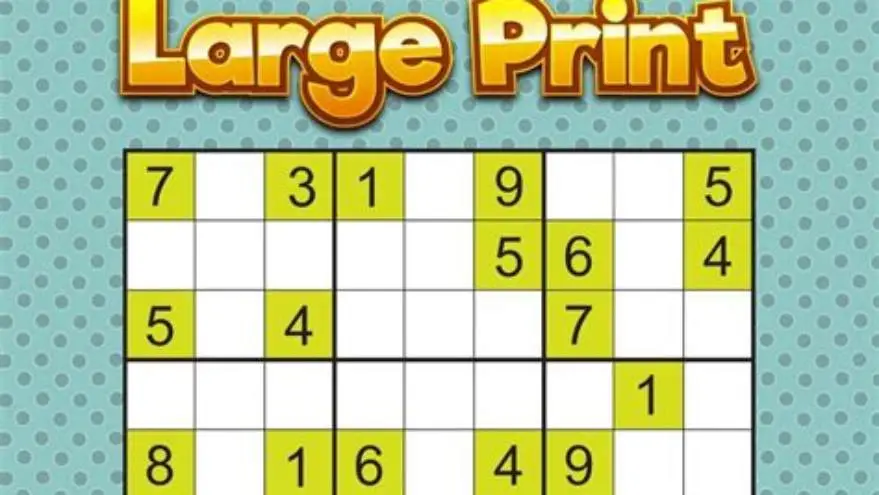
Pick up any large print sudoku puzzle book in a shop and the first thing you see is the title. The letters are often an inch tall. That title and the puzzles inside are typeset separately, sometimes by different people or by templates that scale each independently. A designer can stretch the cover type to any size without touching the grids. Nobody is obliged to tell you.
The same disconnect happens online. Listings say 'large print' or 'easy to read' in the bullet points. Those words cost the seller nothing. What actually determines whether you can pencil in a candidate is the width of a single square in the grid. That number almost never appears on the cover or the product page.
So treat 'large print' on a sudoku book as a claim about the interior, not the packaging. Verify it the only way it can be verified: with a measurement of the grid itself. That takes a ruler and about half a minute. The next section shows exactly what to check.
There is a second trap inside the book too. Some titles use a genuinely big grid but set it low on the page with wide margins, so the digits still come out smallish inside their cells. Cell size is the figure that matters, not page size. People in this spot often ask about total sudoku solution grids as well.
Buying a large print sudoku puzzle book: the one-cell test
Here is the test, and it needs a ruler, not a number. Open to any puzzle and lay the ruler across one cell. Write the printed digit in, then pencil two small candidates beside it. If all three sit inside the cell without crowding, the grid works. If they crowd or spill over the lines, the book is standard print wearing a large print label.
With a book in your hands, check three different pages, not one. Grids can vary through a book, and one generous page proves nothing about the rest. Thirty seconds per page settles it.
On a listing online, look for the Look Inside sample or the preview images. Open a full puzzle page and print it, or set the on-screen zoom so the page shows at true scale. Screens rescale in ways you cannot always see, so a paper measurement is the more reliable one. If you cannot print, ask the seller for a photo of a ruler across one cell. When a listing states the finished grid size, divide it by nine for the cell width. People in this spot often ask about printable 6x6 large print sudoku as well.
Pencil choice decides how much room the test needs. A regular HB pencil with a sharp point writes candidates small enough for a snug cell. A thicker 2B, a mechanical pencil, or a pen built for weak grip all need more room. Match the cell to the pencil, not the other way round.
- Ruler: lay it across one cell and note the width.
- Candidates: write the digit in, then add two small ones beside it.
- Fit: all three inside the cell means the book works.
- Paper: hold the page up and check for show-through.
| What fits in one cell | What it means | Best suited to |
|---|---|---|
| Digit plus two candidates fit | Comfortable: room to pencil and read | Low vision, shaky hands, thicker pencils |
| Digit plus one candidate fits | Workable but snug; use a sharp pencil | Mild vision changes, normal grip |
| Only the digit fits | Standard print in disguise | Not a large print purchase |
The scale trap: why fit to page shrinks your free printable sudoku
Free printable sudoku PDFs are everywhere, and many are genuinely well made, with generous grids and clear digits. Then people print them and wonder why the puzzle comes out small. The culprit is almost always the print dialog. When 'Fit to page' or 'Shrink to fit' is selected, the printer quietly scales the whole sheet down into the printable area. A grid designed with generous cells can land on paper several millimetres smaller per cell, with no warning.
The fix is one checkbox. Choose 'Actual size' - some printers call it '100%' or 'No scaling' - and the PDF prints at the size its designer intended. On most home printers this sits under Page Setup or More Settings. Set it once and leave it alone; the shrink trap catches every printable you will ever use, from sudoku to word searches. We go through killer sudoku printable large print with answers free step by step elsewhere on the site.
Print one page and run the ruler check. If a source PDF claims large print and still measures small at actual size, the PDF itself is the problem. Find a different source rather than scaling it up, because enlarging a low-resolution grid gives you fuzzy digits along with the extra millimetres.
Print quality matters here as well. Cheap photocopies lose the thin inner grid lines first, and faint lines make the eye work harder than any font size ever saved it. Print on decent paper from a clean original, in black, and the grid edges stay crisp.
Using Look Inside to test cell size and paper show-through
Most online book listings offer a Look Inside or preview sample. Open it and find a full puzzle page rather than the introduction. Print the sample page and check it with a ruler, rather than eyeballing the screen. There is more on number search puzzles for seniors in a separate guide.
Check two things the photographs never show honestly: cell size and show-through. Thin paper lets the next page's grid ghost through, and on a puzzle full of thin lines that ghosting tires older eyes. If the sample shows the reverse of a page, judge how much you can read through it. Hold the sample at arm's length, the way the solver will hold the book, and the ghosting shows up at once. When a listing states the paper weight, heavier sheets show through less.
Also glance at how many puzzles share a page and where the solutions sit. A book that looks generous in the photos can turn out to squeeze four grids onto one sheet, which cuts every cell size before you have solved a single number.
Listings that show a full puzzle page let you run this test for free, so use them. Treat the absence of any sample as a reason to look elsewhere. There are enough transparent listings that nobody needs to buy blind. It helps to understand how to teach sudoku to a grandparent before going further.
- Free, before any money changes hands
- Shows real interior layout, not marketing photos
- Reveals show-through and page crowding
- Sample may not include a full puzzle page
- Screen zoom can mislead without printing
Difficulty levels, layout and where the solutions hide
Large print buyers are often older, and many of them want easy or medium puzzles with more givens per grid. More givens mean more digits printed at large size. Check whether a book states its difficulty mix. Titles that promise 'easy to hard' in one volume often front-load the easy ones and hide the jump halfway through.
If the solver gets stuck on hard grids, a book labelled all easy or easy-medium is the better purchase. Some publishers sell graded volumes so you can pick a level deliberately.
Layout is the other quiet decision. Two puzzles per page sounds like value until you divide the available width by two and watch the cells shrink. One puzzle per page is the honest layout for genuine large print, and it leaves room for rough notes beside the grid.
Solutions placement matters too. Most books pile the answers at the back, which means checking a move means flipping forty pages and losing your place. A solution on the facing page or immediately after each puzzle is worth more than a few extra puzzles for solvers who like to verify as they go.
Page count also affects price. Compare price per puzzle rather than price alone. Be suspicious of very cheap, very thin large print books. The savings usually come out of the cell size or the paper.
| Layout | Typical effect on 8.5x11 | Best for |
|---|---|---|
| One puzzle per page | Room for genuinely large cells | Pencil candidates, low vision |
| Two puzzles per page | Cells noticeably smaller | Pen solvers, tighter budgets |
| Solutions facing puzzles | Costs page count and price | Anyone who checks as they go |
Making your own book to sell: work backwards from the cell
Creating a large print sudoku book for Amazon KDP or printables for Etsy means running the same cell measurement in reverse. Start from the trim size, not the puzzle count. On 8.5x11, a single grid per page leaves room for generous cells with comfortable margins.
On a 6x9 trim the cells come out smaller, even with one puzzle per page. Work out your own numbers by dividing the usable page width by nine cells plus margins, then print a proof and measure it.
Whatever cell size you choose, hold it constant across the entire book. A book that starts generous and quietly tightens halfway through usually means the creator shrank grids to fit more puzzles per sheet. Reviews notice. Consistency also makes a truthful listing possible, because you can state the measurement outright.
Write the cell measurement in the subtitle or bullet points. It converts your design decision into the one fact a sceptical buyer can verify. Put a full puzzle page in your Look Inside sample so the buyer can measure it.
For the layout work itself, we make a tool called BigPrint Puzzle Studio. It generates large print sudoku grids, along with word searches and mazes, as print-ready PDFs sized for KDP. It sets the large print options up front so the cell size holds steady across a whole book. The free route is equally valid. Any spreadsheet can draw a 9x9 grid to exact millimetre measurements. It just takes longer and gets fiddly once you want themes, covers and matching listing text.
Whichever way you build it, print one interior page at actual size on plain paper before you publish. Check the proof page with a ruler. If your own book fails the test you would apply to anyone else's, fix it now rather than reading about it in a review later.
The ruler test beats every review, star rating and cover claim: thirty seconds, one cell, one honest measurement.
Still wondering?
What cell size should a large print sudoku have?
No formal standard exists, so measure the actual book. The one-cell test in the buying section shows how: a ruler, one cell, and what fits inside it. Labels vary widely, and the measurement settles the question.
How do I check a book before buying online?
Use the Look Inside sample and the cell measurement. The sample also shows you how many grids share a page, what difficulty mix is stated, and where the solutions sit.
Why do my printed free sudoku PDFs come out too small?
Your print dialog is almost certainly set to Fit to page, which silently scales the sheet down. Choose Actual size or 100% instead, then confirm with a ruler. If it is still small at actual size, the PDF itself is not truly large print.
Should solutions be at the back or on the facing page?
For anyone who likes to check as they go, or for carers sharing the activity, a facing or immediately following solution is much kinder than a block at the back. The back-of-book layout suits confident solvers who check rarely.
Ready to try it? It generates large print sudoku grids as KDP-ready PDFs with the big-print settings built in, so your cell size stays consistent from first page to last.
Build your grid book