Large Print Word Search for Church Groups That Everyone Can Read
A large print word search for church groups works when the grid letters are big enough to read at arm's length. The word list should use familiar Bible words, and every copy should print with an answer key. Aim for word lists at 16 pt or larger, grids of 10 to 15 words, and one puzzle per page.
On this page (8 sections)
- Quick recap
- What makes a word search work for a church group
- Large print word search for church groups: what to look for before you print
- Picking words your group will actually know
- How to run the puzzle as part of the meeting
- Where to find free large print Bible word searches
- Printing tips that keep the letters big and clear
- Still wondering?
Part of our guide on makes reading puzzles more accessible
Key figures
- Word list type
- 16 pt or larger
- Grid letters
- A few points larger than the list
- Words per puzzle
- 8 to 12 for a gentle puzzle
- Time per puzzle
- 10 to 20 minutes
- Paper size
- US Letter or A4
- Answer key
- Print one for the leader
Quick recap
- Print word lists at 16 pt or larger, with grid letters larger still.
- Keep puzzles to 8 to 12 words from the passage you are studying.
- Give each puzzle its own page, with the word list beside the grid.
- Always print an answer key, and keep it with the puzzle.
What makes a word search work for a church group
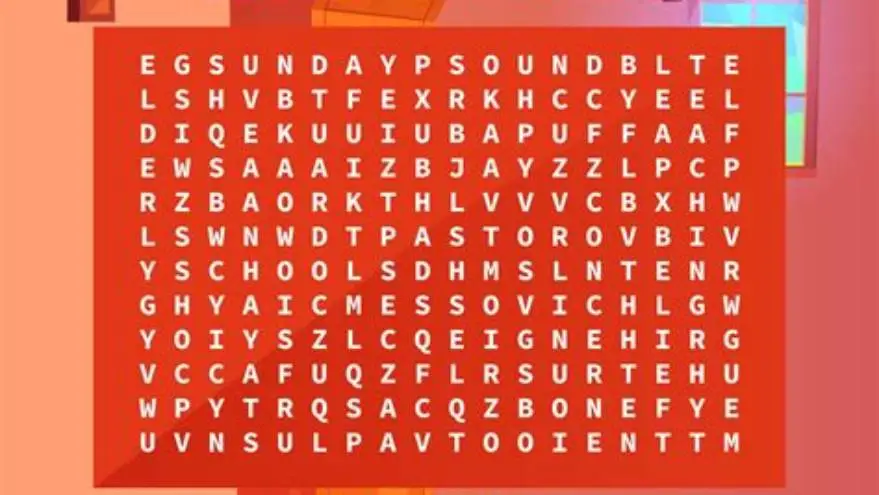
People in a church group have very different eyesight. Others hold the page at arm's length and still squint. Any puzzle that suits only the sharp-eyed half of the room leaves the rest out. Print size is the fix, not a harder puzzle or an easier one. It is a puzzle printed big enough for the person with the weakest eyes in the group. That one choice decides whether the activity includes everyone or quietly excludes some.
Large print means two separate things, and both matter. Lists need large type, and grids need large letters. Big word lists with a cramped grid still fail. Readers scan the grid letter by letter, so cramped letters slow them down and tire their eyes. A full page gives the grid the room it needs. Put the word list beside the grid on the same page, so eyes move a short way between the two. Two puzzles squeezed onto one sheet force the type down, and the saving in paper is not worth the strain.
Words matter as much as the print. Bible readers will enjoy names like Ruth, Amos and Lydia. Newcomers do better with short, familiar words like grace, peace and hope. Long words with double letters slow a search down and frustrate new solvers. Short words keep the pace up and let everyone finish near the same time. That shared finish is what turns a worksheet into a group activity.
Large print word search for church groups: what to look for before you print
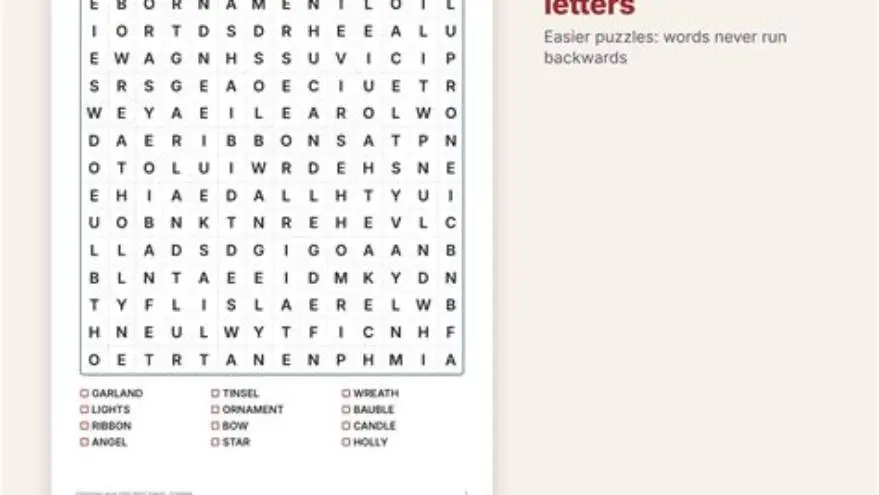
Start with the numbers, because print size is the whole point. Word lists read comfortably at 16 pt or larger, and grid letters should be larger still. Grid letters should run a few points larger than the word list, and the practical test is reading the page at arm's length. If you can read every letter without leaning in, the size is right. We cover share a fun activity in its own article.
When no ready-made puzzle fits your group, make your own with words from the passage you are studying. Our Large Print Word Search Maker turns your word list into a large-print PDF with an answer page, free. Type in the words, print the page, and the grid comes out big enough to read. Our Large Print Word Search Maker builds word searches only, so it will not build a crossword or a trivia round for the same meeting. Know that limit before you plan the whole session around it.
Paper and ink deserve the same care as the type. Run one test copy first and read it under the same lights the group will use. Kitchen-table reading does not guarantee the puzzle reads well in a dim hall. Let the person with the weakest eyes read the test copy, and trust their answer over your own. For anyone who still cannot read the page, a handheld magnifier or a reading partner covers the gap.
Picking words your group will actually know
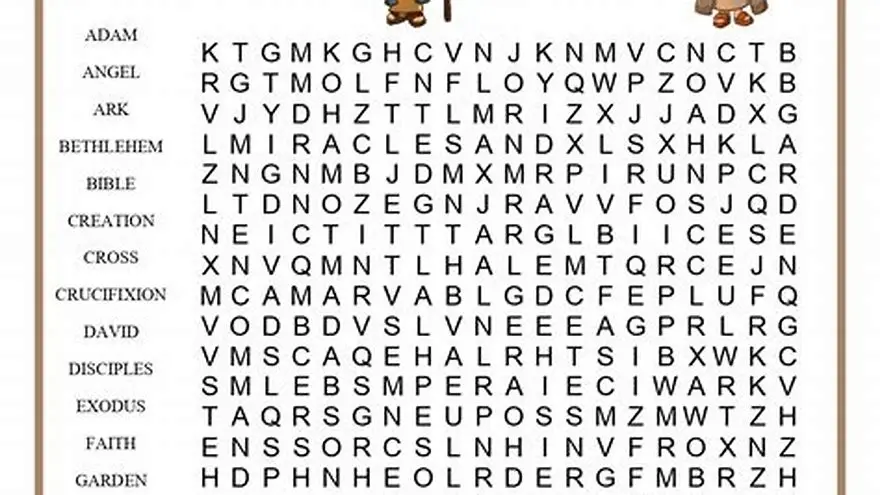
Look to the passage the group is studying that week. Studying the Fruits of the Spirit gives nine words straight from Galatians 5, verses 22 and 23. They are love, joy, peace, patience, kindness, goodness, faithfulness, gentleness and self-control. All nine are familiar, short enough to find, and they give the group something to talk about after the puzzle. There is more on formatting bible puzzles for kdp in a separate guide.
Keep the list short. Eight to twelve words suit a gentle puzzle, and twelve to fifteen suit a group that solves puzzles often. More words than that crowd the grid and stretch the search past the time you have. Mix short words with a few longer ones so the search has some variety, and leave out words that look almost alike. Faith and faithful side by side will trip up good solvers, and so will Mary and Martha. One idea per word keeps the list clean and the answer key easy to check.
Themes carry a whole term of meetings, so build a small set and rotate them. Names of the twelve apostles make one puzzle, and the ten plagues of Egypt make another. Hymn titles suit a singing group, and parables suit a study group working through the Gospels. Seasonal words fit Advent, Lent and Easter without any extra planning. Ten ready puzzles in a folder cover a term. Each one takes only a few minutes to prepare once the word list is set. Clip the answer key to each puzzle so any leader can run it.
How to run the puzzle as part of the meeting
Use the puzzle as a warm-up or a quiet close, not as the main event. Ten to twenty minutes is the usual time for a 15-word puzzle, and that fits neatly into the start of a meeting. Hand out the puzzle as people arrive so early birds can start while the room fills. Latecomers can join in without missing the lesson, and nobody sits idle waiting for the meeting to start. For a group that meets online, send the puzzle as a PDF the day before, and solve it together on screen.
Read the verse or passage aloud before anyone starts searching. Those words then carry meaning instead of sitting as random letters to hunt. Reading the verse first gives the words context, so the group hunts for meaning and not just letters. Ask one person to read the word list aloud so everyone hears each word before they look for it. Hearing the words first helps people who read slowly, and it gives the group a shared start.
Close the puzzle with a short talk, not a race to the finish. Ask which word was hardest to find and why, and let two or three people answer. This turns a quiet puzzle into a conversation, and it often brings out the verse someone needed to hear. Hold an answer key in your hand so you can help anyone who is stuck without taking their sheet.
- Make one puzzle per person, plus two spares.
- Read the passage aloud, then read the word list aloud.
- Give the group 10 to 20 minutes to search in quiet.
- Talk about the hardest word to find for a few minutes.
- Collect the sheets or let people take them home.
Where to find free large print Bible word searches
Free printable collections are the fastest start, and several cover Bible themes well. Good collections cover Abraham and Moses, the apostles, the books of the Bible and Christian hymns, and each puzzle has its own answer key. You may print and copy them for personal, classroom or church use, with the copyright notice left on the page. Check that line before you print a stack for the group.
Online generators sit between ready-made printables and books. They turn a word list you type in into a printable puzzle, often with an answer key and a choice of grid size. Most of them do not say what font size the grid prints at, and that is the catch. Large print on the label does not always mean large print on the page. Test one puzzle before you trust the tool, and measure the printed letters before you print a stack. Pick a generator that lets you choose the grid size and the number of words.
Books are the third option, and they suit a group that meets every week. Large-print Bible word search books vary in puzzle count and type size, so check the publisher's sample pages before you buy. Books cost money, so check the current price before you buy. The steady supply is a book's strength: one book covers months of meetings without any printing. Fixed word lists are the weakness: they will not match the passage your group is studying that week.
| Option | Cost | Best for | Watch out for |
|---|---|---|---|
| Free printable collections | Free | One-off meetings and new groups | Check the copy permission first |
| Word search generators | Free | Matching words to this week's passage | Grid size often not stated |
| Large-print puzzle books | Check the current price | Weekly groups that want a steady supply | Fixed word lists, not your passage |
Printing tips that keep the letters big and clear
Printing trouble usually comes from the printer shrinking the page to fit. Set the scale to 100 percent in the print window and choose US Letter or A4 to match the paper in the tray. Letter-paper puzzles shrink on A4 when the printer fits them to the page, and the letters shrink too. Look at the preview before you print, and study the grid, not just the title.
Bold type reads better than regular type at the same size, so pick a bold font for the grid and the word list. A plain face like Arial or Verdana works well, and both come with most computers. Plain sans-serif faces with even spacing beat fancy faces every time, and letters that touch each other slow the eye down. White backgrounds and black letters work best, and coloured paper is best skipped for the puzzle itself. Coloured paper can look cheerful, and it also lowers the contrast that tired eyes need. Save the colour for the title page or the folder the puzzles live in.
Go double-sided only if the paper is thick enough to stop the grid showing through. Thin copy paper lets the back page ghost through, and ghost letters turn a search into a mess. Standard copy paper is fine for one-sided printing, and it is the cheapest way to print a stack. Store the printed puzzles flat in a folder, with the answer key clipped to the back of each one. Any leader can then pick up the folder and keep the activity going when the usual leader is away.
Still wondering?
Can I photocopy a free Bible word search for my whole church group?
Permission varies, so read the line printed on the page first. Some collections allow printing and copying for church use as long as the copyright notice stays on the page. Confirm that line before you copy.
What size should the letters be in a large print word search?
Aim for word lists at 16 pt or larger, with grid letters a few points larger still. Set the list in a plain bold face, and leave space between the letters. If the page still feels cramped, go bigger.
How many words should a church group word search have?
For a gentle puzzle, use eight to twelve words. A group that solves puzzles often can handle twelve to fifteen. More words crowd the grid and stretch the search. Short, familiar words from the week's passage work best.
How long does a word search take in a church meeting?
Most groups take ten to twenty minutes on a 15-word puzzle. Start with the passage read aloud, then let the room search in quiet. Close with a short talk about the hardest word to find.
Ready to try it? It turns the words from this week's passage into a large-print puzzle with an answer page, free.
Make your church word search