Large Print Word Search to Play With Grandchildren
A large print word search to play with grandchildren needs 18-point letters, a 10-by-10 grid, and 12 short words both generations know. Let the child hold the pencil and hunt together.
On this page (8 sections)
- Quick recap
- Large print word search to play with grandchildren: how to set it up
- How big should the letters be for two generations?
- What grid and word list work for a child and a grandparent?
- How do you play a word search together?
- What if the grandchildren live far away?
- What if the age gap is wide?
- Still wondering?
Part of our guide on large print word search for assisted living
Key figures
- Grandparent's copy
- 18 points or bigger
- Shared grid
- 10 by 10, 12 words
- Grandparents Day 2026
- September 13
- Line spacing
- At least 1.5
- Word directions
- Across and down only
- Child's copy
- Regular print size
Quick recap
- Two copies of one puzzle keep a grandparent and a grandchild at the same table.
- Short words both generations know beat long words only one of them knows.
- A shared word list turns a puzzle into a conversation.
- A video call works when both sides print the same sheet the day before.
Large print word search to play with grandchildren: how to set it up
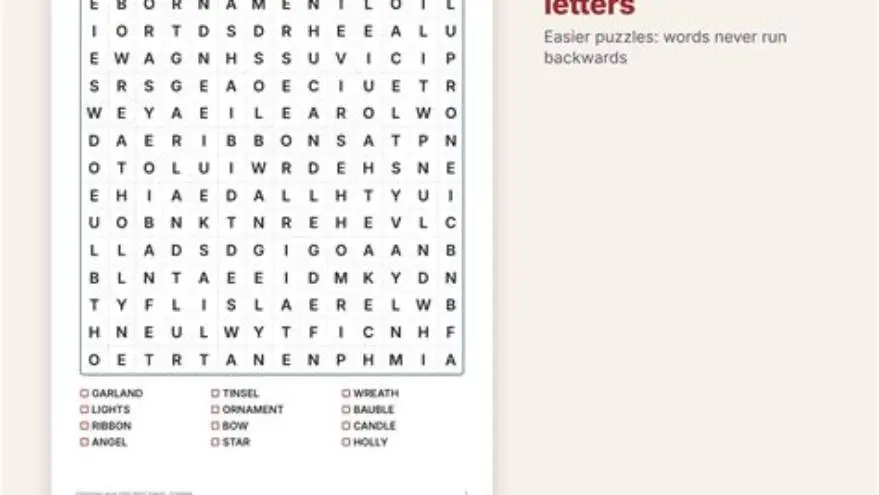
One puzzle can fit two readers when it is built for both. Grandparents need letters big enough to read without strain. Grandchildren need words short enough to spell. Twelve familiar words in a 10-by-10 grid give both of them a fair hunt. That puzzle becomes a reason to sit together, not a test either of them can fail.
Grandparents Day gives the idea a date. It falls on the Sunday after Labor Day each year, which puts it on September 13 in 2026. Its roots go back to a 1978 congressional resolution. Shared word searches fit the day because they cost nothing, need no screen, and work at a kitchen table or over a video call. Families who live close can solve side by side. Families spread across the country can print the same sheet and solve it together on a call.
This page shows how to build that puzzle. First the print size, because two readers need two sizes. Then the grid and the word list, because they set the difficulty for both ages. Then the way to play, the long-distance version, and the fixes when the age gap is wide. Sizes and counts below come from published large-print guides and free printable sets. Everything else is plain setup: paper, pencils, and a list both readers already know.
How big should the letters be for two generations?
Large-print conventions put the threshold at 18 points. Type smaller than that is enlarged print, not large print. Low-vision guides commonly suggest 18 to 20 points with generous line spacing. Grandparents reading at arm's length need that size. Children read smaller print without trouble, so one size cannot serve both. Make the puzzle twice: once in large print for the grandparent, once in a smaller size for the child. We cover large print word search for church groups in its own article.
Line spacing of at least 1.5 keeps the rows apart so a pencil can track one line at a time. Plain sans-serif faces such as Arial, Verdana or Tahoma read cleanest at large sizes. Black ink on plain white paper gives the strongest contrast. Children can read the same words in 12-point type on the same sheet layout. Both copies then look alike, and nobody gets the special one. Matching layouts matter when the solvers sit side by side. Wide-barrel pencils and felt-tip pens suit hands that grip loosely, and matte paper cuts glare.
Start with our free Large Print Word Search Maker when the words are your own. Type in a dozen family words and it builds a large-print PDF with an answer page, ready to print at two sizes. It makes word searches only. Crosswords and sudoku still need another tool, and free printable sets cover themes that already exist.
What grid and word list work for a child and a grandparent?
Twelve words in a 10-by-10 grid, running across and down only, make a workable starting point. That shape fits on one page in big type and finishes in one sitting. It leaves room for a word list in the same large type. Confident older grandchildren can try 18 words in a 15-by-15 grid, adding diagonals. Twenty by twenty with 30 words suits teenagers and adults only. Small grids suit shared solving. Big grids suit solo solving. If that sounds like your situation, read up on interactive activities for grandparents visiting grandchildren next.
For a grandchildren visit, use storytime, sleepover, piggyback, treehouse, allowance, spoiling, sandbox, giggles, bedtime, crayons, cookies, and hugs. Twelve words, all short, all familiar, and every one of them starts a story. Build your own list the same way: names, foods, places, and songs the family shares. Long words hide badly in a small grid and slow a young speller down.
Grandchildren who chose the words usually hunt harder for them. Grandparents who hear a grandchild's word learn something new about the child. Mix the list: half from the grandparent's world, half from the child's. Grown-up words alone bore the child. Child words alone bore the grandparent.
| Level | Grid | Words | Directions |
|---|---|---|---|
| Easy, young child | 10 by 10 | 12 | Across and down |
| Medium, older child | 15 by 15 | 18 | Across, down, diagonal |
| Large print, grandparent | 12 by 12 | 14 | Across, down, diagonal |
How do you play a word search together?
Sit side by side with one puzzle between you, or give each solver a copy. Read the word list aloud together before anyone starts. That minute wakes up the theme and gives both solvers a shared start. Then hunt together: one person points, the other circles. Swap roles every few words so both hands stay busy. Talk while you hunt. Talking is the point.
Keep score out of it. Races suit two children of the same age, not a child and a grandparent at very different speeds. Praise the find, not the speed. When a word hides for a while, read its first letter aloud and let the other solver take it from there. Never take the pencil and finish a word for someone. Found words belong to the person who found them.
End the puzzle before it ends the visit. Short puzzles that finish with smiles beat long ones that drag. Put the finished sheet on the fridge or in a drawer, and bring a fresh one next time. Solved puzzles become keepsakes. Unfinished ones become recycling. A fresh puzzle each visit keeps the habit alive.
- Hand out two copies of the same puzzle, one in large print and one in regular size.
- Read the word list aloud together, slowly, and point to each word as you read it.
- Give the child the pencil and let the child circle the words while the grandparent points.
- Swap roles every few words so both solvers stay in the game.
- Go through the answers aloud at the end, and let the child tick off each found word.
What if the grandchildren live far away?
Distance changes the setup, not the game. Email the PDF to the family the day before a video call, so both sides print their own copy. Children print the regular size while grandparents print the large-print size. Start the call with the word list on screen, then hunt together while the camera shows both puzzles. That puzzle gives a call a job to do. Calls without a job run out of talk fast.
Mail works too, for families who prefer paper. Send two copies in an envelope with a pencil and a short note. A printed puzzle in an envelope often lands better than a file attachment. Time the mailing so it lands a few days before the call, and solve it together on screen. Grandchildren who get mail usually answer it.
Weekly routines stick. One puzzle every Sunday, or every visit, turns into a habit both sides look forward to. Same themes can run for a month with fresh words each week. Habits need no planning once they start. Send the next puzzle before the call ends, and the next visit is already booked.
What if the age gap is wide?
Five-year-olds and teenagers need different puzzles, and the same word list can give both of them one. Give the younger child the easy level: 12 words in a 10-by-10 grid, across and down. Give the teenager the hard level: 30 words in a 20-by-20 grid, in all eight directions. Both solvers hunt the same words. Shared lists keep the table together while the grids differ.
September brings a wide-gap family a reason to start: Grandparents Day. Shared puzzles fit the day because they ask for nothing but paper and pencils. Shared activities give a child time with an older adult and give the older adult a small job worth doing. Word searches are a small way into that kind of time.
Judge the puzzle by the solvers, not the clock. When the child is done and the grandparent is still hunting, the puzzle is right for the child and hard for the grandparent. Next time, print the grandparent a bigger copy. Adjust one thing at a time when a puzzle misses: the words, the grid, or the letters. Change all three at once and you will not know which one helped. For a grandchild who reads slowly, use shorter words and fewer directions.
A shared word search earns its place at the kitchen table when both solvers can read it and both know the words.
Still wondering?
How do I know the print is big enough for a grandparent?
Measure a capital letter on a test page. A capital a quarter of an inch tall reads well at arm's length. If the letter measures an eighth of an inch, double the scale. Always test one page before printing a stack.
What words work best for two generations?
Pick words both solvers already know: names, foods, places, and songs the family shares. Short words hide best in a small grid and tire no one. Long words hide badly in a small grid, so favour short, everyday words. Mix the list so half the words come from each generation's world.
What do I need for a video-call word search?
You need a printed copy on each side, a video call both can see, and the PDF sent the day before. Share the word list on screen at the start. Phones propped on a stack of books show a puzzle to the camera well enough. Keep the call short and the puzzle shorter.
What if my grandchild is too young to read?
Ask a young child to hunt for letters, not words. Point to a letter and ask the child to find its match in the grid. Read each word aloud and let the child find its first letter. Praise every find and keep the hunt short.
Ready to try it? It turns your own family words into a large-print word search PDF with an answer page, ready to print at two sizes.
Make your word search free