Memory Care Activity Stations That Work All Day Long
Memory care activity stations are small, open areas where residents can join a hands-on task whenever they feel like it, with no sign-up. There is no set start time. Three or four stations, stocked with familiar objects, fill the long gaps between scheduled activities.
On this page (8 sections)
Part of our guide on creative nursing home activities
Key figures
- Stations to start
- 3 to start
- Typical stop
- 5 to 20 minutes
- Print size
- 18 pt or larger
- Refresh cycle
- Every 2 weeks
- Best spot
- Near a staffed area
Quick recap
- Fewer stations, used well, beat a crowded hallway.
- Stock each station with familiar objects and one clear cue card.
- Refresh items every two weeks so regulars find something new.
- Watch who stops, not who signs up: lingering is the real measure.
What Memory Care Activity Stations Actually Are
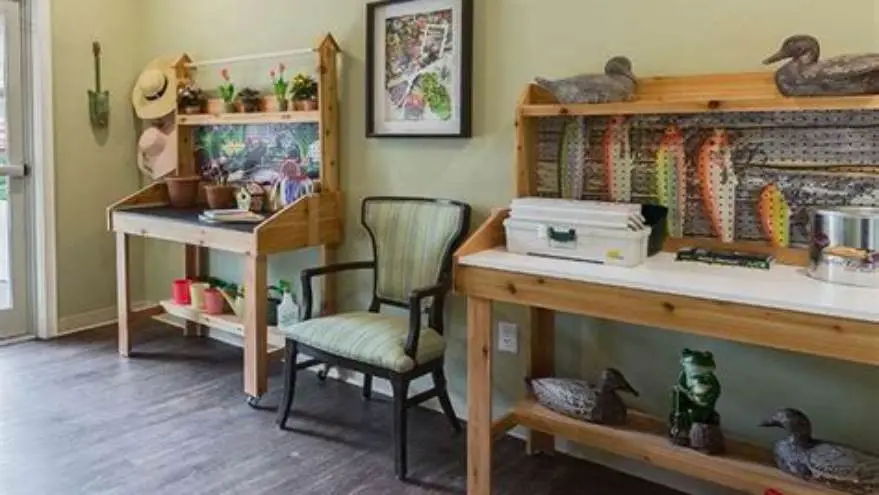
Imagine a small corner of a hallway or lounge that invites a resident to do something with their hands. It stays open all day. Residents drift in and out as they please. Its work happens in the quiet hours between scheduled activities, when the room would otherwise sit empty and residents would sit with nothing to do.
The idea shows up under two names. Montessori-based programs use a prepared environment: a shelf set out so a person can find a task that fits their interests. Some care homes use the term life station. This is a small scene built around a familiar role, like folding laundry, and it gives a wandering resident a reason to stop.
Both names point to the same test. Stations work when a resident uses them without being led there. That test separates a station from a scheduled activity and from a decoration. Folded towels in a basket on a table count as a station once someone picks one up and folds it. That same basket is decoration when it sits untouched behind a rope. What changes it is the invitation, and the invitation is what this page is about.
Why a Full Calendar Still Leaves Gaps
Calendars full of activities look good on a wall. They still leave long empty stretches in a resident's day. Breakfast ends, the morning activity starts at ten, lunch comes at noon, and the afternoon activity runs at two. Hours with nothing planned sit between those fixed points. Before you commit to anything, it is worth looking at easy setup cognitive activities.
Stations cover those hours without adding to the staff rota. Someone who will not sit through a forty-five minute singalong may still spend ten minutes sorting buttons at a table near the lounge. It meets them where they are, for as long as they want it, and it ends when they decide it ends. Printed activities from our Gentle Minds Activity Kit stock a station fast, with three levels so the same table suits residents at different stages. One honest limit is that printed pages wear out at a busy station. Laminate the ones that get used daily, or keep a fresh stack nearby. Hand-written words on a large card do the same job for free.
Aides pass a station on their rounds and can offer a word of encouragement without stopping their work. Family visitors find something to do together instead of sitting across a table with nothing to talk about. Dead time turns into shared time, and it happens without a booking sheet.
Seven Stations That Earn Their Floor Space
Seven stations cover most of what residents reach for. Each one uses objects from ordinary life, not special equipment, and each one works at more than one level of ability. Steady hands can arrange a full bouquet; tired hands can hold one flower and smell it. Both are using the station, and both are doing it right. Nothing on the list needs a special order. It helps to understand senior center group activities before going further.
Pick the stations that match your residents, not the ones that photograph best. Homes where most residents gardened get more from a potting table than from a tinkering bench. Where most residents cooked, a kitchen counter will beat a sorting tray. Ask families what the person did with their hands for most of their life, then build the station around that answer.
Begin with a few and add more only when each one has regulars. Busy stations teach you more about your residents than quiet ones, and they cost less to stock. Once a station has regulars, add the next one beside it. The two then share the same corner of the lounge and the same passing traffic.
- Garden table: a tray of soil, pots, seed packets and a watering can, with gloves and a cloth for wiping hands.
- Music corner: a simple player, headphones, and a short list of songs from the decades your residents grew up with.
- Sorting table: buttons, coins, large beads or cutlery to sort into muffin tins or small bowls by color or type.
- Kitchen counter: vegetables to wash, dough to knead, or napkins to fold, with an apron hung on a hook nearby.
- Reading nook: large-print books, magazines and a photo album, with a lamp and two chairs set close together.
- Tinkering bench: safe tools, wood offcuts, nuts and bolts, and a small project like sanding a birdhouse.
- Conversation table: photo cards, a map, and a few objects from past decades to pick up and talk about.
How to Set Up a Station in an Afternoon
Setting up a station needs no budget line or a building project. It needs a spot, a surface, a few objects and a cue that tells a resident what to do there. Most of the job is walking the building with fresh eyes to find the corners where residents already pause, and it fits into one afternoon. It helps to understand activities for dementia patients in memory care before going further.
Where you put it matters more than the objects. Put the station where residents already walk, near a window or a staffed desk, never at the end of a dead corridor. Nobody uses a station nobody passes. Light matters too: a table in a bright corner draws people in, while a table in shadow reads as storage.
Safety comes before charm. Check every object for sharp edges, small parts that could be swallowed, and anything that needs a plug or a flame. Watch for residents who mouth or eat things that are not food, and keep small items like buttons and beads out of their reach. Put the station where staff can see it from where they already stand. Good light and a clear sightline do half the safety work for you. Stations that need watching from a special chair will not get watched, while stations watched from the nurses' station will get used.
- Walk the lounge and mark three spots where residents already pause or gather.
- Place a table or shelf at each spot, with a chair beside it and light overhead.
- Set out five to eight objects that belong to one familiar task, nothing more.
- Add a large-print cue card that says what to do in one short sentence.
- Watch for a week, note what gets touched, and swap what stays still.
What to Watch When a Station Sits Empty
An empty station is a message, not a failure. It tells you the spot is wrong, the objects are wrong, or the cue is wrong, and each of those has a different fix. A station that nobody uses still costs floor space and staff time, so an empty one deserves a fix, not a shrug. Start by watching the spot for a day before you change anything. If residents walk past without looking, the spot is the problem. If they look and move on, the objects are the problem.
One common mistake is stocking a station like a shop window. Too many objects, too neatly arranged, look like a museum piece, and people leave museum pieces alone. Few objects, slightly untidy, read as a task in progress and invite a hand to join in.
Without a cue card, a station asks a resident to guess what to do, and guessing is work. One short sentence in large print, at eye level, does the job: Fold the towels and stack them here. Readers know the task at once. A clear cue beats a pretty display every time.
Keeping Stations Fresh Without Starting Over
Like a garden, a station goes stale slowly, then all at once. Someone who sorted the same buttons for three weeks stops seeing them. Fix it with small, regular swaps, not a full rebuild. Swap one or two objects every two weeks, change the cue card, and move one station to a new corner each month.
Let residents help with the refresh. Ask who wants to choose the next music list, or which flowers go on the arranging table this week. Choosing the objects gives a resident a reason to return to them, and the choosing itself is an activity worth doing. A station chosen by its users never feels imposed. Freshness lasts because the people who use it keep remaking it.
Keep a notebook at the nurses' station for what you notice: which station drew a crowd, which one sat empty, what broke. Two lines a week is enough. Over a month those lines show a pattern, and the pattern tells you what to buy, what to retire, and what to build next. Name one person to restock each station when the activity director is off, so a holiday never leaves the tables empty. Programs that learn from their own notes get better every month.
Still wondering?
How many stations should a small memory care unit start with?
Three. Three stations give residents a real choice without crowding the lounge, and three are easy for one person to stock and refresh. Add a fourth only when every station has regulars.
Do stations replace scheduled activities?
No. They fill the gaps between scheduled activities; they do not take their place. Singalongs and group games still need a leader and a start time, while a station needs neither. Together, the two work best.
What if a resident takes objects from a station to their room?
Yes, within reason. Taking an object home usually means the station worked: the resident found something worth keeping. Keep spares in a cupboard and check the station each morning so it never sits empty.
How often should station items be cleaned or replaced?
Check them every day and clean what gets handled, the way you would any shared object in the home. Replace anything worn, torn or sticky at once, and rotate the full set every two weeks so regulars keep finding something new.
Can one station serve residents at very different stages?
Residents at very different stages can share one station when the task has more than one way in. Sorting buttons works for a resident who sorts by color and for one who simply enjoys handling them. The station stays the same; the resident chooses how far to take it.
Ready to try it? It gives a station fresh, large-print activities at three levels, ready to print when the table runs low.
Stock a station with it