Killer Sudoku Expert Level: 4 key solving techniques to break tough puzzles
Master expert killer sudoku puzzles using proven advanced methods that simplify tough grids and boost your solving skills.
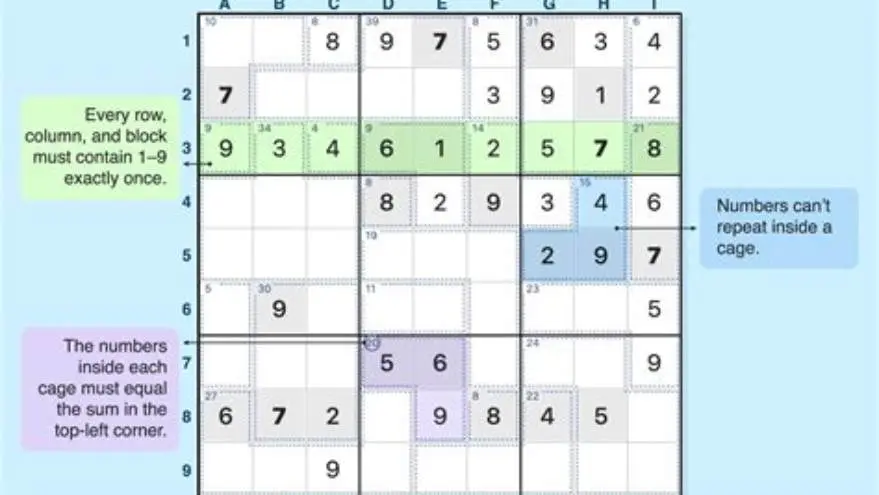
To beat killer sudoku expert puzzles, focus on four main techniques: interpret cage sums with overlaps, use pencil marks to track possibilities, apply advanced deductions like X-wing and chains, and test candidate numbers rigorously to rule out conflicts.
On this page (7 sections)
Part of our guide on printable sudoku for new players
Master expert killer sudoku with four practical techniques that solve tough puzzles without guesswork or confusion.
| Typical cage sum range | 3-45 sum |
|---|---|
| Grid size | 9x9 cells |
| Pencil mark count | 1-9 candidates |
| X-wing pattern size | 4 cells |
| Expert puzzle difficulty | High |
Key takeaways
- Use cage sum overlaps to narrow possible numbers quickly
- Pencil marks help track and eliminate candidates efficiently
- Advanced techniques like X-wing spot hidden patterns in rows and columns
- Testing candidates prevents blind guessing and uncovers conflicts
- Systematic use of these methods improves solving speed and accuracy
How to interpret cage sums with overlaps
In killer sudoku, cages are groups of cells with a fixed sum, often between 3 and 45 depending on cage size. Overlapping cages share cells, which restricts possible number combinations significantly. For example, if two cages overlap in two cells, the values in those cells must satisfy both cage sums simultaneously.
Start by listing all possible number sets that add up to each cage's sum considering the cage's size. Overlaps reduce the sets because shared cells must belong to both. This reduces candidate values faster than in standard sudoku, especially in expert puzzles where cage sizes and sums vary greatly.
Focusing on overlaps first can quickly reveal contradictions or confirm numbers. For instance, if one cage with sum 15 overlaps by two cells with a cage summing 10, the two shared cells must combine to a value possible in both scenarios. This narrows candidates significantly before checking other rules.
Ignoring cage overlaps is a common error that wastes solving time. Always re-examine overlapping cages after filling candidates or numbers to update possibilities dynamically. People in this spot often ask about number of 9x9 sudoku combinations as well.
Using pencil marks to track possibilities
Pencil marks are your best tool for managing complex possibilities in expert killer sudoku. Mark each cell with all possible digits according to cage sums, row, column, and box constraints. This can range from 1 candidate to as many as 9 if undecided.
Update pencil marks dynamically as you uncover new numbers or eliminate candidates. For expert puzzles, regular cleaning of pencil marks is crucial because the density of constraints changes as you progress.
Manual pencil marks can be tedious but are essential for visualizing hidden interactions. You can use a basic pencil or a light colored pencil to avoid clutter. Digital tools can automate this, but for printed large-print puzzles, developing a clear shorthand is key. People in this spot often ask about 6x6 sudoku printable large print as well.
The value lies in spotting patterns like single candidates in a cell (naked singles) or a number only appearing once in a row, column, or cage (hidden singles). Both are common early deductions that prevent guesswork in tougher puzzles.
In expert-level puzzles, it is common for a cell's pencil marks to change multiple times as new information emerges. For example, a cell initially marked with candidates {2, 4, 7} might reduce to {4, 7} after a cage sum overlap is analyzed, then further down to {7} once an X-wing pattern excludes 4 in that row. Keeping track of these changes and regularly erasing obsolete marks prevents confusion and helps maintain a clear view of possibilities.
An effective technique is to highlight cells where pencil marks have been reduced to a single candidate, as these 'naked singles' are immediate next steps. Likewise, marking cells where a candidate is unique within a cage or unit (a hidden single) helps prioritize which cells to solve next. This prioritization accelerates progress in expert puzzles where many cells have multiple candidates. The other half of this decision is step-by-step sudoku solving tips.
Use pencil marks not only for individual cells but also to monitor candidate frequencies within cages and rows. For instance, if a candidate number appears only twice in a cage, those two cells form a strong link that can be exploited with chain logic. Tracking these frequencies visually or with shorthand annotations adds a layer of insight invaluable to expert solving.
Applying advanced deduction techniques like X-wing and chains
Expert killer sudoku demands advanced logic beyond basic elimination. The X-wing technique identifies patterns where a candidate number appears exactly twice in two different rows and the same two columns, or vice versa. This pattern allows you to eliminate that candidate from other cells in those columns or rows.
Chains, or alternating inference chains, link candidates through forcing chains of true/false assignments, revealing contradictions that eliminate possibilities. These are complex but invaluable for expert puzzles where basic methods stall. There is more on free printable number puzzles in a separate guide.
Practicing X-wing and chains requires patience. For X-wing, scan rows and columns for pairs of candidate locations of the same number, then eliminate that number elsewhere in the intersecting columns or rows. For chains, map the candidate relations step-by-step. Keeping pencil marks updated is critical for both.
These advanced deductions reduce the risk of guesswork and uncover hidden relationships missed by simpler methods. They can often break expert puzzles wide open when cage sums alone don't suffice.
Testing candidate numbers and ruling out conflicts
When logical deduction stalls, testing candidate numbers systematically helps avoid blind guessing. Pick a candidate number in a cell and tentatively place it, then follow its consequences throughout the grid. If a conflict arises, that candidate can be eliminated.
This trial-and-error approach is controlled and focused, unlike random guessing. It depends on spotting contradictions such as duplicate numbers in a cage, row, column, or box, or impossibilities in cage sums.
Keep notes or marks to track which candidates have been tested and eliminated. This method often breaks deadlocks in expert killer sudoku, especially after exhausting other techniques.
Overuse of this method can slow you down, so reserve it for late stages or when stuck. Advanced solvers combine this with pencil marks and deduction to minimize tests needed.
When testing candidates, it is crucial to proceed systematically to avoid confusion. Choose the cell with the fewest candidates to minimize branching complexity. For example, if a cell has only two candidates, test one first and follow its implications. If no conflict arises, that candidate is likely correct; if a contradiction appears, eliminate it and try the other.
If a contradiction emerges during testing, it often manifests as a repeated number in a cage or unit, or an impossible cage sum. For example, placing candidate 5 in a cell might force another cage to sum to 46 when the maximum possible is 45, signaling a conflict. Recognizing these contradictions quickly improves efficiency.
A useful check after candidate testing is to review pencil marks for cells affected by the candidate placement. If a candidate is invalidated, updating these pencil marks prevents future reliance on eliminated possibilities. Marking tested candidates with a subtle notation helps avoid retesting the same candidate unnecessarily.
How to beat killer sudoku expert puzzles with these four techniques
You now know the four key methods to break expert killer sudoku: interpret cage sum overlaps, use pencil marks thoroughly, apply X-wing and chains, and test candidates logically. The secret to success is the order: start with cage overlaps to narrow candidates, update pencil marks, then use advanced deduction to eliminate further. Finally, test candidates when stuck.
Working in this sequence maximizes efficiency and accuracy. It avoids wasted time on guesswork or revisiting earlier steps unnecessarily. Mastering this flow will help you enjoy solving without squinting or frustration.
For puzzle creators or those who print large-print puzzles for seniors, tools like BigPrint Puzzle Studio help generate killer sudoku in large, clear print. While it doesn’t solve puzzles, it eases puzzle creation and printing for those who want more accessible challenges.
If you prefer purely manual solving, keep a sharp pencil and eraser handy and practice these techniques consistently. Expert killer sudoku rewards patience and logical rigor over guessing.
Questions people still ask
How do cage sums affect candidate numbers in overlapping cells?
Cage sums restrict candidates by requiring shared cells to satisfy multiple sums simultaneously, reducing the possible numbers in those cells dramatically.
What is the best way to keep track of pencil marks in large-print puzzles?
Use light pencil strokes or shorthand notation consistently. Updating pencil marks after each deduction prevents clutter and confusion.
Can X-wing and chains be used on every killer sudoku puzzle?
These techniques apply mostly to expert level puzzles where simpler deductions don’t work. Not all puzzles need them, but mastering them helps on the toughest grids.
When should I start testing candidates instead of relying on logic?
Use candidate testing when no further deductions emerge from logic. It helps confirm or eliminate possibilities by exploring consequences.
Are there digital tools to assist with killer sudoku solving?
Some apps and websites automate pencil marking and candidate elimination, but manual practice is recommended to sharpen skills and understand the logic.