How to Make a Memory Book for Seniors With Dementia
To make a memory book for seniors with dementia, gather photos from their earlier life. Choose one photo per page, and add a short caption in large print with names, dates, and the person's own words. Build it together in short sessions, follow their lead, and never use it to test what they remember.
On this page (8 sections)
- Quick recap
- What a memory book does for a person living with dementia
- How to make a memory book for seniors with dementia in six steps
- What to put on each page
- How to use the book day to day
- What to leave out, and when to stop
- Keep the book going: copies, updates, and sharing it with carers
- Still wondering?
Part of our guide on how to make large print flashcards for seniors with dementia
Key figures
- Photos per page
- One
- Caption size to try
- 24 pt or larger
- Session length
- 20 to 30 minutes
- Book length
- 15 to 25 pages
- First page
- A 'This is me' sheet
Quick recap
- Build it with the person, not about them: their choices, their words, their pace.
- One photo per page, with the names and relationships written under every face.
- Start with early life: childhood, school, first work, and wedding days come easiest.
- Never quiz: the book is for talk and comfort, not for testing what they remember.
What a memory book does for a person living with dementia
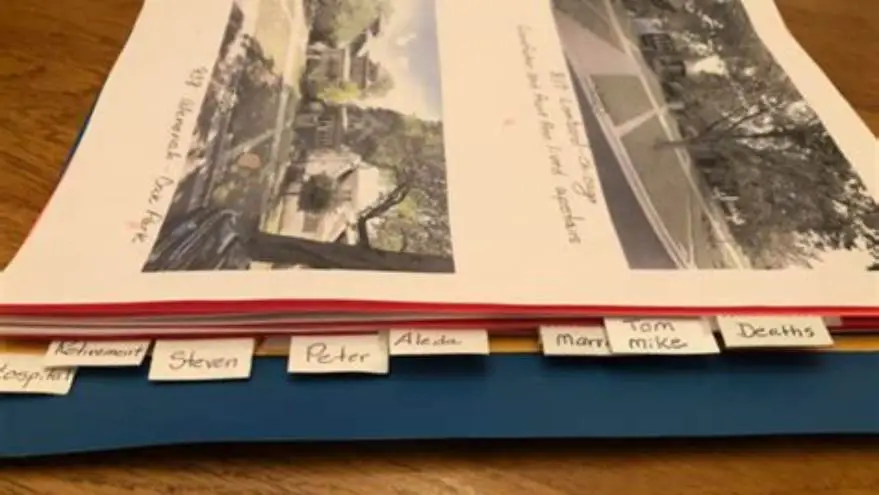
A memory book is a small book of a person's life, made from their photos and their words. Dementia care services call this work life story work. The Alzheimer's Society describes it as a record of important experiences, people, and places, kept as a book, a photo album, or a digital file. It can help a person hold on to their sense of self when recent memories fade.
The book works because it meets the person where their memory still lives. Long-term memories often stay reachable longer than recent ones, so childhood homes, school days, first jobs, and weddings usually bring more talk than last week. Photos of a wedding or a first home can open a conversation that a question never would. Something to hold, point at, and return to: that is what the book gives the person.
Carers and family gain from it too. New carers can learn in minutes what the person likes to be called, what calms them, and who matters most. Family can use it on visits when talk runs dry. This is not a test and not a treatment, but a shared object built for comfort and company.
How to make a memory book for seniors with dementia in six steps
Start on a good morning, when the person is rested and calm. Bring a box of photos, a pen, and a binder or a simple album. Sit side by side, not across a table, so you both look at the same page. Ask plainly if they would like to make a book of their life together. When the answer is no, the answer is no. Come back another week with a smaller ask: one photograph, one story. If that sounds like your situation, read up on dominoes activity for seniors with dementia next.
Work in short sessions at their best time of day, often the morning. One topic and twenty to thirty minutes is enough; stop while the mood is still good. Tiredness shows up as restlessness or silence, and pushing on turns a pleasant hour into a chore. Short sessions keep the book growing at a pace the person can follow, with time to rest between topics.
Let the person choose what goes in. Spread the photos out and watch which ones they reach for. Write down what they say in their own words, even when the details differ from the family version. Their version is the one that belongs in the book. Pages the person chose will get looked at; pages chosen for them may not.
- Photo box: the prints to choose from.
- Pen and labels: for names, dates, and captions.
- Binder or album: pages that open flat.
- Sleeves or laminator: to keep pages sturdy.
- Scanner or smartphone: for copies and reprints.
- Ask if they want to make a book together.
- Gather photos from their earlier life first.
- Pick one photo for each page.
- Caption each page in their own words.
- Label every face with a name and a relationship.
- Put the pages in a binder and keep it within reach.
What to put on each page
One photo per page is the rule that matters most. One clear photo with a short caption is easier to look at than a busy collage. That leaves room for a finger to point. Choose photos that are in focus and show faces clearly. Favour moments of joy: celebrations, pets, favourite places, hobbies, and old friends. Crowded scenes where it is hard to tell who is who belong in the family album, not in this book. People in this spot often ask about word search for seniors in memory care as well.
Write the caption under the photo in the person's own words. Captions that carry their voice work better than bare labels. Which sister stood on the left, what she was known for, why the day mattered. Add the name of every important face and how they are related, with the year when you know it. Names help a carer join the talk, and dates help them place the memory. A good caption has two lines: one that names the people and the place, and one in the person's own words about the day. 'Me and Ruth at the seaside' does the first job; 'We went every summer, rain or shine' does the second. A bare date and place, 'Beach 1962', does neither.
Print captions at 24 pt or larger, in black on white, and check them at arm's length. Pages that read easily get read often. When stories run dry, the conversation cards in our Gentle Minds Activity Kit give ready prompts to try together. Keep the pages sturdy: laminate them or slip them into plastic sleeves, and hold the book in a ring binder that opens flat. Copy the table in this section as your page plan: one photo, one caption, one set of labels.
| Page part | What goes there | How much |
|---|---|---|
| Photo | One clear photo, faces in focus | One per page |
| Caption | Their own words about the day | One or two lines |
| Labels | Names and relationships | Under every face |
How to use the book day to day
Keep the book where the person can reach it: on a bedside table, a lap tray, or a shelf at eye level. Books that live in cupboards do not get used. Bring it out on visits, in quiet afternoons, and in the restless hour before evening, when familiar faces can settle the mood. Let the person open it and turn the pages themselves. Within reach, it gets opened without asking. There is more on how to start a puzzle club for seniors with dementia in a separate guide.
Follow their lead. Point to a photo and wait for them to speak, instead of asking who is in it. Open questions work best: 'Tell me about this day.' Never correct their version of a story, and never quiz them on names. The goal is talk and comfort, not a right answer. When they tire, close the book and come back tomorrow.
Some pages may bring back sad or difficult memories. Stay with the person, let them talk about it when they want to, and take a break when they need one. Leave out any page that upsets them, and do not put it back without asking. Pages that cause distress have no place in a book made for comfort.
What to leave out, and when to stop
Not every photo belongs in the book. Leave out pictures of people the person no longer recognises with pleasure, and any image that brings confusion or distress. Leave out recent photos that highlight what has been lost. The book looks back to stronger years, and recent pages can wait for a short final section. When in doubt, ask the person, and trust a no. Trust the person's own reaction over the family's hopes for a page.
Many hands will hold this book: family, friends, care staff, and visitors. Private stories, family rows, and medical details stay out. That first page can carry the person's wishes in plain words: what to include, what to leave alone, and who may look.
Stop when the book feels finished, not when it feels full. Fifteen to twenty-five pages is a good length: short enough to finish in one sitting, long enough to hold a life. Books that never end never get read. New photos and stories can join later, a page at a time, when the person wants them there. Short books get read; long ones sit on the shelf.
Keep the book going: copies, updates, and sharing it with carers
Make a second copy when the first one starts to wear. Keep a copy at a daughter's house or in the care home, so the book is there when the person needs it. That helps even when the original is not at hand. Scan the photos before you print them, and keep the originals in a labelled box. Scan prints on the scanner's photo setting, or photograph them flat in daylight, so faces stay clear when enlarged. Scans also let you reprint a page that gets torn or stained.
Share the book with the care team. Show new carers the first page, which works like a 'This is me' sheet. That page lists what the person likes to be called and how they take their tea. What they did for work, what calms them, and what they are proud of all go on the same page. Carers who read that page first start the visit on the person's terms, not on a chart.
Update the book a page at a time. Add a new photo after a family visit, a birthday, or a good afternoon together. Take out pages that no longer suit, and ask before you add any. Ready-made large-print activities give carers something to do with the person after the book is finished. Our Gentle Minds Activity Kit is made for that reader. It does not build the book itself: that part still needs the person's own photos and words. It stays theirs as long as they keep choosing what goes in it.
Still wondering?
Can I make a memory book for someone who can no longer speak much?
Yes. Choose the photos together, watch which ones they linger on, and write the captions yourself from what you know of their life. It still works: they can point, smile, and turn pages, and carers can use it to start talk. Keep captions short and faces labelled.
What if my parent gets upset looking at old photos?
Stay with them, let them talk about the feeling when they want to, and take a break. Leave that page out for now, and do not put it back without asking. Some memories are sad even when they are precious, and the book should bring comfort first.
Should a memory book be in order from childhood to now?
Most families find chronological order easiest to follow, from childhood through school, work, marriage, and family life. Recent photos can come last, in a short final section. What matters more than order is that the person can find the pages they love without hunting.
Can I make a memory book on a tablet instead of paper?
Digital works when the person enjoys screens, and it can hold photos and recorded voices. Paper still suits most readers better: it opens flat, needs no charging, and survives a drop. Make the paper one first, and add a digital copy when the family wants one.