How to Play Dominoes with Seniors with Dementia
Dominoes suits seniors with dementia because the game is familiar, the matching is visual, and the tiles feel good to handle. Play a simple version with large tiles, no score, and short rounds that end while everyone is still enjoying the game.
On this page (8 sections)
- Quick recap
- Why dominoes works for a person living with dementia
- How to play dominoes with seniors with dementia
- Which domino set to buy for low vision and shaky hands
- How to simplify the game when the usual rules are too much
- How long to play, and how to end on a good note
- Mistakes that turn a friendly game into a chore
- Still wondering?
Part of our guide on large print flashcards for seniors with dementia
Key figures
- Tiles in a set
- 28 in a double-six set
- Tiles per player
- Seven, in a two-player game
- Best set
- Jumbo, colour-coded dots
- Score
- None needed
- Players
- Two to four at a table
- Session
- Short, end on a high note
Quick recap
- Use large tiles with clear dots, on a plain table in good light.
- Use a rack or holder when hands shake.
- Start with a few tiles and add more only if the game flows.
- End while everyone is still enjoying it, not when the tiles run out.
Why dominoes works for a person living with dementia
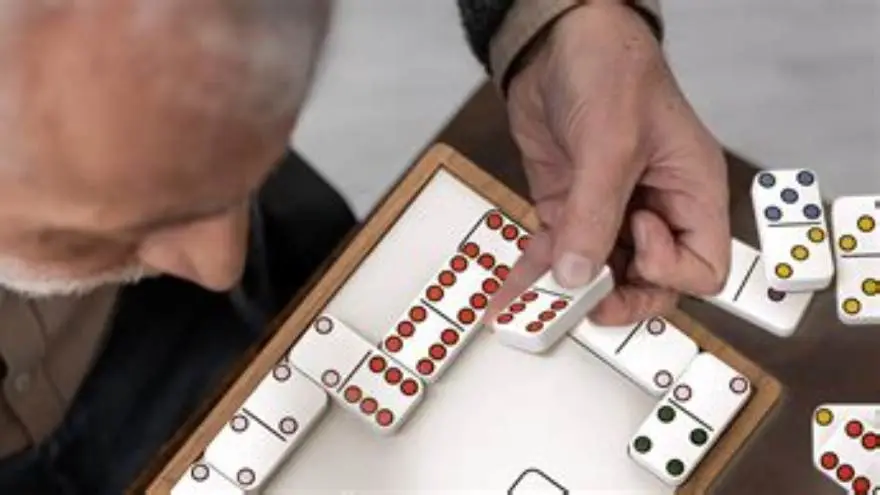
Most older adults learned dominoes long ago, and that familiarity is its strength. Matching a tile takes recognition, not recall, and the dots are plain to see. Hands do the work: pick up a tile, turn it over, lay it down. Nothing on the table asks for a new rule or a fast answer. Games move at the speed of a chat, and the chat is half the point.
Games that ask for memory fail the moment the rules slip away. Dominoes asks for matching instead, and matching is a simpler job than remembering a score. Look at the open ends, find a tile with the same number of dots, and play it. Each turn is one small decision, and the last turn does not depend on the first. Forgetting the score changes nothing: the next tile still plays. That is why the game still works when other games stop working.
Tiles themselves help. They are heavy enough to hold, smooth to turn, and easy to see on a plain table. Larger sets make the dots bigger still, and colour-coded dots let a player match by colour when counting feels hard. Wood clicks mark each turn without a word. Hands, eyes, and ears give a person several ways in, and several ways to stay.
How to play dominoes with seniors with dementia
Set the table before the game starts. Plain cloth or bare wood shows the dots clearly, and a bright lamp from the side beats a light from above. Lay out a standard double-six set, which holds 28 tiles, and turn them face down for the shuffle. Each player takes seven tiles and stands them on edge, or lays them face up in a row. Set the rest of the tiles to one side as the boneyard. Before you commit to anything, it is worth looking at puzzle club for seniors with dementia.
Play starts with the highest double, or with any tile if the group agrees. Players take turns laying a tile against a matching open end, and the row grows across the table. With no matching tile, a player draws from the boneyard until one fits, or passes if the group plays that way. Rounds end when one player has no tiles left, or when nobody can play. Skip the score and start a fresh round, or stop while the game still feels good.
Two to four players suit a table best. Two players get a quiet game with time to talk, and four players make a livelier table. More than four means long waits between turns, and long waits lose people. Small groups keep nobody sitting idle for long. Two players and a cup of tea often make the best game of all.
- Shuffle the tiles face down and each player takes seven.
- Stand the tiles on edge or lay them face up in a row.
- Start with the highest double, or any tile the group agrees.
- Take turns matching a tile to an open end of the row.
- Draw from the boneyard when no tile fits, or pass.
- End the round when one player has no tiles left.
Which domino set to buy for low vision and shaky hands
Sets matter more than rules. Jumbo tiles are larger than standard ones, with dots big enough to see at arm's length. Colour-coded dots help a player who finds counting slow: match by colour as well as number. Tile holders or racks keep the tiles upright, so a player with shaky hands does not chase them across the table. Heavy tiles stay put better than light plastic ones, and a plain table shows the dots best. We cover simple card games for intergenerational play in its own article.
Buy the set from a shop that lists the tile size, not just the word jumbo. Jumbo means different sizes at different shops, so check the measurements before you order. Sets that list tile length in inches or centimetres tell you what you are getting. If the listing gives no size, the tiles may be standard after all. Wooden tiles feel nicer in the hand, but plastic wipes clean after a spill. Either works if the dots are clear.
Racks and holders are worth having if hands shake or grip is weak. It holds the tiles upright and leaves both hands free to choose. Wooden racks from a game shop do the job, and a folded piece of card works as a stand-in. Clear the table of cups and clutter so a knocked tile does not vanish under a plate. Good light from the side helps more than any gadget.
| Set | Tiles | Best for |
|---|---|---|
| Standard double-six | Small tiles | Players who know the game |
| Jumbo double-six | Same count, larger tiles | Low vision and shaky hands |
| Colour-coded set | Dots in colours | Matching by colour, not counting |
How to simplify the game when the usual rules are too much
When the full game feels hard, change the game, not the player. Start with matching only: lay the tiles face up and take turns placing one against a matching end. Drop the score, drop the boneyard, and drop any rule that causes a pause. Players who place the last tile win, or nobody wins and the game is the placing. Games with no loser are games everyone can enjoy. The other half of this decision is memory book for elderly.
Fewer tiles make an easier game. Start with three tiles to match, and add more only when the game flows. Three is a good number for a first try, since the choice stays small and the turn comes round fast. Players who match three tiles with ease can try six next time. Helpers can hold the spare tiles and hand them over one at a time. Small steps keep the game friendly.
Colour matching is the simplest version of all. Use a colour-coded set and match the colour of the dots, not the number. Players who find counting hard can still play a full game this way. Sorting works too: tip the tiles out and sort them by number or colour, then put them away in order. Building works as well: stand the tiles in a row and knock the first one over. Each of these still counts as playing. When dominoes is done for the day, our own Gentle Minds Activity Kit offers more printable activities at three levels for the same reader. It is a printable kit, so the activities need printing before they can be used.
How long to play, and how to end on a good note
Short games work best. Rounds with two players often end in a few minutes, and three short rounds feel better than one long one. Watch the player, not the clock: restless hands, sighing, or tiles pushed aside mean the session has run long enough. Quit while the game still feels good. Leave the tiles out between rounds so the next game starts without a fuss. The other half of this decision is seniors word search in memory care.
Endings stay simple. Say the game is done, name the winner if there is one, and put the tiles away together. Putting the tiles away is part of the game, not a chore after it. Sort them by number, stack them, and slide them into the box. Small rituals at the end give the session a clear finish. Everyone leaves the table with a good feeling, not a sense of being beaten.
If the game goes badly, change it rather than pushing on. Losing badly calls for a change: sort the tiles instead, or build a long row to knock down. Helpers can join in without keeping score, and the game becomes a shared pastime rather than a contest. Nobody needs to win for the afternoon to go well. Tiles, table, and company are the point.
Mistakes that turn a friendly game into a chore
Correcting every wrong tile turns a game into a lesson. Being corrected stops the play: a player waits to be told what to do instead of choosing a tile. Let a wrong tile sit, or suggest another tile with a light word. Nobody is keeping a mark, so a wrong tile is just a tile. Relaxed tables play longer than correct ones.
Keeping score causes trouble when losing hurts. Some players love a score and play better for it, and they should keep one if it makes them happy. Others go quiet after losing twice, and the game stops being fun. Winners can be the person who played the last tile, or nobody at all. Fun is the score that matters.
Too many tiles on the table confuse the eye. Full sets spread out look busy, and a busy table hides the open ends. Play with fewer tiles, or keep the spare tiles in the box until they are needed. Noise hurts too: turn the television off and give the game the table to itself. Quiet, light, and a clear table make the game easy to follow.
Still wondering?
Can a person with dementia still learn dominoes?
Older adults usually know dominoes from years ago, so there is little new to learn. If the game is new to them, start with matching only and skip the scoring. Someone who has never played can still enjoy sorting and lining up the tiles.
What if they forget the rules halfway through?
That happens often, and it does not matter. Play openly, with tiles face up, and suggest the next tile when they pause. The company matters more than the rules. If frustration shows, switch to sorting the tiles by number or colour.
Is Mexican Train a good version for a group?
Mexican Train works well for three or four players who know the game already. It uses a double-twelve set and a central hub, which adds pieces to manage. For a first game with dementia, the plain double-six version is simpler. Small groups mean nobody waits long for a turn.
How do I know when to stop the game?
Watch for yawns, wandering hands, or a player who stops looking at the table. Those signs mean it is time to stop. End with a warm word and put the tiles away together. An ending that feels good is one they will want to repeat.