60s trivia for seniors: ask the artist, skip the release date
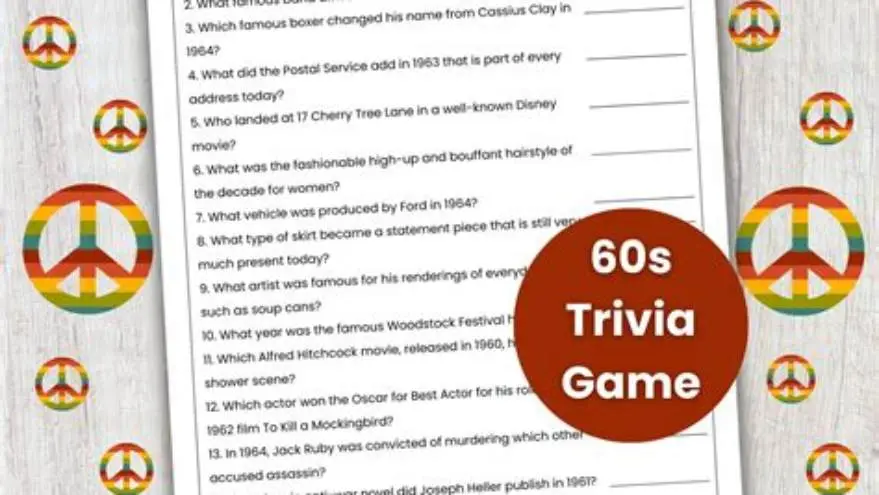
Good 60s trivia for seniors with answers asks for the singer, the show or the object, and never for a year or a chart position. Two ready rounds below follow that rule, with ten music questions and ten general questions, and the answers kept on a separate page.
On this page (8 sections)
- Quick recap
- 60s trivia for seniors with answers starts with the performer, not the date
- Warm-up round: name the singer
- Television, prices and everyday objects: a general 60s round
- Which 60s references are too obscure now
- How to print the sheets so everyone can read them
- How to run the session so nobody feels put on the spot
- Still wondering?
Part of our guide on crossword puzzles seniors large print
Key figures
- Music round
- 10 questions, answers are performers
- General round
- 10 questions, TV, prices, objects
- Team size
- Two or three people
- Answer key
- Own page, kept by the host
- Price answers
- Nearest guess wins
- Reading
- Each question read twice
Quick recap
- Test each question on one person from the group before you print it
- No printer at home? A tablet the team can see, or a hand-written sheet, still runs the round.
- Let teams talk before they answer; a shared answer beats a fast one
- Drop a question the room cannot attempt, even with choices offered
- Close with music, and let the scores go.
60s trivia for seniors with answers starts with the performer, not the date
Several people in the room should be able to attempt a question. The singer of a hit, the show a family watched together, the price of a loaf: these sit in shared memory. A team can talk its way to the answer from any of them. Dates and chart spots sit in one person's notebook, while the rest of the room goes quiet.
That silence is the test. If only the group's keenest fan could answer, the question belongs in a specialist quiz, not a friendly round. Swap it for the person, the tune or the scene behind the fact, and the same knowledge becomes something the whole table can reach.
Every round below follows that rule. Music questions ask for the performer. Television questions ask for the show or the character. Price questions ask for a nearest guess, because what a loaf cost depended on the town and the shop.
Try the swap on any question you already own. Keep the song or the show from a date question, and ask who sang it or what happened next. Most questions survive the swap, and the ones that fail it were never fair. We cover food trivia for seniors without hints in its own article.
| Question type | Example | Why it works or fails |
|---|---|---|
| Performer | Who sang 'Respect'? | A voice the room knows gives everyone a chance |
| Song title | Finish the line: 'The answer, my friend...' | The lyric invites recall and a singalong |
| Television show | Which show featured a talking horse? | A strange premise sticks in memory |
| Release date | What year did that song come out? | A year shuts out everyone but the detail-keeper |
| Chart position | Where did the single peak? | Only chart followers carry that number |
Warm-up round: name the singer
Start with music, because a tune reaches people before a question does. The ten questions below each name a song and ask for the performer. That voice is one the room heard on the radio for years. Hum the first line if the table stalls, and let the group sing the chorus before you move on.
Accept a surname, a band name or a first name when the meaning is clear. Shared memory is the point, not a spelling test, so a team that says the Beatles for Hey Jude has the point. Mark the answer key after each small group of questions, while the tune is still in the air. If two teams name different performers, hum the opening again and let the room settle it together.
A group that meets every week can lean on our Big Print Trivia for Seniors book instead of building every round from scratch. It hands the host ready questions, and the answers follow each round. Printed books give you their rounds as they are, so local questions still need your own sheet. These two rounds, typed into your own word processor, cost nothing and cover the 60s on their own. Before you commit to anything, it is worth looking at provides two-hint classic film clues.
- Who sang 'Respect'? (Aretha Franklin)
- Who sang 'Hey Jude'? (The Beatles)
- Who sang 'I Got You Babe'? (Sonny and Cher)
- Who sang 'My Girl'? (The Temptations)
- Who sang 'Downtown'? (Petula Clark)
- Who sang 'California Dreamin''? (The Mamas and the Papas)
- Who sang 'The Twist'? (Chubby Checker)
- Who sang 'Stand by Me'? (Ben E. King)
- Who sang 'These Boots Are Made for Walkin''? (Nancy Sinatra)
- Who sang 'A Whiter Shade of Pale'? (Procol Harum)
Television, prices and everyday objects: a general 60s round
This round mixes television, prices, household objects and famous moments. Each question asks for a show, a person, an object or a nearest guess, so nobody needs a date or a chart number to play. Any team that watched the shows and shopped in the shops of the decade can attempt every one. The mix keeps every player in the game, whatever they remember best.
Prices need a different kind of answer, because what things cost depended on the town, the shop and the year. The three price questions below say nearest guess wins, and the answers are rough United States averages for 1960. What things cost where your group lived will differ, so let the nearest guess take the point. Your group can say what the same things cost where they lived, and the stories can run from there.
Objects work the same way as the songs. Rotary dials, record players and milk bottles on the doorstep can start conversations a model number never would. What the thing did, where it sat in the house, and who used it: the answer arrives with a memory attached. There is more on printable rebus puzzles for adults in a separate guide.
- Which show featured a talking horse? (Mister Ed)
- Which family lived at 1313 Mockingbird Lane? (The Munsters)
- Which show starred a witch who twitched her nose to work magic? (Bewitched)
- Which show followed the crew of the starship Enterprise? (Star Trek)
- Nearest guess wins: a gallon of gas in the United States in 1960 cost about how much? (About 31 cents)
- Nearest guess wins: a loaf of white bread in the United States in 1960 cost about how much? (About 20 cents)
- Nearest guess wins: a first-class stamp in the United States in 1960 cost how much? (4 cents)
- Who was the first person to walk on the moon? (Neil Armstrong)
- Which president was assassinated in Dallas in 1963? (John F. Kennedy)
- What did people turn to dial a number before push-button phones? (A rotary dial)
Which 60s references are too obscure now
Some 60s names faded even for people who lived through the decade, and those are the questions to cut first. B-sides that radio rarely played will stump a room that knows every word of the hits. So will a song that charted once and vanished, or the backing singer on a famous record. Questions that need a hint to work at all do not belong on the sheet.
Television has the same trap. Guest stars from one episode, minor characters and exact episode titles will stop a good round cold. Name the show, the family or the premise instead, and keep the question on something the whole household watched together. Presenter names matter less when the show itself is the memory.
Check the geography of a question, too. Shows that aired only in one region will leave half the room out. So will a price from another country, or a product sold only in one chain. Ask one person from your group to try each question first. Cut the ones they cannot attempt, and keep the ones that start a conversation. The other half of this decision is answers for daily themed crossword.
- B-side or backing singer: the room knows the hit, not the credit
- Exact episode title: ask for the show instead
- One-region show or price: half the room has no way in
- Needs a hint to work: cut it or offer choices
How to print the sheets so everyone can read them
Print a test page first, hold it at arm's length, and read it under the light of the room where you will play. If you squint or lean in, print larger and test again. Eyesight, lighting and paper all change what reads well, so the test page matters more than any fixed size.
Plain layout works best: black text on white paper, one question per line, a single column, and wide margins so thumbs never cover the words. Number the questions and leave space for a team to write its answers beside them. Crowded sheets slow the game down before the first question is read. Leave a blank line between questions.
Put the answer key on its own page and keep it with the host. Print it last, after the question sheets, so it never slips into the team pile by mistake. Your local library is the first place to ask if you need a printer. Staff there print for visitors every day and can show you how to enlarge the type. Check what a page costs before you print a stack. No printer nearby? A tablet the team can see works, and so does a hand-written sheet. Print the answer key at the same size as the questions. We go through how to play missing vowels puzzle step by step elsewhere on the site.
How to run the session so nobody feels put on the spot
Form teams of two or three, and let each team choose its own name. Small teams spread the memory load. Never direct a question at one person by name; ask the team, and let the talk inside the team do the work. Two players make a good team at home, and three suit a larger room. A team name gives strangers a laugh before the first question.
Leave the buzzer in the cupboard. Racing to answer first rewards the quickest voice, not the best memory, and puts quiet players off the game. Take answers team by team, score quietly if you score at all, and let a close score go without a fuss. The room stays warm when nobody is racing. Some groups drop scoring altogether and enjoy the quiz more.
For a group where memory is fading, keep the same questions and change the help, not the subject. Offer three choices, let players look at a song list, or allow a phone-a-friend call to someone in the room. Shared afternoons are the aim, not tests, and the same rounds work when the help fits the players.
- Print one question sheet for each team.
- Form teams of two or three and let each team pick a name.
- Read each question twice, then give the teams time to talk.
- Take answers team by team and mark them quietly.
- Finish with a tune the whole room can sing along to.
Still wondering?
How many questions should I print for one session?
One round of ten, with a second round to follow, is plenty for most groups. Stop when the room tires rather than pushing through a fixed count. Short sessions people enjoy beat long ones they endure.
Should I offer prizes?
Small shared prizes, such as biscuits for the table, keep the contest friendly. Conversation should matter more than winning, so hand the prize to the table rather than one winner. Shared treats end the afternoon better than trophies do.
What if someone gets an answer wrong?
Move on kindly and invite other views from the team. Where the answer varies by region, accept the explanation rather than forcing one version. Nobody should feel corrected in front of the room.
Can I run this with two people at home?
Yes, and it works well with two. Read in turns, use open-book play, and skip scoring if the quiz feels too formal. Two players can work through both rounds at their own pace.
How do I adapt questions for mixed abilities?
Offer choices or a picture prompt to anyone who wants help, and give everyone the same question. The subject stays the same for the whole room; only the help varies. Photos of the object, or a printed list of singers, can open a question that words alone would close.
Should I ask about famous historical events?
Pick an event people watched or heard about together, such as the first walk on the moon. Keep the question on the person or the moment, not the exact date. Shared memories make better questions than history lessons do.
Ready to try it? It gives a regular group ready large-print rounds with the answers after each round, so the host never has to format a sheet.
Get the printable trivia book