Two-hint classic movie trivia for seniors: answers without guessing
Movie trivia for seniors works best with two clues: start broad, then narrow the choice. Print questions in 18-20 point type as a starting point, test readability with your group, and enlarge the text for readers with low vision.
On this page (8 sections)
- Quick recap
- Why movie trivia for seniors works better with two hints
- How to pick the decade and films by the group's own era
- What makes a two-hint question work
- Large-print layout: font size, spacing and the answer key
- Running it without turning it into a test
- A ready two-hint sample set with answers
- Still wondering?
Part of our guide on large print crossword puzzles for seniors
Key figures
- Font size
- Large type, adjust as needed
- Layout
- One column, one question per line
- Hints per answer
- Two
- Round length
- 8-10 questions
- Answer key
- Separate page
- Best film era
- The group's own era
Quick recap
- Give every answer two hints: a broad clue first, then a narrowing one
- Work backwards from birth years to pick the decade
- Print in 18-20 point type, one question per line, answer key on its own page
- Run it with no scores: ask 'did you see it?' instead of 'who was right?'
- The same two-hint format adapts to TV shows and picture rounds
Why movie trivia for seniors works better with two hints
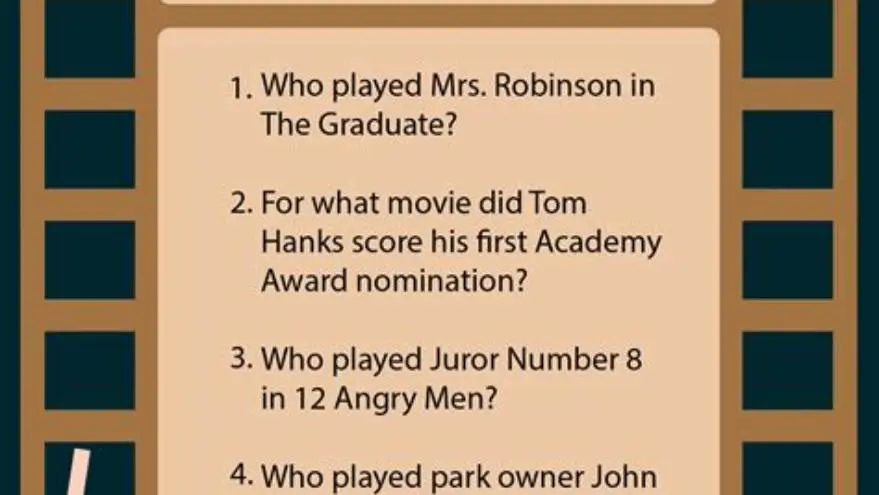
Most trivia sheets fail older adults for a simple reason: they ask for recall. ‘Name the film where Humphrey Bogart plays Rick Blaine’ demands that someone pull a title out of thin air. A clue changes the job from pulling a title out of thin air to spotting it in a short list. That is what the two-hint question does: the first clue narrows the field, and the second names the thing to spot.
Each answer gets two clues: the first is broad, like the era, genre, or star. The second narrows down to a plot point, song, or famous line. Somewhere between the two clues, the film clicks. Nobody guesses blindly, and nobody feels tested.
Standard sheets also fail because they are hard to read. Small type, columns, cramped spacing turn a fun question into an eye-strain test. Large print is not a luxury; it lets people join in instead of handing the sheet back.
| Feature | Recall question | Two-hint question |
|---|---|---|
| What it asks | Pull the title from memory | Spot the title from clues |
| First clue | Often absent | Broad: era, genre or star |
| Second clue | None | Narrowing: plot or famous line |
| How it feels | Like a test | Like reminiscing |
How to pick the decade and films by the group's own era
Pick films based on when the group members were young moviegoers. Start with the films the room names when you ask what they saw as teenagers. Build the list from their answers, not from a best-films list. A title the room chose beats a title a list chose. We cover daily themed crossword answers all levels in its own article.
Work backwards from birth years. A group in their late eighties was born around 1940, so their teenage years fell in the 1950s: musicals, Westerns, and film noir. A group in their late seventies was born around 1950, so their teens fell in the 1960s. Younger residents may connect with the 1970s and 1980s. Mixing decades works in families, but in care settings, matching the decade to the group makes trivia spark real conversation.
A quick way to build a list: pick per decade a musical, a Western, a romance, a comedy, and one film the room knows well. Five decades, five genres, twenty-five films: enough for two full rounds with spares. For images, use publicity stills and posters in the public domain. Borrow the films from the library DVD shelf, or stream them at home before the round, so stills and clips are ready.
- 1940s births, 1950s teens: musicals, Westerns, film noir
- 1950s births, 1960s teens: Hitchcock, Hepburn, musicals
- 1960s births, 1970s-80s teens: blockbusters and TV crossovers
What makes a two-hint question work
The formula is strict and important. Hint one is broad and places the answer in a wide category. Hint two narrows to a single answer. If you reverse this order, questions either give themselves away or leave people stuck. Broad then narrow gives the solver somewhere to start. People in this spot often ask about trivia for seniors as well.
Compare this example. Bad: ‘What film features a boat called the Orca?’ – a narrow clue first. If they don’t know it, there’s nowhere left to go. Good: ‘Hint one: a 1970s adventure film shot at sea. Hint two: a small boat hunts a very large fish.’ Most will name Jaws before hint two ends.
Avoid two-hint questions that confuse or frustrate. For example, a bad two-hint question might say first ‘A horror film with a killer shark’ and second ‘The shark is called Bruce’. That second hint offers no new help. Most know the shark’s name only if they already know the film. Another failed example pairs ‘A musical set in Paris’ with ‘The lead sings I Dreamed a Dream’. That second hint is too narrow for anyone unfamiliar with Les Misérables, so the question is unfair.
Use clues the group would have met at the time: poster taglines, hit songs, famous lines, or the star’s top roles. Test each question on someone younger than the group: if they get the answer from hint two alone, the question works. We go through 60s trivia for seniors with answers step by step elsewhere on the site.
| Part | Job | Example (Jaws) |
|---|---|---|
| Hint one | Broad: decade, genre, setting | A 1970s adventure film shot at sea |
| Hint two | Narrow: plot, line or song | A small boat hunts a very large fish |
| Answer | Spotted from clues | Jaws |
Large-print layout: font size, spacing and the answer key
If the sheet is hard to read, nothing else matters. Test the type on the weakest eyes in the room, and increase to 24 point when several people mention eye strain. Use a plain, wide-lettered font, avoid decorative serifs and never use italics. Print black on white or cream paper; coloured paper reduces contrast and blurs letter shapes.
Keep one column, one question per line, and wide gaps. Avoid two-column layouts; they cause readers to lose their place. Leave a blank or wide line after each question so eyes don’t jump ahead. Keep hint one and hint two on separate lines, labelled clearly. This helps listeners follow when you read aloud.
Put the answer key on its own page in the same large print. This lets people check answers afterwards, and prevents accidental spoilers in group play. Number questions and answers so a helper can read answers out easily. There is more on letter bank puzzle 6x9 page in a separate guide.
- Large type throughout; increase for low vision
- Single column, one question per line, wide gaps
- Answers on a separate numbered key page
- Black on white or cream: no coloured paper
Running it without turning it into a test
No scores is the rule here. Instead of keeping tally, treat questions as conversation starters. Read hint one, pause. Read hint two. When someone names the film, say ‘did you see it when it came out?’ This question opens reminiscence, which is the real activity.
Read every question aloud and show it on the sheet. Hearing and reading together help people with different abilities join in. Ask for answers from the group, not by raised hands. If silence follows hint two, offer a third, softer clue: the star’s initial or the first word of the title. Silence is not failure; it means the hint needs help. A hummed theme song or a short clip works as an extra hint when the printed clues are not enough.
One-on-one sessions work even more gently. Sit with one sheet, read hints slowly, and allow long pauses. With memory loss, someone might hum a theme song or name a star without naming the title. Count that as a win and follow it wherever it leads. Never say ‘you should know this.’ Keep rounds to eight or ten questions. Stop while it’s still fun to bring people back next time. For the detail, see our notes on printable and online word games.
A ready two-hint sample set with answers
Here is a ten-question sample round spanning the 1930s to the 1960s, written with broad hint first, narrow hint second. Read hint one, pause, then hint two. Answers are below in the same numbered order, so you can keep the questions facing the room and the key in your hand.
Note the clues: famous lines, hit songs, unforgettable endings. These are things the group would have heard even if they never saw the film. Every hint should be something the group encountered at the time, not a detail only cinephiles know.
Once you learn this format, you can swap films for TV shows or use picture rounds. Hold up a still as hint two while speaking the broad hint first. The structure stays the same; only the subject changes.
- 1. A 1940s wartime romance set in Morocco / a café owner must choose between love and helping a couple escape: Casablanca
- 2. A 1960s Technicolor musical about a singing family in Austria / a governess leads seven children in song: The Sound of Music
- 3. A 1950s romance about a princess and a reporter in Rome / a daytime escape and a night-time scooter ride: Roman Holiday
- 4. A 1952 musical about silent films turning to sound / a man splashes happily in a rain puddle: Singin' in the Rain
- 5. A 1946 black-and-white Christmas film / a man learns what his town would be like without him: It's a Wonderful Life
- 6. A 1960 black-and-white thriller directed by Hitchcock / a famous shower scene at a motel: Psycho
- 7. A 1939 epic romance set in the American South / a strong-willed woman clashes with a proud man: Gone with the Wind
- 8. A 1959 epic about a Jewish prince / a famous chariot race: Ben-Hur
- 9. A 1956 film about a princess lost to history / a lost Russian grand duchess claims her identity: Anastasia
- 10. A 1967 crime drama about two outlaws / a roadside ambush ends the chase: Bonnie and Clyde
| No. | Answer | Star to name if stuck |
|---|---|---|
| 1 | Casablanca | Humphrey Bogart |
| 2 | The Sound of Music | Julie Andrews |
| 3 | Roman Holiday | Audrey Hepburn |
| 4 | Singin' in the Rain | Gene Kelly |
| 5 | It's a Wonderful Life | James Stewart |
| 6 | Psycho | Anthony Perkins |
| 7 | Gone with the Wind | Vivien Leigh |
| 8 | Ben-Hur | Charlton Heston |
| 9 | Anastasia (1956) | Ingrid Bergman |
| 10 | Bonnie and Clyde | Faye Dunaway |
Still wondering?
How many questions should a round have?
Eight to ten questions fill a round without dragging. That count leaves room for the talk each question starts, and it ends while people still want more.
What if nobody can answer a question?
Add a third, softer clue: the star's first name or the first word of the title. If it still falls flat, simply give the answer and move on. You might say, ‘worth seeing again, if you ever fancy it.’
Is this suitable for someone living with memory loss?
Yes. The two hints do the hard work: the first narrows the field, and the second names the thing to spot. Accept any sign of connection (a hummed song, a star's name, a story about the cinema) as a successful answer.
Can I make my own sheets without buying anything?
Absolutely. A word processor set to 20 point type, one column, will produce a perfectly good sheet. Paid options save time but aren’t necessary.
How do I turn this into a picture round?
Treat one publicity still per question as hint two, with your spoken broad clue as hint one. Public-domain stills are available on Wikimedia Commons and the Library of Congress websites.
Ready to try it? It provides ready-made large-print trivia rounds with answer keys and host sheets, so you skip formatting and question writing.
Get the printable trivia rounds