Missing vowels puzzles: the step-by-step rules to play and check answers
Step through how to play missing vowels puzzles, from spotting missing vowels to filling and checking answers, ideal for large-print puzzles with seniors.
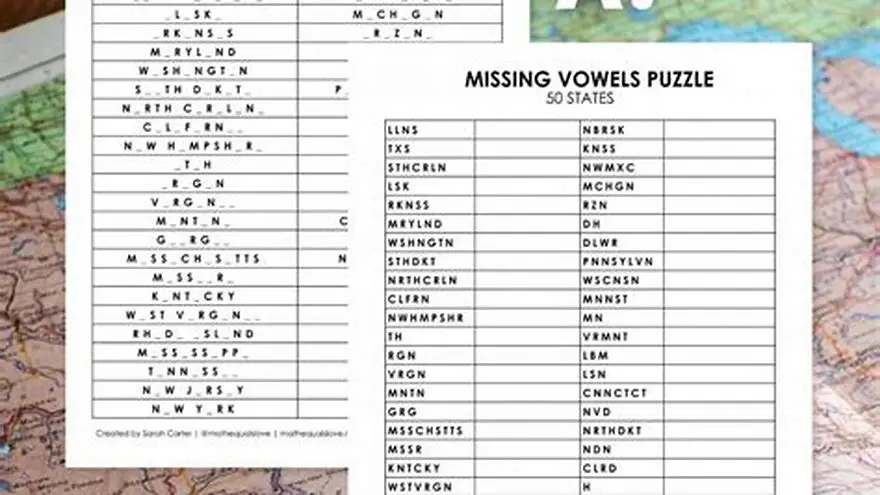
To play missing vowels puzzles, identify words with vowels replaced by blanks or missing letters, fill in the correct vowels to form valid words, then verify answers by checking against a known word list or answer key.
On this page (8 sections)
- Key takeaways
- What is a missing vowels puzzle and how do you start playing?
- How to identify missing vowels in words
- How to fill in vowels correctly in missing vowels puzzles
- How to verify answers when playing missing vowels puzzles
- When and why to use digital tools to create or check missing vowels puzzles
- Missing vowels puzzle how to play: step-by-step gameplay and checking answers
- Questions people still ask
Part of our guide on puzzles tailored for seniors
Clear step-by-step rules show how to fill missing vowels and check answers for easy, large-print word puzzles.
| Common vowels | A, E, I, O, U |
|---|---|
| Word length range | 3-10 letters typical |
| Print size | 16-24 pt large print |
| Verification method | Answer key or dictionary |
| Puzzle type | Fill-in vowels only |
Key takeaways
- Missing vowels puzzles hide only vowels in words.
- Players fill only the missing vowel letters, keeping consonants intact.
- Verification requires checking words against a dictionary or answer key.
- Understanding vowel patterns helps avoid common mistakes.
- Manual checking is effective but digital tools speed up puzzle creation.
What is a missing vowels puzzle and how do you start playing?
A missing vowels puzzle presents words with all vowels removed, leaving only consonants visible. You start by closely inspecting the consonant clusters to guess the full word. For example, 'PLN' might become 'PLAN' after adding the missing vowel 'A'.
Words in these puzzles usually range from 3 to 10 letters, depending on the difficulty. The challenge lies in mentally restoring the vowel sounds that complete the word meaningfully. Consonant patterns guide you to figure out which vowels fit best.
To begin, scan each puzzle word for its consonants and think of common vowel combinations that form valid English words. Not all vowels will be used; some puzzles omit 'Y' even when it acts as a vowel. Recognizing common word fragments like 'STR' or 'PL' helps narrow options.
In some puzzles, the context or theme can greatly assist in starting the game. If the puzzle is themed around sports, for example, consonant clusters like 'CRKTBLL' will likely resolve to 'CRICKET BALL'. Recognizing such themes narrows down vowel possibilities and speeds up the solving process. For the detail, see our notes on tools for creating large acrostic puzzles.
Sometimes, puzzles include multi-word phrases rather than single words. For instance, 'CLN DR' might stand for 'CLEANER' or 'CLEAN DRY'. Distinguishing between these requires careful attention to the number of missing vowels and how they fit into the phrase structure. Puzzles often indicate word boundaries to help with this.
How to identify missing vowels in words
You identify missing vowels by spotting gaps or blank spaces where vowels should be. Most puzzles use underscores, dashes, or simply omit the letters entirely, leaving only consonants. Recognize that vowels in English are typically 'A', 'E', 'I', 'O', 'U', and sometimes 'Y'.
Look for consonant groupings that wouldn’t normally stand alone in English. For instance, 'BND' is likely 'BAND' or 'BOND'. The length of the word and the number of missing vowels influence the possible combinations. People in this spot often ask about daily themed crossword answers all levels as well.
Some puzzles provide partial clues, such as the first or last letter included, which helps pinpoint which vowels fit. If the puzzle uses large-print format, missing vowels are often indicated clearly to assist players with visual challenges.
The position of missing vowels can change the meaning drastically. For example, the consonant pattern 'BT' can become 'BAT', 'BET', or 'BIT', each a valid but different word. The player must consider surrounding clues or the puzzle’s theme to select the correct vowel.
If the puzzle includes longer words, multiple vowels may be missing, making identification trickier. A word like 'STRNGTH' could be 'STRENGTH', with vowels 'E' and another 'E'. The length of the word and common vowel groupings like 'EA' or 'EE' often guide correct vowel placement. We go through word games for elderly at home step by step elsewhere on the site.
Pay attention to letter frequency and common English spelling patterns. For example, 'TH' is often followed by a vowel like 'E' or 'I', as in 'THE' or 'THIN'. Such heuristics help to identify which vowels are missing, especially when the consonant sequence is ambiguous.
How to fill in vowels correctly in missing vowels puzzles
After identifying the positions of missing vowels, focus on filling them using common vowel patterns. English vowels tend to cluster in syllables; consider how words sound aloud to select the right vowels.
Avoid randomly inserting vowels. Instead, use letter frequency and word familiarity as guides. For example, short words with a single missing vowel often default to 'A' or 'E', but look for context clues in the puzzle theme or surrounding words.
If you’re unsure, write down multiple vowel possibilities and test each to see if they form legitimate words. Large-print puzzles for seniors might include hints or partial vowel placements to ease this step.
Filling vowels correctly depends heavily on vocabulary knowledge and awareness of English phonetics.
Sometimes puzzles include words where 'Y' acts as a vowel, such as in 'CRY' or 'SKY'. Deciding whether to add 'Y' or a standard vowel requires understanding if 'Y' is functioning as a vowel or consonant in that instance, which adds an extra layer of complexity.
When multiple vowels could fit, try pronouncing the word with each vowel alternative to determine which sounds most natural. For example, 'CLN' could be 'CLAN' or 'CLEAN'; saying both aloud helps choose the correct option based on the puzzle’s theme or logical meaning.
A helpful technique is to look for common vowel pairs and diphthongs like 'EA', 'OI', or 'OU'. Recognizing these common vowel combinations can guide you to the correct vowels to fill in, especially in longer words with multiple missing vowels.
How to verify answers when playing missing vowels puzzles
Verification involves confirming that the filled-in vowels create valid words. The most straightforward method is to compare your answers against an official answer key, if provided by the puzzle source.
If no key is available, use a dictionary or online word lists to check each completed word. This helps catch errors where the inserted vowels form non-words or invalid phrases.
Another manual approach is to read the word aloud; if it doesn't sound correct or familiar, re-examine vowel choices. For large-print puzzles designed for seniors, answer keys often include clear, printed solutions to ease verification.
If you create your own puzzles, tools like BigPrint Puzzle Studio automate answer checking by cross-referencing your word list, saving time and reducing human error.
If you have access to a digital dictionary or word verification software, inputting your completed words can quickly confirm their validity. This is especially useful for longer or more obscure words where manual checking is time-consuming.
Cross-checking answers by using anagrams or rearranging consonants may reveal if the vowels you inserted create valid words. If rearranging letters results in no meaningful word, it signals a possible vowel placement error.
In multiplayer or competitive settings, verifying answers quickly is essential. Using standard dictionaries agreed upon beforehand ensures fairness. Misplaced vowels often result in nonsensical words that stand out, so careful verification avoids losing points or making incorrect guesses.
When and why to use digital tools to create or check missing vowels puzzles
Digital tools help automate the creation and verification of missing vowels puzzles, especially useful if you want to produce large-print puzzles quickly for seniors or sell them as books on platforms like Amazon KDP or Etsy.
BigPrint Puzzle Studio is an example designed for this task. It allows you to generate puzzles with clear, large fonts and automatically creates answer keys. It greatly reduces the time spent manually preparing puzzles and checking vowel placements.
However, not everyone needs these tools. If you're playing puzzles at home or running small activities, manual methods using pencil and paper, dictionaries, and answer sheets work fine. The digital approach mainly benefits activity directors or sellers needing volume and consistency.
The trade-off with digital tools is the upfront learning curve and one-time purchase cost. If you only occasionally handle puzzles, manual methods remain effective and cost-free.
- Speeds up puzzle creation
- Automates answer keys
- Formats for large print
- Suitable for selling puzzles
- Requires initial setup
- One-time purchase cost
- Less useful for casual play
- Not a medical tool
Missing vowels puzzle how to play: step-by-step gameplay and checking answers
Playing a missing vowels puzzle involves a clear sequence: first, identify all the consonant letters displayed and note where vowels are missing. Next, think through possible vowels to fill in based on word length and context. Then, write in the vowels carefully to complete the words.
Once every word has vowels filled in, check your answers using a provided answer key or dictionary to confirm correctness. Errors often come from confusing vowel sounds or inserting extra vowels where none are needed.
This process suits large-print puzzles especially well because the clear letters reduce guessing errors. If you’re an activity director or family caregiver, encourage players to say words aloud to verify plausibility.
Below is a numbered sequence for playing and checking your missing vowels puzzle accurately.
- Examine each puzzle word for consonants and vowel gaps.
- Generate possible vowel options based on English vowel usage.
- Fill in vowels one word at a time, avoiding guesswork.
- Re-read completed words aloud to check for sense and flow.
- Use an answer key or dictionary to verify all filled words.
- Correct any errors found and confirm all words are valid.
Questions people still ask
Can missing vowels puzzles include the letter Y as a vowel?
Usually, missing vowels puzzles focus on the five standard vowels: A, E, I, O, U. The letter Y is sometimes treated as a vowel but is often left as a consonant to keep puzzles simpler for players.
Are missing vowels puzzles suitable for people with memory loss?
Yes, especially in large-print formats, as they support word recognition and cognitive engagement without overwhelming complexity.
Is it better to guess vowels by sound or by dictionary lookup?
Start by guessing vowels aloud to use phonetic clues, then verify with a dictionary or answer key for accuracy.
Can I create my own missing vowels puzzles at home without software?
Yes, by removing vowels from word lists and writing consonants only. However, checking answers manually can be time-consuming.
What common mistakes should I avoid when filling missing vowels?
Avoid inserting vowels randomly or filling all blanks with the same vowel. Use word structure and sound to guide vowel placement.