Rebus puzzles for adults: free printables by difficulty
Search for "rebus puzzles PDF with answers" on puzzle sites and teacher marketplaces, and filter for adult-friendly phrases. Many free sheets are aimed at children, so check the word list before you print. Start at 16 pt and go larger until the page reads easily at arm's length.
On this page (9 sections)
- Quick recap
- What a rebus puzzle is and how adults solve them
- Where to get free printable rebus puzzles for adults
- How to tell easy, medium and hard rebuses apart before you print
- Three worked puzzles you can run today
- Printing tips for large, clear puzzles for older adults
- How to run a rebus session at home, in memory care or a senior center
- Answer-checking etiquette so no one feels stumped or talked down to
- Still wondering?
Part of our guide on large print crossword puzzles for seniors
Key figures
- Easy tier target
- Under 1 minute
- Hard tier target
- 5 to 10 minutes
- Print size to try
- 16 pt, then larger
- Puzzles per page
- 1 to 2
- Group size to aim for
- 4 to 8 per table
- Session to plan
- 20 to 30 minutes
Quick recap
- Match difficulty to the group, not to the puzzle: easy rebuses solve fast, hard ones can stall a whole session.
- Choose PDFs that include a separate answer page so you never solve aloud from the same sheet.
- Print large, one or two puzzles per page, on white paper with strong contrast.
- In memory care, reveal half the answer if a table stalls, and stop the moment it feels like pressure.
- Build a tiered folder: one sleeve each for easy, medium and hard, so you can swap sheets mid-session.
What a rebus puzzle is and how adults solve them
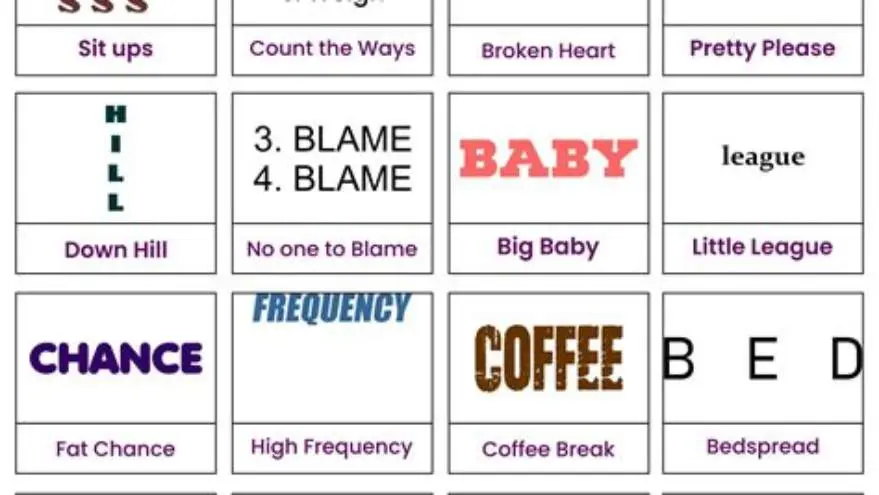
A rebus hides a familiar phrase in pictures and placed words. Write "stand" above "I" and you get "I understand". Print "head" four times with one raised and you get "heads up". Position, size, repetition and colour all carry meaning. Colour can hide an answer too: a red word on a red background fades until you look twice. It can look like nonsense until it snaps into sense all at once.
The habit that solves most rebuses is reading the layout out loud. What is the word? Where does it sit? Is it bigger, sideways, upside down, repeated? Say the visual trick out loud and the answer often follows. Name what you see, then hear what it sounds like.
That shared, visible clue is what makes rebuses work for a table of older adults. Nobody has to recall a fact, so nobody is put on the spot about memory. It sits on the page in front of everyone, and the solving happens out loud together. For people with low vision or memory loss, shared clues give the table something to talk about.
| Trick | Example | Answer |
|---|---|---|
| Position | "Man" above "board" | Man overboard |
| Repetition | "cycle" written three times | Tricycle |
| Size | tiny "talk" | Small talk |
| Direction | "back" written backwards | Backwards |
| Addition or subtraction | "Cat" minus "at" | C |
Where to get free printable rebus puzzles for adults
You have three honest options, and the trade-offs matter before you print. Free puzzle sites come first. Several established puzzle websites and hobby blogs offer rebus pages as downloadable PDFs. Bundles of ten or more often include an answer key at the end. Search for "rebus puzzles PDF with answers" and look at the preview first. Many free sheets are aimed at children. The other half of this decision is 60s trivia for seniors with answers.
Teacher resource marketplaces come second. They lean towards classrooms, but the easy tiers often suit memory care sessions because the clues are simple and the type is reasonably large. Filter for the answer key. Sheets without one will cost you time later. Bundles that look easy on the cover can hide hard idioms inside.
Making your own comes third. Building one needs only a large font and a position trick in any word processor. Put "his" above "story" and you have "history". Homemade rebuses let you personalise: the name of the town, a phrase from the group's shared past. Clues about the group's own life give the table something to talk about.
Before you print in bulk, one more thing: licensing. Most free printables are released for personal or single-classroom use only. Printing a few sheets for a family table is almost always fine. Printing twenty copies every week for a paid programme is a different use. Some creators restrict it or ask for a licence fee. Check the site's terms page for the words "personal use" or "commercial use". When in doubt, ask the creator. We go through word puzzles for adults large print step by step elsewhere on the site.
- Check that the PDF includes an answer page before printing.
- Avoid children's bundles: cartoon art and kid-friendly answers read as patronising to adults.
- Look for bundles of ten or more puzzles, so one download covers several sessions.
- Read the licensing terms before printing for a paid or professional programme.
How to tell easy, medium and hard rebuses apart before you print
Difficulty in rebuses is not about vocabulary. It is about how many steps sit between the picture and the phrase. Grade a sheet yourself in under a minute with three questions. How many tricks does each puzzle use? Does the answer need a pun as well as the visual clue? Would you get it in ten seconds without the answer page?
Easy rebuses use one trick and one common phrase. "STAND" above "I" resolves to "I understand" in seconds, because the position does all the work. Plan on under a minute for an easy rebus. Medium rebuses stack two steps, such as a visual trick plus a wordplay step. Hard rebuses use three or more tricks, or answers that depend on phrasing the group may not share.
Judge it by this rule: a table should be getting roughly half the puzzles unaided. Groups that solve everything instantly should move up a tier. Two puzzles in a row unanswered means drop down a tier. Sort your printouts into three labelled sleeves before the session, so you can swap tiers without leaving the room. It helps to understand crossword puzzles for seniors large print before going further.
| Tier | Tricks per puzzle | Typical solve time | Best audience |
|---|---|---|---|
| Easy | One, no pun | Under 1 minute | Memory care, first-timers, mixed groups |
| Medium | Two, mild pun | 2-4 minutes | Family visits, senior centre clubs |
| Hard | Three or more, layered puns | 5-10 minutes | Confident puzzle fans on request |
Three worked puzzles you can run today
These three examples use only simple position, repetition and size tricks, so they work even if a downloaded sheet falls through. Write each clue on its own line at 24pt or larger. Start with the easiest and let the group find its rhythm.
Puzzle one: the word "MAN" printed on the line above the word "BOARD". Walk the table through reading top to bottom, and the phrase arrives: man overboard. This is a pure position puzzle, so it makes a good warm-up. Point at the top word first, then the bottom one. Let the answer come from the room, not from you.
Second puzzle: the word "STAND" printed above the letter "I". Read it as written and you get "I understand". Some tables need the nudge "read it exactly as it looks", but once someone hears it aloud, it clicks. This is the classic one-trick easy rebus. The other half of this decision is food trivia for seniors.
Third puzzle: the word "cycle" printed three times in a row. Count them together, and the answer is tricycle. Counting tricks work well because everyone can join in, even solvers who find puns difficult. A dozen more in the same style gives you a session that never depends on a download working.
Printing tips for large, clear puzzles for older adults
Rebus puzzles are unusually forgiving to enlarge because they are mostly white space. Unlike a crossword grid, nothing breaks when you scale them up. Begin at 16 pt and go larger until the page reads easily at arm's length. Many readers find 18 to 24 pt comfortable for low vision, but the arm's-length test beats any number. Picture symbols matter as much as the words. Thin, grey graphics call for a fix: raise the print density or trace over the clue with a marker.
One or two puzzles per page beats six. One large puzzle with room to write feels like an invitation; a crowded sheet of a dozen feels like a test. Use plain white paper and set your printer to its darkest normal mode rather than draft. Pages flat on the table under good light matter more than another point of font size. We go through layout for large letter puzzles step by step elsewhere on the site.
For a group, print one copy per person plus two spares. Mark answers on your master copy in bold pen, so you can re-print the set without hunting through the PDF again. Keep a sheet of blank paper at each place. Many adults prefer to sketch their guess rather than say it first.
How to run a rebus session at home, in memory care or a senior center
Every rebus session runs on the same shape. Warm up with two easy ones, then spend the middle on medium puzzles solved as a table. End on one puzzle the group nearly gets, with the answer revealed generously. Plan 20 to 30 minutes as a starting point. Sit with the group, not at a board. The solving happens in conversation, not at a lectern.
In memory care, treat the rebus as a conversation starter, never a test. If a table stalls on a puzzle, give the trick out loud. Say the word is upside down, then ask why it would be upside down. Let someone land the answer. Half the table drifting off means drop to the easy sleeve without comment. Trivia rounds in the same format make good companions on alternate weeks.
Puzzle-book makers for KDP or Etsy should test their generator with a rebus page first. Some tools make rebus pages and some do not. Check before you plan a rebus chapter, so the format does not surprise you.
- Leader's master: one sheet listing each puzzle, its tier, its answer, and how many copies to print.
- Open with two easy rebuses solved together, answers given freely.
- Move to medium puzzles and let the table work each one for a few minutes.
- If a puzzle stalls, move on and come back to it at the end.
- Finish with one hard puzzle revealed as a group effort.
- Leave the printed sheets on the table afterwards for revisiting.
Answer-checking etiquette so no one feels stumped or talked down to
How you handle answers decides whether the session becomes a regular fixture or a one-off. Never read the answer from the same sheet the group is looking at. Print the answer page separately and keep it face down at your end of the table. When a puzzle is solved, ask how they got it. Skip the confirmation. "How did you see that?" gives the solver credit and teaches the table the trick for next time. Praise the method, not the answer: "nice spot on the upside-down word" beats "correct" every time.
When nobody gets one, resist the urge to explain the whole chain step by step, which can feel like a lesson. Say the answer yourself, quickly and lightly, and move on. Puzzles that cost the group five minutes of silence have already cost more than they were worth.
Watch who answers first in mixed family sessions. If the same person solves every puzzle, give the older solvers first refusal on each puzzle. Hand them the sheet to read the clue aloud instead. Never score a memory care session. Tables of people talking are finished sessions, whatever the answer page says.
Rebus puzzles earn their place in a senior activity plan when the difficulty is matched to the table and printed large enough to read.
Still wondering?
Can someone with dementia or memory loss enjoy rebus puzzles?
Often yes, if you stick to the easy tier and keep the mood light. Rebus clues are visible on the page, so nothing depends on recall. Stop the moment it feels like pressure.
How many rebus puzzles should I print for one session?
Plan six to ten puzzles for a 20 to 30 minute session, with a few extra easy ones ready in case the medium tier stalls. Print one copy per person plus two spares.
What font size should I print rebus puzzles at?
Try 16 pt first, then go larger until the page reads easily at arm's length. Because rebuses are mostly white space, enlarging them rarely causes layout problems. Check that picture symbols stay dark and thick after scaling.
Can I print free rebus puzzles for my care home or senior centre?
Usually yes, but check first. Most free printables are licensed for personal or single-classroom use. For a paid programme, look for a commercial-use licence.
Are rebus puzzles suitable for selling in KDP or Etsy puzzle books?
They can be. Test your generator with a rebus page first: if it cannot make one, plan extra time for those pages.