Bedridden senior activities: what works flat on a lap tray, what doesn't
Word searches and large-print trivia sheets are the best activities for bedridden seniors. They need only one hand and fit a lap tray. Skip dense sudoku and anything that needs two hands to hold open. Start with the setup, not the puzzle.
On this page (9 sections)
- Quick recap
- Choosing activities for bedridden seniors starts with the setup, not the puzzle
- Eyes-only activities that need nothing held
- One-handed lap-tray puzzles: which formats survive lying down
- Things to hold: card stacks, fidget items and a hand massage
- The print specs and tray setup that decide whether it works
- When low vision or hearing loss joins bedrest
- Memory loss in bed, and a weekly rotation that keeps pages fresh
- Still wondering?
Part of our guide on reduce glare in games
Key figures
- Minimum print size
- 18pt, ideally 24pt in bed
- Attention window
- 10 to 15 minutes
- Puzzles per page
- One, with wide margins
- Best bed format
- Word search, single clipboard
- Worst bed format
- Dense sudoku, thick books
- One-handed extra
- Card stack or fidget item
Quick recap
- Sort activities into three groups: eyes-only, one-handed on a tray, and needs-a-table
- Prop the page so it faces the eyes; a flat page on the covers is the worst angle
- Use 18pt or larger type, matte paper and one puzzle per page
- Add something to hold: a card stack, a fidget item or a hand massage
- For low vision or hearing loss, shift to sound and touch, not bigger print alone
Choosing activities for bedridden seniors starts with the setup, not the puzzle

Most lists of activities for bedridden seniors fail for the same reason. They assume the person can sit at a table and hold a book open with two hands. Someone flat in bed cannot do any of those things reliably. Pages lie at a shallow angle. One hand may be busy steadying the body or resting on the covers.
Bed changes the person as well as the page. Head support is fixed, so tilting the head down toward a chest-level page tires the neck fast. Arm reach is short. Anything past the edge of the mattress means stretching, and stretching while lying down is awkward. Ten to fifteen minutes of focused activity is a good working window, so plan in chunks that size rather than half-hour blocks. Some people cannot turn or tilt the head at all. If the tray sits outside their line of sight, move the tray and not the head. Ask their doctor about safe positioning.
Sort every activity into one of three groups before you offer it. Eyes-only activities need nothing held. One-handed activities work on a lap tray with one hand free. Table activities need a firm surface and two hands. They belong in a chair, not in bed.
| Group | What it needs | Works in bed? |
|---|---|---|
| Eyes-only | Nothing held; a voice or a view | Yes, always |
| One-handed on a tray | Lap tray, single sheet, pen or finger | Yes, with the right print |
| Needs-a-table | Firm surface, two hands, items to spread out | No - move to a chair |
Eyes-only activities that need nothing held
When energy is lowest and even a pen is too much, eyes-only activities carry the day. Read-aloud trivia is the workhorse. You read a question, the person answers aloud, and nothing needs gripping. Multiple-choice questions work well because three lettered options give memory a handrail instead of demanding recall from nothing. Before you commit to anything, it is worth looking at senior friendly crafts.
Audio earns its place here too. Radio plays, podcasts about old sport or music, an audiobook chapter, or a playlist from the person's teens and twenties all work. One chapter is a natural ten-to-fifteen-minute unit. Birds, weather and passers-by count as an activity if someone names what they see.
Ready-made rounds help when your own questions run out. Anyone visiting can pick up a printed round in large type and read it aloud, no preparation needed. Trivia needs someone present to read it, so it does not cover the hours when the person is alone. Trivia is the one exception to the one-hand rule. A sheet needs a hand to mark, but the questions need a reader, so it works best with company.
One-handed lap-tray puzzles: which formats survive lying down
Printable sheets live or die here. One hand must do the whole job while the other rests. Finger-tracing counts as doing. Formats needing two hands on the page, or constant re-angling, fail at once. If that sounds like your situation, read up on activities for blind elderly next.
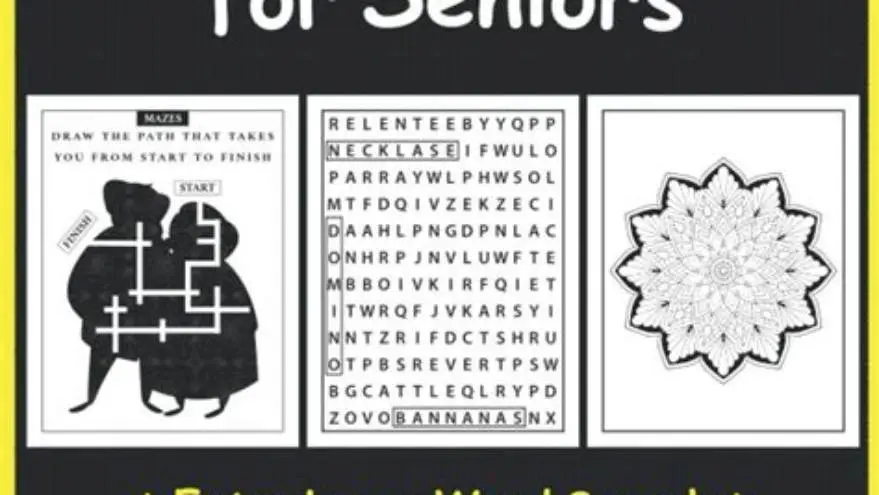
Word searches are the strongest performers. Circle or tick with one hand, or just trace a finger along the line. Find-the-picture sheets and spot-the-item sheets come next. Simple large-print crosswords with short answers work too. Skip sudoku grids beyond the easiest 4x4 level. Tracking rows and columns at a flat angle is hard even for sharp eyes. Long-stroke mazes fail the same way. At a shallow angle, a wandering line disappears. Thick bound books fail too. Bound books will not stay open on a tray and need one hand just to hold them.
Our free Large Print Word Search Maker turns any list of your own words into a large-print word search PDF with an answer page. Use the names, places and hobbies this person cares about, printed one to a page. Nothing else: it makes word searches only. If hunting for sheets sounds like a chore, that one free page is the fastest thing to try first.
| Format | One hand enough? | Verdict in bed |
|---|---|---|
| Word search | Yes | Best choice |
| Find-the-item sheet | Yes, pointing counts | Best choice |
| Large-print crossword | Mostly | Good, keep clues short |
| Easy 4x4 sudoku | Yes | Acceptable |
| 9x9 sudoku | Yes, but tiring | Leave for chair time |
| Long-stroke maze | Line vanishes flat | Skip |
| Thick puzzle book | Needs two hands | Needs a table |
- Works with one hand resting on a tray
- Finger-tracing counts as participation
- Single sheets stay flat on a clipboard
- Attention fades after 10 to 15 minutes
- Dense grids defeat even good eyes at a flat angle
- Bound books will not stay open
Things to hold: card stacks, fidget items and a hand massage
Not every bed activity is a puzzle on paper. Some people want something in their hands, and a lap tray holds more than a sheet. Large-print playing cards work one-handed in a small stack, when a wooden card rack holds them. Solitaire needs only one free hand that way. It helps to understand seated puzzles for parkinson's before going further.
Fidget items suit restless hands. Soft cloth, a smooth wooden bead string, a small squeeze ball or a fidget blanket gives fingers something to do. No rules, no right answers. Keep every item large enough to grip and too big to swallow. Check the tray each evening and take away anything small that has worked loose.
Hand massage is the simplest hands-on activity of all. Warm lotion, slow strokes across the palm and fingers, two or three minutes at a time. It needs only lotion and a towel under the hand. Offer it when words run out or energy dips. If the skin is broken, sore or swollen, skip the massage and ask their doctor instead. Massage is comfort, not care for the skin. Someone who cannot shift in bed needs regular position changes, so ask their care team how often to move them.
Keep food, drink and small game pieces off the tray while the person lies flat. Sit them up for snacks and drinks first, and clear the tray before the next activity. People in this spot often ask about printable functional vision checklist as well.
- Card stack: large-print cards in a wooden rack, solitaire with one hand
- Fidget blanket: soft cloth with sewn-on textures
- Hand massage: warm lotion, slow palm strokes, two or three minutes
- Squeeze ball: soft, palm-sized, for restless fingers between activities
The print specs and tray setup that decide whether it works
Once the puzzle type is right, print quality decides the rest. In bed the viewing angle is shallow and the light is often poor, so ordinary print is not enough. Aim for 18pt type as the floor and 24pt where you can get it, on matte paper. Keep one puzzle per page, with generous margins, so a second puzzle never crowds the bottom of the sheet.
Then fix the angle. Flat on the covers, a page is read at the worst possible angle. Prop it. Lean a clipboard against a pillow to lift the top edge toward the eyes. Under the sheet, a wedge cushion works too. Judge the result from the person's own position, lying down, not from standing beside the bed.
Clip a bright reading light to the headboard instead of relying on the ceiling light. It puts the light where the page is. Test the light and the propped page together. It helps to understand sequence a crossword for short attention span before going further.
| Item | Specification | Why it matters in bed |
|---|---|---|
| Type size | 18pt minimum, 24pt better | Compensates for shallow angle and distance |
| Paper | Matte, single-sided | No lamp glare, no show-through |
| Layout | One puzzle per page | No crowding at bottom of sheet |
| Binding | Clipboard or spiral | Stays put on the tray |
| Page angle | Propped toward the eyes | Neck stops doing the work |
| Tray | Non-slip mat, raised edge | Nothing slides or escapes |
When low vision or hearing loss joins bedrest
Bedrest rarely arrives alone. Low vision and hearing loss often travel with it, and each one changes what still works. A substantial share of older adults have low vision even with glasses. Bigger print is not always the answer. Sound and touch take over.
For low vision, lean on the ears and the hands. Audiobooks replace the printed page entirely. The National Library Service for the Blind and Print Disabled (NLS) runs a free talking-book program. Eligibility and what it mails are set by NLS, so ask at the local library about joining. Magnifiers help with a short label or a single clue. For a whole puzzle page it is a poor tool, so do not build the afternoon around it.
Hearing loss needs a different fix. Sit on the side of the better ear and face the person so your lips can be seen. Turn off the television and radio first. Speak a little slower and a little louder, but do not shout. If the person wears hearing aids, check they are in and switched on before the activity starts.
Touch carries the day when both vision and hearing are weak. Hand massage, a fidget blanket or a familiar object to hold all work without sight or sound. Card games played by feel work too. Keep the room calm and one thing happening at a time.
Memory loss in bed, and a weekly rotation that keeps pages fresh
Memory loss changes the rules again. The winning move is repetition rather than novelty. Repeat the same puzzle format week after week, in themes the person already knows well. That lets someone with memory changes succeed. Leave scoring out entirely. Scores turn a pleasant page into a test. Bad tests end the whole activity fast.
Themes drawn from the person's own life work far better than generic ones. Custom word searches earn their keep here. Type in words that mean something to this person and get a fresh puzzle that is secretly familiar. For a whole ready set at this level, we make the Gentle Minds Activity Kit. The kit holds activities at three levels and conversation cards.
Forty printed pages in a folder, offered in the same order, turn into the same afternoon within a fortnight. Rotation fixes that with almost no work. Print a small set of five to seven pages in two or three formats, and put the rest away. Swap roughly half the set each week.
Variety beats size in the set. Mix the set: one word search, one find-the-item sheet, one trivia page, one easy crossword. Track the rotation in the simplest way that survives real life. Track it with a pencil note on the back of each sheet.
- Print five to seven pages in two or three formats
- Offer them in short sittings across the week
- Note the week on the back of each page
- Change about half the set every week
- Retire any format that goes unfinished twice
Still wondering?
What print size do puzzles need for someone reading in bed?
Use 18pt type as a minimum and 24pt where possible. Print that is fine in a chair often looks small in bed, because a shallow angle costs effective size. Matte paper and one puzzle per page help close that gap.
Can sudoku work for a bedridden senior?
Only in its easiest forms. An easy 4x4 grid can work on a propped page. Standard 9x9 grids ask too much of tired eyes in bed. Swap it for word searches in bed.
How long should an activity session last in bed?
Plan for ten to fifteen focused minutes, then rest. Short sittings several times a day beat one long session. Finishing while interest is still there makes the next session welcome.
What if my parent can't hold a pen at all?
Move to eyes-only activities: read-aloud trivia, spoken word games, audiobooks and music. Massage or a fidget item also works when holding a pen is out of reach. Finger-tracing counts too.
What if my parent has hearing loss as well?
Sit on the side of the better ear, face them so your lips can be seen, and turn off background sound first. Speak slower and a little louder, but do not shout.
Ready to try it? It prints a free, one-to-a-page large-print word search from your own words, which is exactly the format that survives a lap tray.
Make a free word search