Sensory Activities for Dementia Patients That Bring Calm
It depends on the person: the best sensory activities for dementia patients match what that person still enjoys and can do safely. Start with one sense, one item, and ten to fifteen minutes. Soft cloths, familiar smells, and favourite songs all count.
On this page (8 sections)
- Quick recap
- What are sensory activities for dementia patients?
- Which sensory activities work best at home?
- How long should a sensory session last?
- How do you set up a sensory session, step by step?
- What should you avoid with sensory activities?
- How do you know if a sensory activity is working?
- Still wondering?
Part of our guide on activity book for adults with dementia
Key figures
- First session length
- 10 to 15 minutes
- Senses per session
- One at a time
- Best routine
- Same time each day
- Label print size
- 18 pt or larger
- Best time to try
- When they are calmest
- Cost to start
- Free, from home
Quick recap
- Start small, with a single item and a few minutes.
- A smell or song from their own past is the best place to start.
- Watch their face and hands, not the clock.
- Keep small items, strong scents and hot water out of reach.
- Write down what worked, so next time starts from a win.
What are sensory activities for dementia patients?

Sensory activities for dementia patients are simple, hands-on moments built around touch, smell, sound, sight, or taste. Someone holds a soft cloth, smells fresh coffee, or listens to a song from their youth. Nothing is tested and nothing is scored. The point is a calm, pleasant few minutes, shared with someone they trust. Words get harder as dementia moves on, but the senses often stay open longer. These are everyday care ideas, not a treatment, and no single activity suits everyone.
Good sessions have no right answer. The person can hold an item, put it down, watch, or just sit close by. All of those count as taking part. Carers sometimes worry when nothing much seems to happen. Quiet minutes with a warm cloth in hand still count as a good result. The aim is comfort and company, not progress.
These activities fit every stage, but the shape changes with the stage. Early on, a person might talk through a recipe or sort buttons by colour. Later, the same person may only want to hold one smooth stone and listen. Both are fine, and the late stages are where the simplest versions often work best. You adjust the activity to the person in front of you, not to a fixed plan. Sticking to a single sense keeps it simple. Mixing several senses at once can overwhelm a tired person. This is general activity advice, not medical guidance: diet, swallowing, allergy and medication questions go to their doctor, nurse, or speech pathologist.
Which sensory activities work best at home?
Touch is the easiest sense to start with, because it needs no setup and no shopping. Fill a basket with four or five large pieces of fabric: fleece, cotton, corduroy, satin, and a knitted square. Hand over one piece at a time and let the person feel it, fold it, or just hold it. Sorting smooth stones and folding warm towels work the same way. Pieces stay large, so nothing small can be picked up and swallowed. It helps to understand activities for dementia at home before going further.
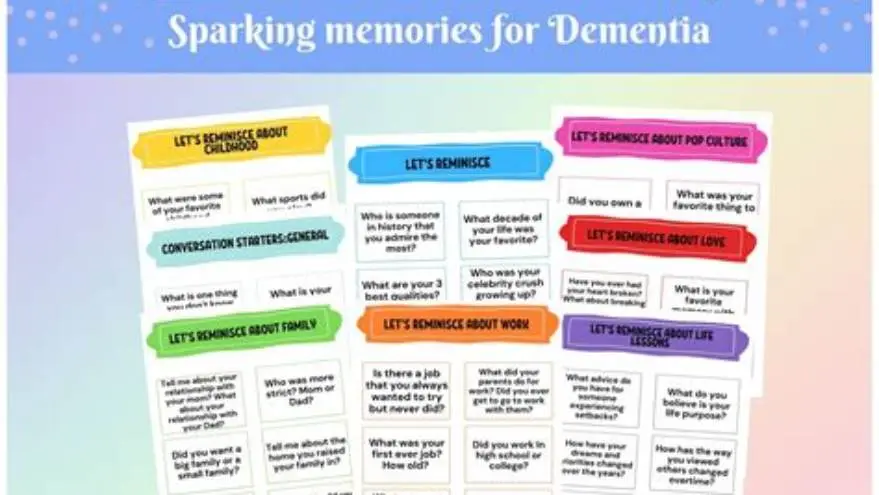
Smell comes next, and it is the sense most tied to old memories. Coffee beans in a jar, a cinnamon stick, or an orange peel can start a conversation without a single question. Offer one scent at a time, and end the session if the person turns away. Printable activity sheets can pair a smell or texture with a conversation prompt. Printed pages are not hands-on objects, though, so the basket and jars still come from your own cupboards.
Sound and sight fill the room without any handling at all. Play songs from the person's teens and twenties, at a low volume, and watch for a toe tap or a hum. Outside the window, a bird feeder, a fish tank, or a slideshow of family photos gives the eyes somewhere gentle to rest. Taste rounds out the five senses: a small piece of chocolate or a slice of orange, checked against diet and swallowing advice first. Keep portions tiny and stay close by.
| Sense | Easiest start | Watch out |
|---|---|---|
| Touch | Fabric basket, smooth stones | Keep pieces large |
| Smell | Coffee beans, cinnamon stick | One scent at a time |
| Sound | Songs from their youth | Keep the volume low |
| Sight | Photo slideshow, bird feeder | Avoid flashing lights |
| Taste | Orange slice, ice cream | Check diet advice first |
How long should a sensory session last?
Fifteen minutes at most is a good length for a first session at home. That is long enough for the person to settle in, and short enough to end before tiredness sets in. In a care home, a group session can include several people at once, with one person leading. At home, one person and one carer need far less time. End before tiredness sets in, so the person is glad to come back tomorrow. The other half of this decision is activities for late stage dementia patients.
Time of day matters more than the clock does. Most people have a part of the day when they are calmer and more open, often the morning. Try the session then, and keep the same time each day so it becomes part of the routine. If the person is tired, unwell, or upset, skip the session. Tomorrow is another chance.
Watch for the signs that the session has run its course. Someone who looks away, pushes items aside, or grows quiet has had enough. This is the moment to stop, not the moment to push on. If the person grows upset, speak softly, offer a hand to hold, and move to a quieter spot. Pack the items away together, slowly, as part of the wind-down. That last minute shapes how the person remembers the whole session. End with something warm: a hand held, a favourite song, or a cup of tea.
How do you set up a sensory session, step by step?
Planning matters more than supplies for a first session. Pick a quiet room, close the door on background noise, and put the phone on silent. Lay out one item, not a whole box, so the person faces one choice instead of ten. Sit beside them rather than across, so you can pass items by hand without reaching. Hold the item out in an open hand and wait. Silence is fine. People in this spot often ask about calm activities for dementia as well.
Label anything that needs a label, in large print. Mark a scent jar in 18 pt or bigger. That size is a common large-print standard, and larger is better when the label sits away from the eyes. Hand-written labels in thick marker work just as well as printed ones. Labels stay short: one word, like 'lavender' or 'wool', beats a sentence. If the person can read the word, they may say it out loud, and that small win is worth the effort.
Simplicity is the rule for the rest of the session. Keep it short: a single item, a few minutes, no rush. When the first item lands well, offer a second one from the same sense. When interest fades, stop and try again another day with something else. Do not run through a list for the sake of finishing it. It belongs to the person, not to the plan.
- Pick a quiet room and silence the phone.
- Lay out one item, labelled in large print.
- Sit beside the person and offer it in an open hand.
- Wait a full minute before saying anything.
- Offer a second item only if the first one lands well.
- Pack the items away together when attention fades.
What should you avoid with sensory activities?
Small items are the first thing to rule out. Buttons, beads, dried beans, and small stones can all be picked up and swallowed. Someone living with dementia may put things in their mouth without thinking. Use pieces too big to swallow, and stay in the room the whole time. For someone known to mouth objects, keep loose items out of reach and stick to large fabric pieces or a warm towel. The other half of this decision is dementia-friendly crafts for seniors.
Strong smells and loud sounds are the next watch-out. A scent that seems light to you can feel overpowering to someone else. Hold a scent jar at arm's length and let the person lean in. Never use a lit candle or a diffuser that fills the room. Music should stay low, and sudden sounds should stay out of the session entirely. Blenders and televisions in the next room can undo a calm spell in seconds.
Food and drink need the same care as everything else. Check for allergies before offering any scent or taste, and check diet and swallowing advice before offering food at all. Someone who coughs on thin liquids should never be handed a drink as part of an activity. Ask their doctor about any health question, including whether a scent, food, or lotion is safe for them. When in doubt, leave the item out.
- Small items: buttons, beads, dried beans, small stones.
- Lit candles: use closed scent jars instead.
- Strong scents: one jar at arm's length, never a diffuser.
- Hot water: warm only, tested on your own wrist first.
How do you know if a sensory activity is working?
Look at the person's face and hands, not at any score. A relaxed jaw, slower breathing, a small smile, or fingers that keep stroking a piece of fabric all say the activity is landing. Humming along to a song or naming a smell out loud is a clear win. None of this needs a chart. You will know it when you see it.
One short note after each session turns guesswork into a plan. Note the date, the item, and one line about the response: 'loved the lavender, ignored the stones'. Over a fortnight, a pattern shows up. Some senses will keep working, and some items will keep failing, and that is useful knowledge. Share the note with other family carers or care staff, so the next person does not start from zero.
Failure still teaches something, so do not count a bad session as wasted time. The item may have been wrong, the hour may have been wrong, or the person may simply have been tired that day. Change one thing next time: a different scent, a morning slot instead of an afternoon one, or a softer texture. Small changes, tried one at a time, show you what matters. If distress keeps happening, talk to their doctor about it.
Still wondering?
Can sensory activities help someone in the late stages of dementia?
Yes, they often suit late stages best, because they ask nothing of memory or words. Warm towels, familiar songs, and soft blankets can still bring comfort when conversation has faded. Keep the session to one sense and a few minutes, and end it when attention fades.
What if the person refuses to join in?
Refusal is an answer, not a failure. Put the item where they can see it and carry on with your own cup of tea. They may reach for it in a few minutes, or they may not. Try a different sense another day, and never push an activity on someone who has said no.
Do I need to buy special sensory equipment?
No. Most sessions use things already in the house: fabric, kitchen smells, music, and photographs. Bought kits and sensory boards can help when you run out of ideas, but they are a convenience, not a requirement. Start with the cupboard and see how far it takes you.
How often should we do sensory activities?
Short sessions most days beat one long session a week. Daily practice builds a routine the person can count on, and it gives you fresh notes on what works. Unwell days and hectic days are fine to skip, without guilt. Missed days cost nothing.
Ready to try it? It gives ready-made printable activities, so a carer always has a next activity ready.
See the activity kit