Thanksgiving Activities for Dementia Groups: Stage, Size, and Prep
It depends on the stage: early-stage groups do best with word searches and discussion cards, middle-stage with sorting and simple crafts, and late-stage with sensory activities like scent jars or music, all in groups of 1 to 6.
On this page (8 sections)
- Quick recap
- Which Thanksgiving activities suit early, middle, and late stage dementia
- How many people one activity can really handle at once
- How much prep time each activity actually takes
- Which pages come printed and which need household supplies
- How to adapt one Thanksgiving craft across all three stages
- Cleanup and safety notes for Thanksgiving activities
- Still wondering?
Part of our guide on senior thanksgiving activities
Key figures
- Group size range
- 1 to 12 people
- Prep time buckets
- 0, 5, or 15 min
- Stages covered
- early, middle, late
- Printable pages in kit
- over 130 pages
- Conversation cards included
- 48 cards
- Session length, most groups
- 20 to 30 minutes
Quick recap
- Match the activity to the stage first, group size second, prep time third
- One-on-one sessions need less structure than groups of 8 to 12
- A 5-minute prep activity on a bad day beats a 15-minute one that doesn't happen
- The same craft can flex across three stages by changing how much you do for them
- Printable pages save the most time when a room has mixed-stage residents
Which Thanksgiving activities suit early, middle, and late stage dementia
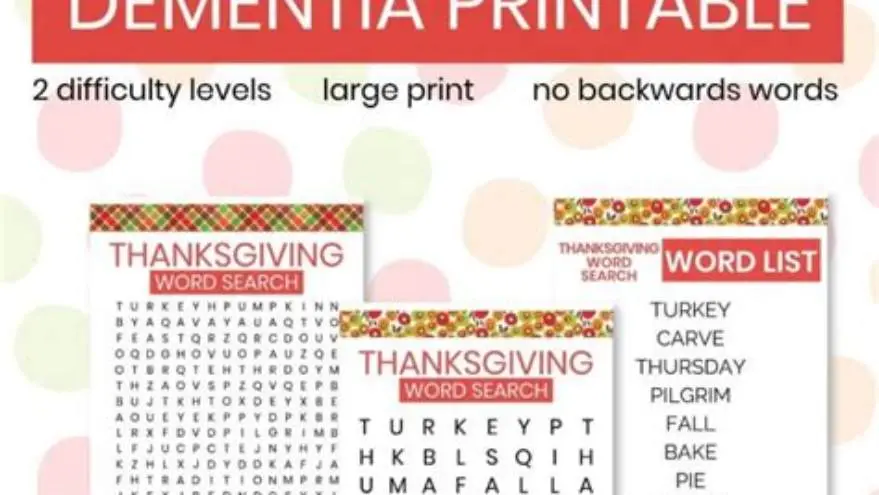
Early-stage residents can usually follow a word search, hold a conversation about past Thanksgivings, or fill in a large-print crossword with light prompting. They still read short instructions and track a page without losing their place.
Middle-stage residents do better with activities broken into one step at a time: sorting fall-colored buttons by size, tracing a simple turkey outline, or passing around a basket of real cranberries and pinecones to touch. Long instructions lose them; a single clear action does not.
Late-stage residents respond to sensory input more than tasks. A cinnamon-and-clove scent jar, a short clip of familiar Thanksgiving music, or a warm washcloth scented with vanilla can hold attention for a few minutes even when words no longer land.
The stage is not fixed within a group. Someone having a good day can handle more than their usual baseline, and a bad day pulls the other way, so the activity director checks in as they go rather than assigning by diagnosis alone. We go through winter activities for seniors indoors step by step elsewhere on the site.
- Early stage: word searches, crosswords, reminiscence conversation, simple trivia
- Middle stage: sorting, tracing, passing and touching real objects, call-and-response songs
- Late stage: scent jars, music, hand massage with warm lotion, soft textured fabric
How many people one activity can really handle at once
A one-on-one visit allows full flexibility: you can stop, repeat, or switch activities the moment attention drifts, which matters most for late-stage residents who tire fast.
Groups of 4 to 6 work for most craft and sorting activities, because a helper can reach every chair within a few seconds if someone needs a cue. Past 6, the room starts to split into people waiting and people working.
Groups of 8 to 12 only hold together for activities that do not depend on individual pacing: group singing, a shared discussion prompt read aloud, or passing a basket around a circle. Trying to run individual worksheets at that size usually means half the room sits idle. We go through thanksgiving activities for dementia patients step by step elsewhere on the site.
The honest trade-off is time against reach. A 1-on-1 session reaches one resident well; a 12-person circle reaches everyone thinly. Most care homes run both in the same afternoon rather than picking one.
| Activity | 1-on-1 | 4-6 people | 8-12 people |
|---|---|---|---|
| Large-print word search | Yes, with prompting | Yes, independent-ish | Only with a helper per 2-3 people |
| Sorting fall objects | Yes | Yes, works well | Needs 2 helpers |
| Scent jars / sensory | Best fit | Workable in rotation | Too slow to reach everyone |
| Group singing / music | Not needed | Fine | Best fit |
| Reminiscence discussion | Yes | Best fit | Works if one person leads |
How much prep time each activity actually takes
A 0-minute activity means it is already printed, already in a drawer, or needs nothing gathered: a stack of word search pages, a box of conversation cards, or a playlist already saved on a phone.
A 5-minute activity needs one trip to a cupboard: pulling out real cranberries, pinecones or fabric scraps, or printing a single fresh page if the stack has run low. This is the bucket most afternoons actually fall into. People in this spot often ask about calming winter puzzles as well.
A 15-minute activity involves setup that cannot be skipped: mixing a scent jar, cutting shapes for a craft, or arranging a table for a group that is bigger than usual. On a short-staffed day, this bucket is the one that gets dropped first.
The practical fix is to keep a standing stock of 0-minute options so a bad day never means no activity at all, and save the 15-minute ones for days with an extra pair of hands.
- 0 minutes: printed pages already on hand, conversation cards, a saved playlist
- 5 minutes: grabbing real objects to pass around, printing one more page
- 15 minutes: mixing a scent jar, cutting craft shapes, rearranging tables
Which pages come printed and which need household supplies
Word searches, crosswords, trivia sheets and conversation cards are things you print once and reuse for months; they need nothing from a kitchen or craft cupboard. This is where a printable kit saves the most time, because someone has already written the clues, sized the print and laid out the answer key. There is more on christmas dementia patient activities in a separate guide.
Sensory activities need real objects: dried herbs, cotton balls, small jars, warm washcloths. No printable replaces these, and that is fine. Buy a bag of cinnamon sticks once and it covers a season of scent jars.
The Gentle Minds Activity Kit, which this site makes, is a printable set built for this exact mix: it has three levels, Gentle, Easy and Steady, so early, middle and late-stage pages sit in the same download instead of three separate purchases. It will not replace the scent jars or the real cranberries, and it is not a therapy tool, just a way to stop re-searching for age-appropriate pages every week.
What it gets a director past is the printing bottleneck: pages print as many times as needed for different residents, and the 48 conversation cards work for both 1-on-1 and small-group discussion without extra setup. For the detail, see our notes on fall activities for seniors in nursing homes.
- covers three stages in one download
- reusable, reprint as many times as needed
- caregiver guide included for new staff
- does not cover sensory or scent-based activities
- not a substitute for therapy or medical care
How to adapt one Thanksgiving craft across all three stages
Take a paper turkey craft as the example, because it scales down cleanly. The core idea, a hand or feather shape colored in fall colors, stays the same; only the amount of independent work changes.
For early-stage residents, hand them the blank outline and let them pick colors and cut the feather shapes themselves, with the helper only there for conversation.
For middle-stage residents, pre-cut the feather shapes and hand them one at a time with a single instruction: 'glue this one here.' The task becomes placement, not planning.
For late-stage residents, skip cutting and gluing. Let them touch the textured feathers, name the colors out loud for them, and tape the finished piece to their wall so they still get the end result.
- Pick one craft idea, like a paper turkey or a leaf collage
- Decide what the early-stage group does unassisted: cutting, coloring, choosing colors
- Pre-cut or pre-glue the same pieces for the middle-stage group, then hand them one step at a time
- For late-stage residents, reduce it to a sensory moment: touching, naming colors, smelling a real leaf
- Display every finished version the same way so no one's piece looks less finished
Cleanup and safety notes for Thanksgiving activities
Scent jars and small objects carry a choking risk for residents who put things in their mouths; check with staff before passing around pinecones, dried corn or small buttons, and swap in larger, soft items if there is any doubt.
Scissors and glue need the same judgment call most crafts always need: fine for early and most middle-stage groups with supervision, skipped for anyone with a history of using tools unsafely. Safety scissors cut this risk without cutting the activity.
Food-based crafts, like real cranberries, should be treated as non-edible once handled, and swept up fully afterward since a dropped cranberry on a carpet is a slip risk as much as anything else.
Cleanup goes faster when the activity is matched to the room ahead of time: paper crafts leave scraps, sorting activities leave nothing but a basket to put away, and printed pages leave only the page itself, which some residents like to keep.
For a mixed-stage group, start with the decision table, pick 0-minute options as a safety net, and let the same craft flex rather than running three separate ones.
Still wondering?
What if the same room has residents at three different stages?
Run a shared opener, like a song or a conversation prompt, then split into small clusters for the stage-matched task. A helper rotates between clusters rather than trying to run one activity for everyone.
How long should a Thanksgiving activity actually run?
Most sessions hold attention for 20 to 30 minutes, shorter for late-stage residents who may tire after 10 to 15 minutes. Watch for fidgeting or looking away as the cue to wrap up, not the clock.
Can the same printable pages work for both home caregivers and care home staff?
Yes. The pages themselves don't change based on setting; what changes is group size and how much one-on-one time is available to prompt.
Is a Thanksgiving-themed activity necessary, or does any activity work in November?
A seasonal theme helps with reminiscence conversation, since it prompts memories tied to the holiday, but it is not required. Any familiar, stage-matched activity works; the theme is a bonus, not a must.
What's the biggest mistake activity directors make with Thanksgiving planning?
Picking one activity for the whole room regardless of stage, which leaves either the early-stage residents bored or the late-stage residents overwhelmed. Matching by stage first avoids both.
Ready to try it? It gives you three stage-matched activity levels in one download, so you're not hunting separate pages for early, middle and late-stage residents in the same room.
Get the printable kit