Trivia for dementia residents: 20 large-print questions with answers
The best trivia for dementia residents uses familiar subjects from childhood and early adulthood. Large type, spoken choices and no writing make joining in easier. Below are 20 questions with answers, plus practical ways to lead the game and adapt it for your group.
On this page (10 sections)
- Quick recap
- What makes trivia feel safe for dementia residents?
- How large should dementia trivia print be?
- 20 large-print trivia questions with answers
- How can music support dementia trivia?
- How should you lead a dementia trivia game?
- What to do when someone cannot join in or keeps disrupting the group
- Where can you find more large-print trivia?
- When family is unavailable and nobody knows their history
- Still wondering?
Part of our guide on features that aid memory and engagement
Key figures
- Print size
- 16 pt Arial or larger
- Session length
- Often 10-15 minutes, with flexibility
- Question count
- 20, in two rounds of 10
- Format
- Multiple choice, A B C
- Best era for questions
- Match each resident's childhood and early adulthood
- Writing needed
- None
- Cost
- Free with a printer and paper
Quick recap
- One or two questions per page keeps the sheet calm and readable.
- Print sample pages at several sizes and let each resident's reading decide the size.
- Watch faces and hands for answers, not just words.
- Give each person a way to join in, even if that means listening, holding a card or choosing the next song.
- End on a high note, while the room is still enjoying itself.
What makes trivia feel safe for dementia residents?
Household routines, school lessons, familiar songs, films and local traditions make useful subjects for seniors with dementia. Their own history matters more than a fixed age cutoff. When a question touches something the person once knew well, answering feels like remembering, not being tested.
Dementia is not one condition with one pattern. Different conditions, stages and health changes affect memory, language, hearing and attention in different ways. Each person may need a different pace, topic or format.
Questions feel less threatening when they invite a choice instead of demanding one exact answer. Ask, 'Was it 1945, 1955 or 1965?' rather than asking someone to produce a year alone.
Flexible questions also protect the mood. Ask someone to name a flower, colour or breakfast food, then accept several reasonable answers. Familiar questions may come up repeatedly, and that repetition is fine when it creates an easy success. If that sounds like your situation, read up on short sessions bring connection next.
| Question type | Example | How it lands |
|---|---|---|
| Open question, single answer | What year did the war end? | Harder when the exact fact is unavailable |
| Multiple choice | Was it 1945, 1955 or 1965? | Residents choose from three options |
| Many right answers | Name a flower. | Flexible and easy to personalise |
| Current events | Who is the president? | Often difficult when recent information is unclear |
How large should dementia trivia print be?
Print beats guessing when the type is big enough for the reader in front of you. Ordinary book print is too small for many older adults with low vision, cataracts or macular degeneration. Start larger than a normal book page and test from there.
Take the same three questions and print them at three different sizes on separate sample pages. Hand each page to the resident and ask them to read it from the distance they will use during the activity. Choose the smallest size they read comfortably. RNIB defines large print as 16 point Arial or larger, so use that as your starting point and test upward from there.
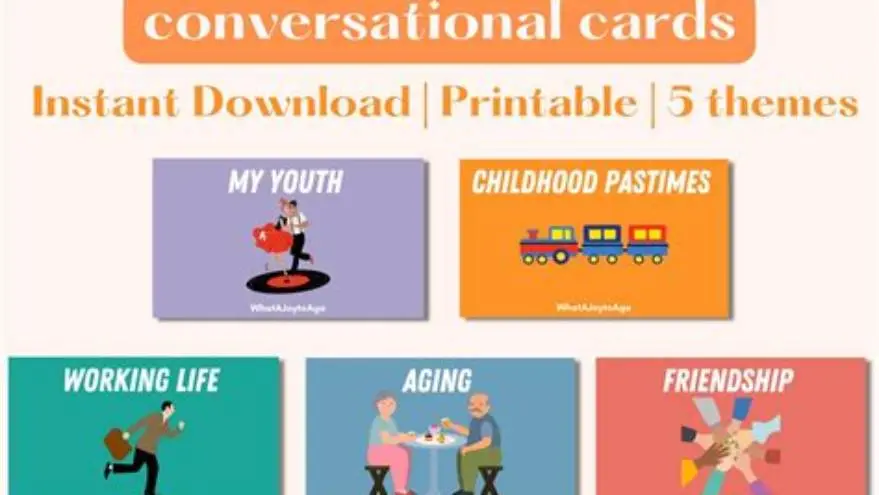
Sans-serif fonts such as Arial or Verdana keep letter shapes clear. Use black text on white paper, generous spacing and one or two questions per page. Avoid pale colours and crowded answer choices. There is more on conversation cards for dementia reminiscence in a separate guide.
Test the sheet before the session. Put it in the resident's hands, change the viewing distance and check whether they need to squint, tilt the page or bring it close. Their comfort decides the final size, not a fixed rule. If print still fails, ask the question aloud, offer two spoken choices, or use a familiar object they can hold.
- Font: start at 16 pt Arial, adjust after a reading test
- Layout: one or two questions per page
- Contrast: black on white, no pale greys
- Answers: same size as questions
- Paper: single sheets that stay open on the table
20 large-print trivia questions with answers
These questions use familiar subjects, household knowledge and older popular culture. Read through the list first and drop any topic that would not suit your room.
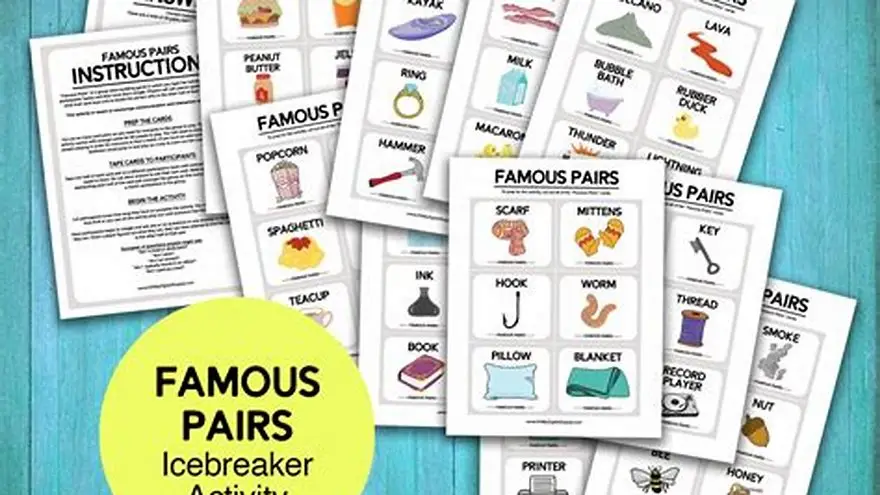
Five questions suit a short visit, or divide the list into two rounds. Give the answer after each response, then add a related comment or memory prompt. It helps to understand pairs game for older adults before going further.
This list suits the early and middle stages, when familiar facts are still within reach. For later stages, use the same topics as either-or choices, songs or objects to hold.
Adapt the carrot question. Ask what went into the stews made at home, or what grew in a vegetable garden. The question stays the same; the follow-up changes.
- 1. What colour is a school bus? (Yellow, in places where buses use that colour)
- 2. Which animal says moo? (Cow)
- 3. What do you call frozen water? (Ice)
- 4. How many days are in a week? (Seven days)
- 5. What season comes after summer? (Autumn or fall)
- 6. What do bees make? (Honey)
- 7. Which hand do many people traditionally wear a wedding ring on? (The left hand, though customs differ)
- 8. What is the opposite of night? (Day)
- 9. What do you use to tell the time? (Clock or watch)
- 10. What do you call a baby dog? (Puppy)
- 11. What fruit appears in the saying about keeping the doctor away? (Apple)
- 12. What do you call a house made of ice? (Igloo)
- 13. What might you wear on your feet in cold weather? (Boots, shoes or slippers)
- 14. What colour is grass usually? (Green)
- 15. How many colours are traditionally named in a rainbow? (Seven colours)
- 16. What might you keep in a bank? (Money or savings)
- 17. What long orange vegetable might appear in a stew? (Carrot)
- 18. What do you call a group of sheep? (Flock)
- 19. What do you use with thread when sewing? (Needle)
- 20. What meal do many people eat after waking? (Breakfast)
How can music support dementia trivia?
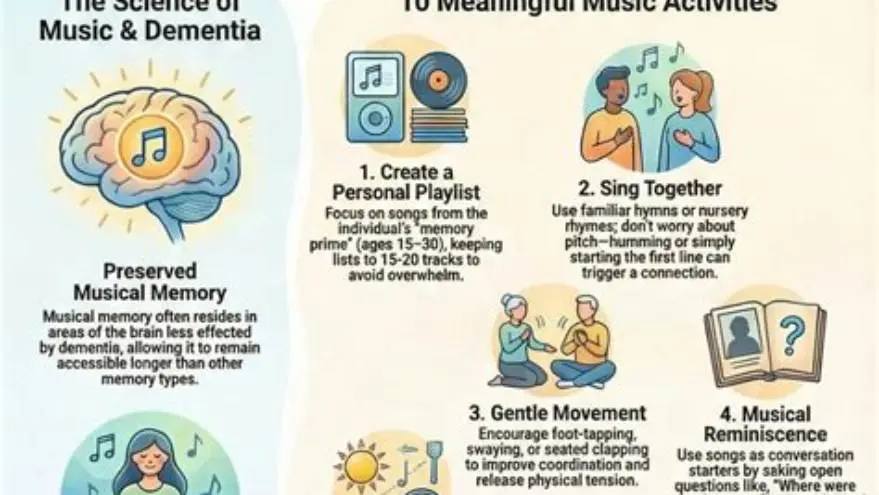
Music can offer another route into participation when a spoken answer is difficult. Residents might hum, clap, move a hand or complete a lyric without naming the song. There is more on dementia activities for seniors in a separate guide.
Start with songs from the decades the group grew up with, and watch which ones draw a response. Hymns and radio favourites from those years are a practical starting point.
Play a short, quiet section and ask what comes next. You can also ask whether a song feels happy, sad, gentle or lively.
Keep the volume moderate and watch the room. Hearing aids, background noise and poor acoustics can make music tiring. Quieter songs may work better than a group sing-along.
- Finish the lyric: play a short section and invite the next words
- Name the feeling: ask whether the music sounds happy or sad
- Choose the dance: ask whether people might waltz, march or sway
- Sing together: accept humming when words are unavailable
- Try familiar hymns or folk songs common to the region when preferences are unknown
How should you lead a dementia trivia game?
Arrange chairs in a circle or horseshoe so residents can see faces. Four to eight people often give quieter residents room to participate.
Speak clearly, then pause. Ten or fifteen seconds can feel long to the leader, but the resident may still be forming an answer. Offer the choices again if needed, without turning the pause into pressure.
Praise effort rather than scoring the group. Confirm an answer warmly. Add a simple follow-up such as, 'Did you have a garden?' Skip topics involving death, money troubles or painful family situations.
If one resident answers every question or speaks for others, thank them and set a turn-taking rule. Invite each person by name, then pause before accepting another answer. Offer the dominant resident a helpful role, such as holding the answer card.
Meet a wildly incorrect answer with calm, not correction. Acknowledge the feeling, offer a gentle correction only if safety requires it, and redirect to a neutral topic.
- Set out chairs and turn off or lower the television, radio and nearby alarms.
- Greet each person by name.
- Present one question and its choices clearly.
- Wait, then repeat the choices if needed.
- Confirm the response warmly.
- End on a calm note: a familiar song or a thank-you to the group.
What to do when someone cannot join in or keeps disrupting the group
Some residents cannot take part in a question round at all, and that is not a failure of the session. Give them a seat in the circle without any pressure to answer.
Offer a role instead of a question. Holding the answer cards, choosing the next song or handing out the sheets all count as taking part. A small job gives some residents a reason to stay.
For a resident who disrupts the group again and again, stay calm and do not argue. Acknowledge what they say briefly, then guide the group back to the next question. Move the resident to a seat beside you, where a quiet word can settle them without stopping the game.
When disruption keeps going, end that person's part in the round gently. Offer a one-to-one activity instead, such as looking through a picture book or listening to a favourite song. Afterwards, note what set the disruption off, since noise, tiredness, hunger, pain or a sore topic can all play a part.
Where can you find more large-print trivia?
Writing your own rounds costs nothing. Take the topics that worked and shape the next round from them, swapping in fresh questions on the same themes.
Commercial large-print trivia books exist as paid options. Check the type size, answer format and topics before buying, because layouts and accessibility features differ. Our Big Print Trivia book is one such option, with themed rounds and answers included.
An online word-search maker is a free alternative. Enter names of songs, towns, hobbies or foods familiar to the group, then print the result in a size residents can read.
| Approach | Cost | Best for |
|---|---|---|
| Write your own rounds | Free, your time | Personal topics and local memories |
| Commercial large-print trivia book | Paid purchase | Groups needing ready-made rounds |
| Free word-search maker | Free | Quiet individual activity |
When family is unavailable and nobody knows their history
Family members are not always available, and staff do not always know a resident's history. Start with topics almost everyone of that generation shares: household routines, school days, familiar foods and songs.
Ask the resident directly, with simple either-or prompts. 'Did you grow up in a town or in the country?' opens more than a blank question.
Check the care plan and any notes already on file. Daily records and handover sheets often hold small facts: a former job, a favourite hymn, a hometown. Even one fact can shape a whole round of questions.
Build the picture over time. Keep a shared notebook where staff jot down what drew a smile, a song or a story.
Still wondering?
How long should a trivia session last for someone with dementia?
There is no single correct length. Try a short round of five questions, then continue only while residents remain comfortable. Finish when the person asks to stop, or when conversation becomes strained.
Should I give the answers right away or save them?
Give the answer after each response, especially when the activity uses multiple choice. Immediate confirmation keeps the game moving and prevents residents waiting for a result.
What if a resident gets upset by a question?
Stop the question and change direction without arguing. If the answer reveals confusion, respond calmly rather than forcing a correction. You might say, 'That year is on your mind. What did you enjoy then?' Then offer music, a familiar object or a neutral topic. Seek staff help if the person remains distressed or safety becomes a concern.
Can I use these questions one-on-one as well as in a group?
Yes. One-to-one sessions let you change the wording, offer pictures or follow a personal memory. Some residents may prefer conversation without answer choices, while others need the choices to feel secure.
Do I need a projector or screen for large-print trivia?
No. Printed sheets and a clear voice are enough for many rooms. Screens can help a larger group, but check text size, glare and viewing distance before using one.
How do I know which questions will work for my group?
Begin with a small sample and watch the room. Change topics when a question causes silence or discomfort. What residents do tells you more than any printed list.
Ready to try it? A ready-made large-print trivia book gives you themed rounds with answers included, so you can lead a session without writing every question yourself.
Try large-print trivia