Word games for early stage dementia: 4 types that boost cognition gently
Find 4 types of word games that help cognition gently in early stage dementia, with tips on choosing and adapting them for success.
Four types of word games suit early stage dementia: simple word searches, basic crosswords, matching word games, and fill-in-the-blanks. Each type supports different cognitive skills gently and maximizes success by using large clear print and easy vocabulary.
On this page (8 sections)
- Key takeaways
- What types of word games suit early stage dementia
- How each type of word game supports cognitive skills
- Examples of word games in each type
- How to adapt or choose games for ease and engagement
- Word games for early stage dementia: practical choices and creation tips
- Choosing the right word games for your early stage dementia loved one
- Questions people still ask
Part of our guide on activities for dementia patients at home
| Print size | 16–24 pt large print |
|---|---|
| Typical word search size | 10–15 words |
| Crossword clue complexity | simple definitions only |
| Session length | 15–30 minutes |
| Early dementia stage | mild to moderate memory loss |
Key takeaways
- Choose word games that avoid frustration and support calm engagement.
- Simple word searches improve recognition and attention.
- Basic crosswords aid language recall without complex clues.
- Matching games strengthen memory and word association.
- Fill-in-the-blank puzzles promote word retrieval and sequencing.
What types of word games suit early stage dementia
Early stage dementia players benefit from word games that do not overwhelm but gently challenge cognitive skills. Games must focus on clarity, simplicity, and success to maintain engagement and avoid frustration.
Four types stand out: word searches, basic crosswords, matching word games, and fill-in-the-blanks. These games keep instructions straightforward and rely on familiar vocabulary and themes.
Large print puzzles sized between 16 and 24 points help accommodate common vision decline in older adults. The number of words or clues should be kept moderate — usually no more than 10–15 words in a word search or crossword — to match the attention span and reduce fatigue.
Certain sensory preferences also influence game suitability. For example, some early stage dementia players respond better to tactile or physical elements alongside visual cues, such as using letter tiles or cards instead of paper puzzles. This multisensory approach can support memory by engaging different brain pathways. Players with mild hearing loss may benefit from verbal instructions repeated clearly or written down to complement game rules. We cover seniors 1950s reminiscence activities in its own article.
The pacing of games should also be considered carefully. While 10–15 words is a common recommendation, some players may find even fewer words more manageable, especially if they are new to the game or having a more difficult day cognitively. Observing the individual’s stamina and concentration span helps tailor the game length to maximize engagement without causing fatigue.
How each type of word game supports cognitive skills
Word searches improve visual scanning and word recognition, reinforcing attention to detail and sustained focus. Finding 10–15 simple words in a grid supports memory retrieval without frustration.
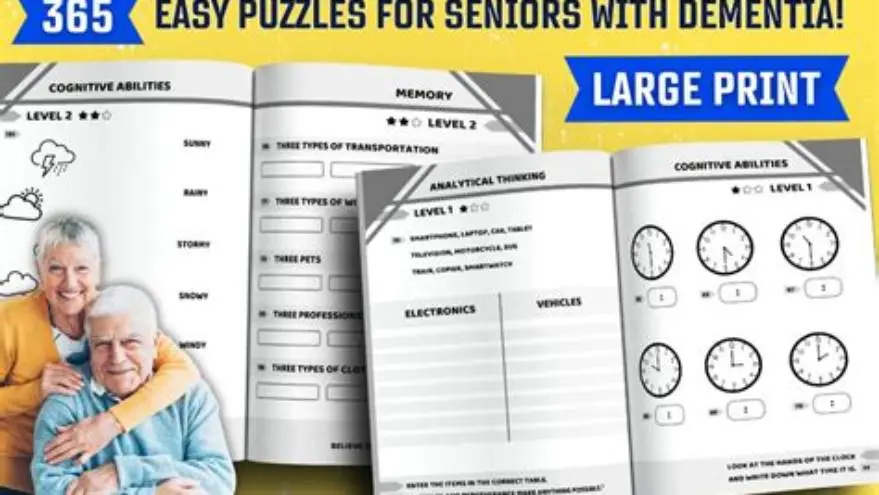
Basic crosswords with straightforward clues engage language recall and semantic processing. Avoid cryptic or multi-step clues; instead, focus on simple definitions or picture clues where possible. For the detail, see our notes on puzzles with large print type.
Matching word games like pairing words to pictures or synonyms strengthen associative memory and word comprehension. These games encourage connection-making with minimal pressure.
Fill-in-the-blank puzzles support sequencing and word retrieval by prompting players to complete partial phrases or sentences. The partial cues reduce the cognitive load compared to free recall tasks.
Matching word games, besides strengthening associative memory, can also support executive function by encouraging sorting and categorizing skills. For example, grouping synonyms or antonyms requires the player to analyze word relationships, subtly exercising flexible thinking. There is more on puzzle features that help dementia in a separate guide.
Fill-in-the-blank puzzles additionally promote language organization and can aid in practicing sentence structure, which may decline in dementia. For instance, completing a sentence like 'The cat is ___ the mat' reinforces prepositional use and comprehension.
An example to illustrate: a word search with 12 words related to fruits (apple, pear, grape, etc.) not only helps visual scanning but subtly reinforces vocabulary and categorization, while a basic crossword with clues such as 'yellow fruit' for 'banana' supports word recall and semantic memory.
| Game Type | Attention | Memory | Language | Ease |
|---|---|---|---|---|
| Word Search | High | Moderate | Low | Easy |
| Basic Crossword | Moderate | High | High | Moderate |
| Matching Word Game | Moderate | High | Moderate | Easy |
| Fill-in-the-Blank | Moderate | Moderate | High | Moderate |
Examples of word games in each type
For word searches, choose puzzles with themes relevant to the player’s interests and familiarity, such as seasons, animals, or common household items. Keep the grid size manageable — about 10x10 letters. There is more on large-print puzzles and stories in a separate guide.
Basic crosswords should use simple, direct clues. For instance, 'red fruit' for 'apple' or 'small pet' for 'cat'. Avoid multi-word answers or complex wordplay.
Matching games can be physical cards or worksheets pairing words with images, synonyms, or antonyms. For example, matching 'hot' to 'cold' or pictures of objects to their names.
Fill-in-the-blank puzzles might present a familiar phrase or song lyric with key words missing, such as 'Twinkle, twinkle, little ___'. These should have limited blanks and multiple-choice options if possible. It helps to understand distinguishing made-up tales from memories before going further.
One practical example of a matching word game is using laminated cards showing common objects and separate cards with their names. The player matches pairs, reinforcing word recognition and object identification. This physical interaction can increase engagement and aid memory through motor involvement.
A fill-in-the-blank example might be a worksheet with a simple sentence: 'I like to eat ___ in the morning,' with options like 'toast,' 'eggs,' or 'cereal' provided. This structured choice reduces guessing pressure and supports word retrieval by providing contextual clues.
For word searches, a grid size of 8x8 or 10x10 letters with 10 simple words, such as basic colors or animals, balances challenge and success, keeping the player motivated and avoiding overwhelm.
How to adapt or choose games for ease and engagement
Adapt word games by adjusting font size, reducing word list length, and selecting familiar vocabulary. Use high contrast colors (black on white or cream) for better visibility.
Removing time limits and allowing players to work at their own pace reduces stress. Provide gentle encouragement and celebrate partial successes to keep motivation high.
Offer multiple-choice options or visual cues for fill-in-the-blank and crossword clues to ease cognitive load. Avoid forcing players to guess unfamiliar words or complex concepts.
Choosing or creating puzzles themed around personal interests or past experiences increases emotional connection and willingness to engage.
Visual aids can extend beyond multiple-choice hints; incorporating pictures alongside words or clues can provide context and reduce confusion. For instance, a crossword clue might show a small image of a dog next to the hint 'pet,' easing the retrieval process.
Simplifying instructions by using short, clear sentences or bullet points helps players with processing difficulties. Repeating instructions and demonstrating the game before starting can also increase confidence and reduce anxiety.
Using familiar themes like holidays, hobbies, or family-related topics enhances emotional engagement and makes the games more meaningful, which can improve participation and enjoyment.
- 1. Select puzzle type appropriate to cognitive ability (start simple).
- 2. Adjust print size to at least 16 pt for readability.
- 3. Simplify word lists or clues to familiar items and concepts.
- 4. Add visual aids or multiple-choice hints where helpful.
- 5. Monitor player’s fatigue and adjust puzzle length accordingly.
Word games for early stage dementia: practical choices and creation tips
Creating or sourcing suitable word games manually is possible but can be time-consuming. You might print simple word search templates and customize word lists by hand, focusing on large fonts and familiar words.
BigPrint Puzzle Studio is a straightforward online tool designed to create large-print puzzles including word searches, crosswords, and more, tailored for older adults with memory loss. It speeds up producing consistent, clear puzzles without needing graphic design skills.
This tool fits well for caregivers or activity coordinators wanting a reliable way to generate multiple puzzles with clear print and answer keys quickly. However, it’s less suitable for those not needing large-print puzzles or who want medical cognitive training programs rather than activities.
Free alternatives include downloadable blank puzzle templates and editing them with familiar word lists or using online puzzle makers that may lack large-print options or senior-friendly customization.
- Fast creation of large-print puzzles
- Customizable word lists and themes
- Includes answer keys and page numbers
- No monthly fees or complex software needed
- Not designed as a medical or cognitive therapy tool
- Requires basic computer skills
- Limited to puzzle creation, no direct gameplay support
Choosing the right word games for your early stage dementia loved one
Observe how your loved one responds to different word games. Do they enjoy searching for words, or do they prefer matching pictures and words? Their feedback will guide your selections.
Avoid puzzles that cause frustration or fatigue by scaling complexity carefully. Games with 10–15 words and large print are a good starting point.
Rotate among the four types to keep interest fresh and cover different cognitive skills. This also helps avoid overloading one area, like language recall, too much at once.
Consider printing puzzles in batches and keeping a regular game time of 15–30 minutes to build routine and reduce overwhelm.
Questions people still ask
Can word games delay cognitive decline in early stage dementia?
Word games help maintain engagement and stimulate cognition but do not prevent decline. They improve quality of life by promoting mental activity and social interaction.
How often should someone with early stage dementia play word games?
Sessions of 15–30 minutes several times a week balance stimulation with avoiding fatigue. Consistency matters more than duration.
Are large-print puzzles necessary for all early dementia players?
Not all need large print, but many benefit due to common vision changes. Checking readability first is important.
What if my loved one gets frustrated with a game?
Switch to simpler puzzles or different types, offer clues or breaks, and prioritize calm and success over challenge.
Where can I find free large-print word games?
Many senior centers and online sites offer free printable large-print puzzles. Customization may be limited compared to dedicated puzzle software.
Should I supervise or play word games together?
Playing together supports social connection and can help gently guide and encourage, reducing frustration and enhancing enjoyment.
Ready to try it? It simplifies creating large-print, easy word games tailored for early dementia, saving time and ensuring accessibility.
Create large-print puzzles