Printable dementia puzzles and short stories: large print, easy, and varied
Large-print printable puzzles and short stories that bring calm and success to dementia patients with easy, clear activities.
Printable activities for dementia patients work best when they are large-print, simple, and varied, such as word searches, sudoku, and short fill-in-the-blank stories designed to avoid frustration and promote calm engagement.
On this page (8 sections)
- Key takeaways
- Why printable activities for dementia patients must be large and simple
- Printable puzzles for dementia that are big and easy to read
- Dementia word search printable: design and themes that work
- Short fill in the blank stories for memory care groups
- How to create your own printable dementia puzzles and stories
- Printable activities for dementia patients: choosing what works best
- Questions people still ask
Part of our guide on activities for dementia at home
| Print size | 16-24 pt |
|---|---|
| Puzzle types | Word search, sudoku, crosswords |
| Story length | Short, fill-in-the-blank |
| Common frustration | Complex rules |
| DIY tool | BigPrint Puzzle Studio |
Key takeaways
- Large print (16-24 pt) is essential for visibility and comfort.
- Choose simple puzzles avoiding complex rules to reduce frustration.
- Short fill-in-the-blank stories stimulate memory without overwhelming.
- Word searches and sudoku with large grids aid focus and calm.
- Printable tools like BigPrint Puzzle Studio streamline creating tailored puzzles.
Why printable activities for dementia patients must be large and simple
Dementia patients typically benefit from activities printed in 16-24 point font size because vision and cognitive processing slow down. Activities with small fonts or cluttered layouts cause frustration and disengagement.
Complex puzzles require memory or reasoning that may be impaired. Simple word searches or sudoku with clear, bold grids are more suitable. Keeping puzzles straightforward fosters calm and feelings of success.
Printed puzzles create a tactile, focused task, making working memory demands manageable. Repetitive formats like word searches also help build confidence. Avoid multi-step or timed puzzles; they risk confusion.
Choosing activities that promote success rather than failure reduces agitation. Printables should balance engagement with ease, emphasizing large clues, minimal instructions, and plenty of white space. If that sounds like your situation, read up on selecting puzzles for dementia next.
Printable puzzles for dementia that are big and easy to read
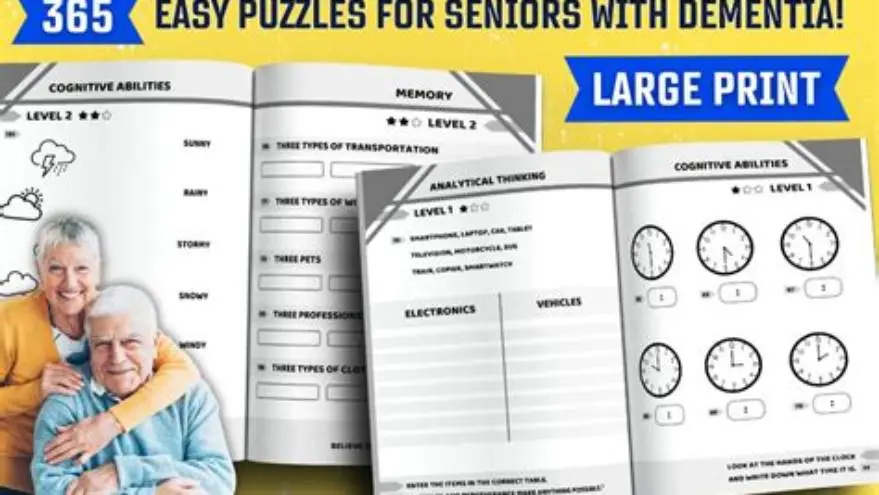
Big puzzles printed with 16-24 pt font and bold lines improve readability and usability. Word searches with 10x10 or 12x12 grids are common; they provide manageable challenge without fatigue.
Sudoku puzzles for dementia patients should limit to 4x4 or 6x6 grids instead of standard 9x9, simplifying the task. Large-print crosswords also require simple clues and minimal word overlap.
Word puzzles with thematic word lists (e.g., animals, food) improve recognition and memory by tapping into familiar concepts. Avoid abstract or obscure vocabulary.
Large-print puzzles can be printed from free sources online or created using software tools that allow adjusting font size and puzzle complexity to the user's needs.
Another effective way to increase usability is to limit the number of words hidden in the puzzle. For example, a 10x10 grid containing 10 to 12 words spaced evenly allows enough room for each word to stand out without overwhelming the solver. This balance helps maintain engagement without causing visual confusion.
A worked example of a suitable word search might include words like CAT, DOG, APPLE, BOAT, and TREE arranged horizontally and vertically only within a 10x10 grid. Each word would be printed in 18 pt font in the accompanying word list, making it easy to scan and find each term. If that sounds like your situation, read up on patients making up or recalling stories next.
Checking the puzzle's readability involves testing it under different lighting conditions and at typical reading distances seen in care settings. Ensuring that fonts remain clear and contrast remains high even under soft lighting helps maintain the activity's effectiveness and reduces eye strain.
| Puzzle Type | Common Grid Size | Print Size (pt) | Complexity Level |
|---|---|---|---|
| Word search | 10x10 to 12x12 | 16-24 | Low |
| Sudoku | 4x4 or 6x6 | 16-24 | Low to Moderate |
| Crosswords | Simple 5-7 words | 16-20 | Low |
Dementia word search printable: design and themes that work
Word searches are one of the most effective printable puzzles for dementia patients when designed properly. Use themes linked to the person's interests or memory, such as 'fruit', 'pets', or 'holiday'.
Include word lists printed in large, bold text near the puzzle but spaced clearly. Highlighting found words can be part of the activity or left for the helper to encourage interaction. The other half of this decision is reminiscence activities for seniors 1950s.
Limit the word count per puzzle to 8-12 words. Words should be horizontal or vertical only, avoiding diagonal or backward words to reduce unnecessary difficulty.
Print on uncoated white paper to reduce glare. Use black text and thick grid lines for maximum contrast. Laminating sheets allows reuse with dry erase markers.
Word searches designed for dementia patients should also consider the patient's cultural background and personal history. For instance, a holiday-themed word search tailored to Christmas may include words like TREE, GIFT, SNOW, and SANTA, which are familiar and evoke positive memories. For the detail, see our notes on word games for early stage dementia.
Increasing the font size of the word list to 20 pt and spacing the words with line breaks rather than commas prevents words from blending together, aiding recognition. For example, instead of "apple, banana, cherry," the list would show each fruit on its own line.
A quick check to confirm the puzzle’s appropriateness is to observe the patient’s response during the activity. Signs of frustration or disengagement suggest it's too difficult or cluttered. Adjustments such as reducing word count or simplifying word placement can restore confidence and enjoyment.
- Select a familiar theme relevant to the patient.
- Generate a 10x10 or 12x12 grid word search with 8-12 themed words.
- Print using 16-24 pt font and bold grid lines.
- Provide a word list in large font next to the puzzle.
- Encourage highlighting or circling words with a marker.
Short fill in the blank stories for memory care groups
Short fill-in-the-blank stories help dementia patients recall personal and common facts with support. These stories typically range from 50-150 words, broken into easy segments.
Fill-in-the-blank prompts should be simple and contextually obvious, such as names, dates, or places familiar to the group. This reduces cognitive load and encourages success.
Stories focusing on daily routines, holidays, or popular culture topics work best. They stimulate conversation and social engagement when read aloud in groups.
Avoid abstract language or complex sentence structures. Provide a word bank in large print to assist. The goal is not test memory but to prompt recognition and fun interaction.
An example short fill-in-the-blank story might read: "Yesterday, I went to the ___ (park) and saw a ___ (dog). The sun was ___ (bright) and the sky was ___ (blue)." Providing the words park, dog, bright, and blue in large print below helps prompt correct answers without pressure.
To vary the activity, create stories with blanks for names of family members, favorite foods, or commonly visited places, fostering personal connection. For example, "I like to eat ___ (pizza) on Fridays with my ___ (grandchildren)." This approach stimulates memory linked to positive emotions.
A way to check the activity’s success is by observing participants’ willingness to attempt the blanks and their ability to relate answers to their own experiences. When patients finish with smiles or ask to do another, it signals well-chosen content and format.
- Story length: 50-150 words
- Prompts: names, objects, familiar routines
- Word bank: large print, clear choices
- Use in groups: read aloud and discuss
How to create your own printable dementia puzzles and stories
Creating your own large-print puzzles tailored to dementia patients involves choosing font size, puzzle type, theme, and puzzle complexity carefully.
Free online tools or word processing software can generate simple word searches or sudoku puzzles. Adjust font sizes to at least 16 pt and use bold grid lines.
For fill-in-the-blank stories, write short narratives with key missing words and provide a word bank in large print alongside. Keep vocabulary simple and personal.
Using a dedicated tool like BigPrint Puzzle Studio speeds this process. It offers ready templates for large-print puzzles and stories, adjustable font sizes, and auto answer keys.
- Select 16-24 pt font size for print
- Choose simple puzzle formats (word search, sudoku)
- Use familiar themes and simple words
- Draft short fill-in-the-blank stories with word banks
Printable activities for dementia patients: choosing what works best
When selecting printable activities for dementia patients, prioritize clarity, familiarity, and success. Large print puzzles like word searches are best for early to moderate dementia.
Short fill-in-the-blank stories encourage social interaction and recall. Sudoku or crosswords require more cognitive effort and suit those in earlier stages with good vision.
Avoid overly challenging or abstract puzzles that cause frustration or agitation. Rotate activities and observe the patient's response to adjust difficulty.
Printing materials on matte, non-glossy paper with high contrast improves usability. Laminated sheets extend usability and allow reuse with erasable markers.
BigPrint Puzzle Studio offers a strong option for those needing consistent, tailored large-print puzzles quickly, especially useful in care homes or for active family caregivers.
| Puzzle Type | Dementia Stage | Print Size (pt) | Best For |
|---|---|---|---|
| Word search | Early to moderate | 16-24 | Visual recognition and calm |
| Sudoku | Early | 16-20 | Cognitive challenge with guidance |
| Fill-in-the-blank story | All stages | 18-24 | Memory prompts and group engagement |
| Crossword | Early, mild | 16-20 | Language and word recall |
- Easy to tailor puzzles
- Promotes calm engagement
- Supports a range of dementia stages
- Some puzzles too complex for late stages
- Requires oversight for best results
- DIY creation can be time-consuming
Questions people still ask
What font size is best for printable dementia activities?
A font size between 16 and 24 points is best for dementia patients to ensure readability and reduce eye strain.
Can I use regular crossword puzzles for dementia patients?
Regular crosswords are often too complex; simplified versions with fewer clues and larger print are preferable.
How many words should a dementia word search include?
Limit word searches to 8-12 words to avoid overwhelming the patient and keep the activity manageable.
Are fill-in-the-blank stories helpful for memory care groups?
Yes, they encourage memory recall in a calm, engaging way, especially when words are familiar and prompts are simple.
Is there software that helps create large-print puzzles?
Yes, tools like BigPrint Puzzle Studio let you create large-print puzzles and stories quickly and easily.
Ready to try it? It simplifies making large-print puzzles and stories tailored for dementia patients, saving time and ensuring clarity.
Create large-print puzzles