1950s-themed reminiscence activities for seniors with dementia: 5 unique ideas
1950s-themed reminiscence activities using large-print puzzles and cultural prompts help seniors with dementia recall memories calmly and successfully.
Seniors with dementia respond best to reminiscence activities themed around the 1950s that use clear, large-print word searches, simple memory prompts about music and culture, and calm, success-oriented games tailored to their stage of memory loss.
On this page (8 sections)
- Key takeaways
- How to use 1950s cultural references to prompt memory
- Examples of reminiscence questions and games from the 1950s
- Ways to adapt activities for dementia stages
- Tips for large-print and clear layouts
- 1950s-themed reminiscence activities for seniors with dementia
- Leveraging BigPrint Puzzle Studio to create 1950s puzzles
- Questions people still ask
Part of our guide on playlist for sundowning hours
Discover 1950s reminiscence activities with large-print puzzles and cultural prompts designed for calm, dementia-friendly engagement and success.
| Large print size | 16-24 pt |
|---|---|
| Puzzle types | Word search, crossword, sudoku |
| Typical 1950s themes | Music, TV, cars, fashion |
| Recommended dementia stage | Early to mid-stages |
| Adaptations needed | Simplify for later stages |
Key takeaways
- Use large-print puzzles sized at 16-24pt for visibility
- Tailor prompts to 1950s culture for stronger memory recall
- Adapt difficulty for dementia stage to avoid frustration
- Incorporate music, TV, and common 1950s items as cues
- Tools like BigPrint Puzzle Studio simplify making suitable puzzles
How to use 1950s cultural references to prompt memory
If you are planning reminiscence activities for seniors 1950s, begin by matching prompts to what the person actually lived through rather than assuming national pop culture was central to their life. Ask a few short biographical questions first — where they grew up, their work, whether they served in the armed forces, and whether they married or raised children in the 1950s — then choose cues that map to those answers. This reduces confusion, increases comfort, and makes memories more accessible.
Evidence supports the general effectiveness of reminiscence techniques for people with dementia. A systematic review by Woods et al. (Cochrane, 2018) found that structured reminiscence and life-review approaches can improve mood and quality of life in older adults with cognitive impairment. Clinical guidelines from NICE (NG97) and practice summaries from Alzheimer’s associations recommend individualized, person-centred prompts as best practice. Use those sources to justify choosing tailored 1950s material over a one-size-fits-all packet of trivia.
Concrete tailoring examples make sessions more effective. If a person once worked in a textile mill, bring fabric swatches, photographs of local factories, and a simple question such as, “Which machines did you use in the mill?” For someone who emigrated after World War II, use maps, train timetables or immigration forms copies and prompts like, “Do you remember your journey to this town?” For a former teacher, show a 1950s school reader page and ask about morning routines or playground games.
When music or national stars are likely triggers, anchor them to the person’s context. Instead of naming celebrities only, try: “We played this record at our church dances — did your family ever go to dances?” Show a short clip of a dance song no longer than 30 seconds, then follow with a specific question about where they danced or who accompanied them. Short sensory cues — a smell from a favorite soap, a photograph of a local diner, a sample menu — work better than lists of famous names. There is more on do dementia patients make up stories in a separate guide.
Avoid numerical rules about how many references to use; rigid counts are not supported by the evidence and can lead you to ignore what matters to the individual. Focus on one to three well-chosen, personally relevant cues per session, observe the person’s responses, and follow their lead. If a cue clearly stimulates conversation, stay with it; if it causes distress or silence, switch tone or topic. Keep sessions short, calm, and guided by the person’s comfort rather than a preset quota.
- Start with brief biographical questions to guide cue selection
- Use sources (Woods et al., Cochrane 2018; NICE NG97) to support person-centred reminiscence
- Tailor prompts to occupations, migration, family events, local places, or religious life
- Prefer short sensory or contextual cues over long lists of celebrity names
- Monitor response and stick with topics that clearly engage the person
Examples of reminiscence questions and games from the 1950s
Simple games like large-print word searches with 1950s-themed words engage seniors by prompting recognition and discussion. For example, a puzzle containing words like 'rock and roll', 'drive-in', and 'diner' triggers memories tied to those experiences.
Question prompts such as 'What was your favorite dance in the 1950s?' or 'Do you remember watching the Ed Sullivan Show?' encourage storytelling, which can reduce anxiety and frustration when successful. For the detail, see our notes on choose puzzles for dementia.
Other activities include matching pairs of 1950s icons, identifying objects from images, or listening to 1950s music clips to prompt reminiscence. These methods keep engagement high while avoiding memory strain.
A worked example for a matching game could include pairing 'Elvis Presley' with a black-and-white photo of him performing. This visual association helps reinforce recognition. Participants might name the song or recall a related personal story, confirming successful engagement.
When a game fails to spark recognition, watch for signs such as blank stares or disengagement. This indicates the need to simplify content or switch to more sensory activities like music listening. Consistent check-ins during activities help ensure they remain within the senior's comfort zone. The other half of this decision is printable activities for dementia patients.
- Word searches: large-print with 1950s terms
- Matching games: pair 1950s icons and images
- Music listening: identify or discuss 1950s hits
- Story prompts: questions about dances, events, TV shows
Ways to adapt activities for dementia stages
For early-stage dementia, encourage participation in more complex puzzles like 1950s-themed crosswords or sudoku with large print. At this stage, individuals can often handle some challenge without frustration.
Mid-stage dementia requires simpler formats: word searches with fewer words, more visual cues, or matching games that rely on recognition rather than recall. The goal is engagement without failure.
Late-stage dementia demands very basic prompts and sensory activities: playing 1950s music, showing large, clear photos, or gentle conversation starters with strong visual supports. Frustration arises quickly if activities exceed ability. We go through easy puzzles for dementia patients step by step elsewhere on the site.
Always observe the participant's response and adjust difficulty accordingly. The key is balancing stimulation with calm success, not pushing for perfect memory.
In mid-stage dementia, fading short-term memory means prompts should rely on recognition rather than recall. Visual aids with bold colors or tactile elements like fabric samples (e.g., poodle skirt material) can enhance memory cues beyond words or images alone.
Caregivers can use repeated, short sessions rather than long ones to accommodate attention span fluctuations. For example, three 10-minute activities spaced out through the day work better than a single 30-minute session, reducing fatigue and improving mood. For the detail, see our notes on word games that boost cognition.
| Dementia Stage | Activity Type | Difficulty Level | Key Consideration |
|---|---|---|---|
| Early | Large-print crossword, sudoku | Moderate | Encourage problem solving |
| Mid | Simplified word search, matching | Low | Focus on recognition |
| Late | Music, photos, sensory prompts | Very low | Prevent frustration |
Tips for large-print and clear layouts
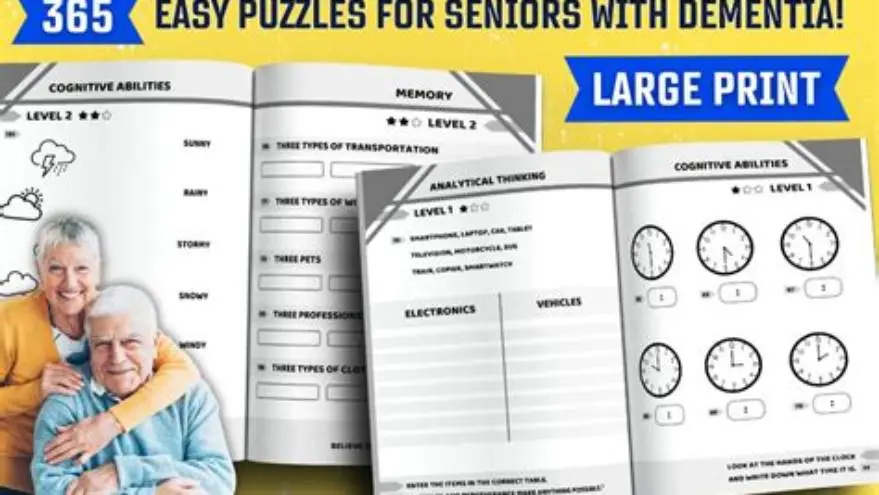
Use font sizes between 16 and 24 points to accommodate common senior vision impairments. Larger print reduces eye strain and improves task engagement.
Choose sans-serif fonts like Arial or Verdana for clarity. Avoid decorative fonts that complicate letter recognition.
Keep layouts simple and uncluttered. Use high-contrast colors, such as black text on white or cream backgrounds, to enhance readability.
Maintain clear spacing between letters, words, and puzzle elements. Crowded layouts can overwhelm and confuse, especially for those with dementia.
Number puzzles clearly and include answer keys with the same large-print format to support independent activity or caregiver assistance.
- Font size: 16-24 pt for visibility
- Font type: sans-serif for clarity
- Contrast: high (black on white/cream)
- Layout: uncluttered with good spacing
- Support: large-print answer keys included
1950s-themed reminiscence activities for seniors with dementia
Using 1950s-themed reminiscence activities for seniors with dementia offers calm, success-oriented engagement. You can create or find large-print word searches, crosswords, and matching games featuring 1950s cultural references.
Start with simple word searches containing 10-15 words related to well-known 1950s icons. These puzzles gently encourage memory recall without overwhelming participants.
Incorporate music from the era and ask open-ended questions about dances, shows, or daily life to deepen engagement. Games that tie into these conversations, like matching the name to a picture of a 1950s celebrity, extend the activity time while keeping frustration low.
Focus on flexibility: adapt word counts or puzzle complexity to the individual's abilities, and use large print consistently. Repetition and gentle encouragement make these activities effective tools for memory stimulation.
- Simple 10-15 word word searches with 1950s terms
- Matching games pairing 1950s celebrities with photos
- Listening to 1950s music to prompt discussion
- Open-ended questions about 1950s daily life and entertainment
Leveraging BigPrint Puzzle Studio to create 1950s puzzles
BigPrint Puzzle Studio is a practical tool that helps you create custom large-print puzzle books themed around the 1950s quickly. It lets you pick font sizes between 16 and 24 pt and includes word search and crossword templates with themed word lists.
This software is especially helpful if you want to tailor puzzles to the interests and abilities of the seniors you care for. It generates printable puzzles with answer keys formatted in large print, reducing setup time.
Limitations include the need for some computer use comfort and the focus on puzzles only, so you will need other activities for music or conversation prompts. An alternative is free printable word search generators online, but they often lack large-print clarity or themed word lists.
Questions people still ask
How do I choose 1950s themes that will resonate with my senior?
Focus on cultural icons and common experiences from the 1950s like music stars (Elvis Presley), popular TV shows, cars, and fashion. Personalize based on what your senior enjoyed or lived through in that decade.
What font size is best for seniors with low vision?
Fonts between 16 and 24 points in sans-serif styles work best. Larger sizes improve readability and reduce eye strain, especially for those with dementia.
Can these activities be used for all dementia stages?
Activities must be adapted. Early stages tolerate more challenge; late stages need very simple, sensory approaches. Always observe for signs of frustration and adjust accordingly.
Are there free resources for 1950s-themed large-print puzzles?
Some free online word search generators exist, but they often lack large print or tailored 1950s word lists. Manual creation or tools like BigPrint Puzzle Studio offer better customization and print quality.
How do I prevent frustration during reminiscence activities?
Use simple, clear prompts and large-print materials, focus on success, and avoid testing memory hard. Encourage storytelling and provide supportive cues to keep the mood positive.
Is music beneficial in 1950s reminiscence activities?
Yes, playing familiar 1950s music can evoke strong memories and emotions, helping engagement, especially when combined with discussion or puzzle activities.