What Big Print Trivia for Seniors Does in a Real Session
Big Print Trivia for Seniors is the trivia pack we make for group sessions. It turns a room of players into teams, hands the host ready questions, and keeps score for them. Players answer with A, B or C, and everyone hears how their team did.
On this page (8 sections)
Part of our guide on large print word search printable for seniors
Key figures
- Questions
- 400 multiple choice
- Rounds
- 20 themed rounds
- Print size
- 19 pt questions
- Choices
- A, B or C
- Answers
- After each round
- Scoring
- Score cards included
Quick recap
- A ready-made trivia game for groups, run from printed sheets.
- Scoring happens as you play, while the game is still warm.
- Everything a host needs comes in the pack.
- Small teams, read aloud twice, one point per right answer.
- Write your own round when the group wants fresh questions.
What does Big Print Trivia for Seniors do?
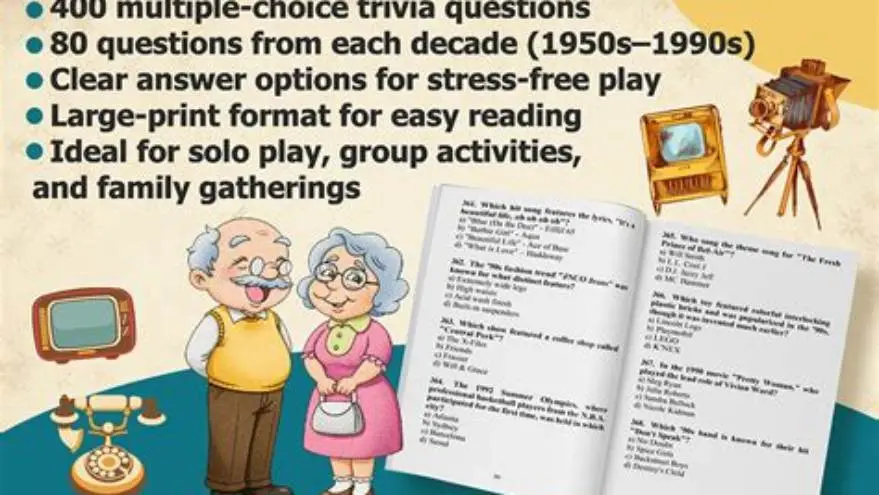
Our trivia pack does one job: it turns a room of players into teams and gives them a game to play together. The host runs the session from the printed sheets, and players answer with A, B or C. Nobody needs a phone, a screen or an app. Everything sits in one pack, so the host spends time with the players instead of hunting for material.
The kit's listing describes a set of multiple-choice questions in themed rounds, so one pack covers many sessions. Each round has a theme, and the answers sit with that round instead of at the back. That layout matters in a live room. Answers can be checked at once, and the pace keeps moving without flipping pages. That gives a host enough material for weeks of sessions. A host can run one round for a short visit or several for a longer one.
Questions come in large print sized for arm's-length reading, with three choices each. Players who read the sheet themselves can see the words at arm's length. Listeners can follow the host and still join in. The listing also names score cards, team sheets, certificates and a host kit.
What is inside the pack?
Rounds sit at the heart of the pack. Each round covers one theme, and every question gives three choices: A, B or C. Players circle a letter or call it out, so nobody has to spell a long answer or write a full sentence. Three choices keep the game moving and keep wrong answers painless. We go through themed word searches seniors step by step elsewhere on the site.
Each round runs from the printed sheets. Players learn at once which answers they got right, and the group can talk about the ones that surprised them. Most of the chat happens in that short pause between rounds. Host kits set out plain steps for running a session, so a first-time host can start without guessing.
Big Print Trivia for Seniors is the pack we make for this kind of session. Its limit is plain: the rounds are fixed, so a group that plays every week will meet the same questions again.
Themes give each round its own flavour. A host can pick the themes the group knows best and skip the rest for another day. That choice matters more than the number of rounds, since a round on a loved topic beats two rounds on a dull one. Before you commit to anything, it is worth looking at do word searches help with memory.
How does a trivia session run, start to finish?
Sessions start before anyone sits down. Pick one or two rounds for the day and print enough sheets for each team. One round is plenty for a short visit, and two rounds fill a longer one. Print a score card for each team too, and keep the answer page close.
Small teams tend to work better than large ones. In a small team, quiet players get a voice, and nobody has to shout an answer across a table. Read each question slowly, repeat the three choices, and give the teams time to agree before moving on. Reading the question twice helps players who missed a word the first time.
Scoring stays simple. Each right answer earns one point, and the host marks the score card after each round. Answers are read aloud, so players hear at once how their team did. Wrong answers cost nothing, and the host can note the questions that stumped everyone for the next visit. End with the totals, the certificates and a short chat about the round players liked best. Keep the answer page out of sight until the round ends. People in this spot often ask about make word search easier to read as well.
- Pick one or two rounds and print a sheet for each team, plus a score card.
- Read each question twice, then wait for the teams to agree.
- Give teams time to agree on one letter before you move on.
- Read the answers after the round and mark the score cards.
- Hand out certificates and ask which round to play next time.
Who does it suit, and who should skip it?
This pack suits a family visit, a care home activity room and a senior center group. Family members can host at home, and activity directors can host a full room with teams. Questions need no special knowledge to answer, and the three choices mean a player can guess and still join in.
Low vision is no barrier here, since the questions print in large type and the choices match. Players who tire of writing can answer aloud while a teammate marks the sheet. Slow readers can listen to the host and answer from what they heard. It asks for attention and talk, not speed or neat handwriting.
Skip it when nobody can host. One person still needs to read the questions and keep score, even in a small group. It also fits less well for a player who wants fresh questions every day. For those readers, a free round of your own questions works well. Write ten questions about the player's life, town or favorite shows, print them large, and read them aloud the same way. A host who has never run a game before can start with one round and learn as they go. We cover three difficulty levels for engagement in its own article.
| Way to play | Prep | Best for | |
|---|---|---|---|
| Printed trivia pack | Large print, set for the page | Print the rounds | Groups and care homes |
| Questions read aloud | Depends on the sheet | Write the questions first | One visit, no printing |
| Quiz book | Varies by book | Open and read | One reader, small groups |
How big is the print, and why does it matter?
Per the kit's listing, the questions print at 19 pt, with the choices in large type to match. That size reads well at arm's length for most players, even in a bright room. Large print is generally set well above body-text size, and this pack sits clearly above that floor. Letters stay bold enough to tell apart, and the lines have room to breathe.
Print size is only half the job. Page layout matters just as much. Each question gets its own line, the choices sit under it, and a sheet with a few questions per page never looks crowded. A crowded sheet slows a reader down more than small type does. White space between questions lets a player find their place again after looking up to think.
Check the print before the session, not during it. Print one round at 100% or Actual size and hold the sheet at arm's length. If the letters look small, the printer may have shrunk the page to fit, so check the setting and print again. That quick check takes moments and saves a room of players squinting at the first question. Good light helps too, so sit near a lamp or a window. For the detail, see our notes on extra large print word search for low vision.
What do you need to run it well?
You need the printed rounds, a pen for each team and a quiet corner of the room. Reading comes from the printed sheets, so no screen or speaker is needed. Tables for each team work well, with chairs close enough that teammates can talk without shouting. Keep an eye on the clock so the session ends when the group expects.
Pace matters more than speed. Read each question once, then again with the choices, and wait for the teams to settle. Some players need a few seconds to think, and a rushed host leaves them behind. When a question stumps every team, say so out loud and move on. Groups enjoy a hard question more when nobody feels singled out for missing it. A pause between rounds gives everyone a breather.
Two rounds are plenty for most groups, and a short session leaves players looking forward to the next one. Ask which theme the group wants next time, and note it on the host sheet. Games that end on a laugh get played again, and the same rounds can wait a few weeks before they come back.
A ready-to-run pack for groups that want trivia without prep; the set rounds are its one real limit.
Still wondering?
Can one person play Big Print Trivia for Seniors alone?
Solo play works too: one player can read the questions, pick a letter and check the answers at once. It works best in a group, though, since the talk between rounds is half the pleasure. Solo players can still keep score across rounds and try to beat their own total.
How long does a round take?
That depends on the group. Each round gives the group plenty to talk through, and most groups take their time with the answers. Plan for one or two rounds in a session, and stop before the room grows tired.
What if a player cannot read the questions?
Every question is read aloud by the host, so a player who cannot read the print can still play. Teammates can mark the sheet while the player answers by voice. Large print also helps players who read slowly or tire easily.
Do the rounds repeat?
Yes. The pack holds a set list of rounds. A group that plays every week will meet the same questions again once they run out. Mixing in a round of your own questions keeps the game fresh between repeats.
Does trivia help with memory?
Trivia gives players a pleasant way to stay mentally active and talk with others. No game can treat, slow or prevent memory loss, and this pack makes no such claim. Anyone worried about memory should ask their doctor.
Ready to try it? It gives the reader the ready-made rounds this article describes, with answers and score sheets included.
See the trivia pack