Which reminiscence cards suit early, middle, or late dementia stages best
Early-stage dementia responds to open-ended questions and detailed images; middle stages need simpler prompts with one clear subject per card; late stages work best with single familiar objects or faces and very few words, often paired with touch or music.
On this page (8 sections)
Part of our guide on simple activities for dementia patients
Key figures
- Early stage
- open questions, detailed scenes
- Middle stage
- single subject, 3-5 word prompts
- Late stage
- one image, touch or sound cues
- Session length early
- 20-40 minutes
- Session length late
- 5-10 minutes
- Frustration signal
- time to simplify one level
Quick recap
- Early-stage dementia: use cards with open questions and detailed scenes that invite storytelling
- Middle stages: switch to single-subject images with short prompts, avoiding cards that require sequencing or choice
- Late stages: choose cards showing one familiar object or face, with touch or sound cues replacing most words
- Watch for frustration or withdrawal as the signal to move down one complexity level
- Homemade cards using family photos often work better than generic packs once memory narrows
How dementia stages change what conversation cards can do
Dementia narrows communication in stages, and reminiscence conversation cards for dementia work only when they match where the person is now. Early on, someone might talk for minutes about a photograph of a 1950s kitchen, pulling up details about the stove, the curtains, their mother's apron. A year later, that same card might produce silence or agitation because the brain can no longer hold the question, search memory, and form a sentence all at once. The card hasn't changed. The cognitive load has.
Middle-stage dementia shortens working memory and makes it hard to choose between options or follow a thread. Cards with multiple people, busy scenes, or questions like "Which of these do you remember?" ask too much. The person stalls, looking confused, or says yes to everything. Late stages strip language further: nouns vanish, attention span drops to seconds, and recognizing even close family becomes uncertain. At that point, most printed cards sit ignored unless they show one large, high-contrast image of something the person touched daily for decades.
Choosing the right cards means watching how the person responds, not guessing from a diagnosis. Someone officially in middle-stage dementia might still handle complex prompts on a good day, or might need late-stage simplicity by afternoon when fatigue sets in. The stage is a guide; frustration, silence, or turning away are the real measures. Move to simpler cards the moment a session stops feeling easy.
Reminiscence works by pulling up long-term memory, which outlasts short-term recall, but only if the prompt is clear enough and the person has enough cognitive bandwidth left to process it. A card that lands slightly too hard feels like a test, and the person shuts down. One that's slightly too simple still sparks a smile. Err on the side of easier. We cover reminiscence activities for seniors 1950s in its own article.
Conversation cards that work in early-stage dementia
Early-stage dementia leaves most language intact, so cards can ask open-ended questions and show detailed scenes. A photograph of a crowded dance hall, a street market, or a workshop full of tools gives the person enough to look at. The prompt might be "What do you remember about Saturday nights?" or "Did you ever work with your hands?" These cards assume the person can hold the question, scan the image, and build a response of several sentences.
Look for cards with realistic period detail: clothing, cars, shop fronts, kitchen appliances from the 1940s through 1970s, depending on the person's youth. Generic or modern images don't trigger the same depth of recall. A 1965 Ford Cortina will start a ten-minute story about a first car; a generic "old car" illustration might get a shrug. Specificity matters because long-term memory is filed by association, and a detail as small as a door handle or a shop sign can unlock a whole scene.
Questions on early-stage cards should invite storytelling, not test memory. "Tell me about a time you felt proud" works; "What year did you get married?" can feel like an exam. The person should be able to answer in any direction without being wrong. Some people talk for twenty minutes from one card; others need three or four cards in a session to stay engaged. Both are fine. The goal is conversation, not coverage. There is more on reminiscence conversation cards for dementia in a separate guide.
At this stage, many families print their own cards using old family photographs. A picture of the person's childhood home, their wedding day, or their own children as toddlers often works better than any commercial set because the memory is direct and strong. You can make a simple set by printing 6x4 inch photos on cardstock, one image per card, with a single question handwritten on the back.
- Detailed scenes: use images with multiple elements the person can look at and comment on
- Open questions: phrases like "What was it like?" or "Do you remember?" that allow any answer
- Period accuracy: cars, clothes, and settings from the person's young adulthood, usually 1940-1970
- Family photos: print pictures of the person's own past when you have access to them
Cards to use in middle-stage dementia
Middle-stage dementia makes it hard to process busy images or hold a question long enough to answer it. Cards need to show one clear subject: a single loaf of bread, a rotary telephone, a knitted cardigan, a teapot. The image should fill most of the card, with high contrast and no clutter. A card showing a bakery counter with twelve items will overwhelm; a card showing one crusty loaf on a breadboard will get a smile and maybe a sentence about how bread used to smell.
Prompts at this stage should be three to five words, spoken aloud rather than read. "Do you like tea?" or "Did you knit?" give the person a simple yes-or-no anchor, and they might add a detail or a name. Avoid questions that ask the person to choose ("Which did you prefer, tea or coffee?") or remember a sequence ("What did you do after breakfast?"). The working memory needed to compare or order events is fading, and those questions produce visible effort and often silence. People in this spot often ask about dementia conversation starters with activities as well.
Many middle-stage sessions work better when the carer names what's in the picture first: "Here's a lovely old iron, the kind you heated on the stove." That removes the cognitive step of recognizing and naming the object, and the person can simply agree, nod, or add a memory. You're not testing whether they know what it is; you're giving them a launchpad. Some people will correct you if you get a detail wrong, and that's a good sign: they're engaged.
Watch for frustration or blank stares. If the person looks at a card and turns away, or says "I don't know" to every prompt, the cards are still too hard. Move to even simpler images: a single face, a single flower, a cat. Cut the words further. Some people at this stage respond better to cards that pair an image with a texture (a card showing wool glued to a picture of a sheep, or sandpaper on a picture of a workbench) because touch bypasses some of the cognitive load.
| Feature | Early stage | Middle stage |
|---|---|---|
| Image complexity | Multiple subjects, detailed scenes | One subject, plain background |
| Prompt length | Full questions, 8-15 words | 3-5 words, often yes/no |
| Session length | 20-40 minutes | 10-20 minutes |
| Recognition help | Not needed | Carer names the object first |
What works in late-stage dementia
Late-stage dementia strips most expressive language, and many people stop recognizing photographs of anyone except perhaps their parents or spouse. Conversation cards at this point need to be very large, very simple, and very familiar: a single red apple, a baby's face, a dog, a rose. High contrast helps: black-and-white images or bold colors against plain backgrounds. The card is less a prompt for conversation and more a focus point that might produce a smile, a hum, or a hand reaching out. For the detail, see our notes on activities for alzheimer's patients printable.
Words mostly disappear from late-stage cards. Instead, pair the image with something tactile or auditory: a card showing a cat, with soft fur glued to it; a card showing a piano, while you hum a hymn. The person might stroke the fur, nod to the music, or look at the image for a few seconds. That's success. You're aiming for a moment of recognition or comfort, not a sentence. Some people will say a single word ("baby," "nice," "yes") and that word is the whole conversation.
Session length at this stage might be five minutes, often less. Attention span is short, and pushing beyond it causes agitation. You might show three cards, get a smile or a touch from one of them, and stop. The person might not look at the cards at all on some days, and that's fine. Forcing engagement when someone is tired or distressed makes things worse, not better. Reminiscence in late-stage dementia is about presence and calm, not output.
Homemade cards showing the person's own face as a young adult, their parents, or their childhood home sometimes still register when nothing else does. Print these large (A5 or half a sheet of letter paper) and laminate them so they can be touched and handled without damage. Some families add a line of a favorite song or prayer in large print under the image, which a carer can read aloud. The person might not respond visibly, but familiar words spoken in a calm voice still reach further than new ones. We go through activities for dementia table top step by step elsewhere on the site.
- One subject only: a single face, object, or animal filling the card
- High contrast: bold color or black-and-white images with plain backgrounds
- Texture and sound: glue fabric, sandpaper, or soft material to cards; hum or sing instead of asking questions
- Short sessions: 5-10 minutes, stopping the moment attention drifts
Choosing or making cards by stage: the quick test
The fastest way to tell whether a set of reminiscence cards will fit is to look at one card and count the distinct things on it. If there are five or more separate objects, people, or background details, the cards suit early-stage dementia. If there's one main subject and maybe a simple background, they'll work for middle stages. If there's one thing and nothing else, they're right for late-stage use. This test works on commercial packs and on cards you make yourself.
A second test: read the prompt aloud and time yourself. If it takes more than three seconds to say, it's too long for middle or late stages. "Tell me about a time you went dancing" is an early-stage prompt. "Did you like to dance?" works for middle. No words, or just "dancing" said warmly while pointing, is late-stage. Complexity isn't better; it's just different. The person's ability right now decides what's useful.
When you're between two levels, start with the simpler cards. A card that's too easy still gets used; a card that's too hard sits ignored or causes visible frustration. You can always add complexity if the person responds well, but you can't undo the feeling of failure that comes from a session that was too difficult. Watch the person's face: if they lean in, smile, or start talking, the level is right. If they look away, go quiet, or say "I don't know" more than once, drop down.
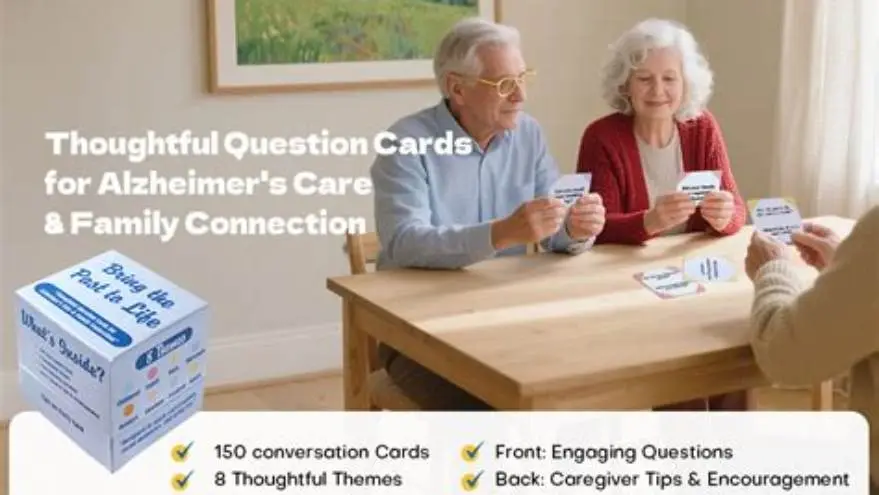
For families printing their own, we built the Gentle Minds Activity Kit with 48 conversation cards at three levels (early, middle, and late-stage prompts) plus a guide that explains which to use when. The cards use realistic period images and include both printed prompts and blank backs so you can write your own or add family names. It's a printable PDF, so you can reprint any level as the person's needs change without buying a new set. It won't replace professional therapy, and it won't slow progression, but it does give you a ready set of prompts that match where the person is now.
When to move from one card level to the next
The signal to move down a level is repeated frustration or withdrawal. If the person used to talk for five minutes per card and now falls silent after one, or if they start saying "I don't know" before you finish the question, the cards have become too hard. This shift can happen over months or quite suddenly after an illness, a fall, or a medication change. Some people plateau at one level for a year; others move through stages faster. There's no standard timeline, and trying to hold someone at a level they've moved past makes sessions stressful for everyone.
A good day doesn't reset the baseline. If someone handles complex cards well on Monday but struggles on Wednesday, Thursday, and Friday, Wednesday is the new normal. Use the simpler cards from now on, and celebrate the good days when they come rather than expecting them every time. Dementia is progressive, and capacity generally moves in one direction. Accepting that lets you meet the person where they are instead of where they were.
Sometimes moving to simpler cards feels like giving up, especially for family members who remember long conversations from a few months ago. It's not. It's meeting the person's need for success and calm. A session with simple cards that gets a smile and a few words is infinitely better than a session with complex cards that ends in confusion and silence. The relationship and the comfort matter more than the cognitive challenge.
Conversely, if someone at late-stage level suddenly starts responding to middle-stage prompts (naming objects, answering short questions) don't dismiss it. Try a few slightly more complex cards and see what happens. Dementia doesn't usually reverse, but infections, dehydration, poor sleep, or medication side effects can all temporarily suppress function, and treating those can bring someone back a step for a while. Most of the time, though, the direction is simpler, and that's okay. The cards adapt. You adapt. The person gets what they need.
Still wondering?
Can I use the same conversation cards for someone who moves between stages day to day?
Yes, if you pick cards from the simpler level the person needs on their harder days. Print a few sets at different levels and start each session with a middle or late-stage card to see how they respond, then adjust up or down. Starting simple and adding complexity works; starting too hard and pulling back often leaves the person feeling tested and frustrated.
Do commercial reminiscence card packs state which dementia stage they suit?
Most don't, or they claim to suit "all stages," which usually means early to middle. Check the sample images: if they show detailed scenes with multiple people and long questions, they're early-stage. If they show single objects with a few words, they'll work for middle. Very few commercial packs simplify enough for late stages, so families often make their own or use large printed photos.
How do I know if a card is triggering a bad memory instead of a good one?
Watch for a sudden shift: the person's face tightens, they push the card away, or they become quiet and withdrawn. Remove the card immediately, switch to a safer subject, and don't use that card again. Not all memories are happy, and you can't predict which image will land wrong. If distress lingers, end the session and try again another day with different cards.
Should I correct the person if they misidentify something on a card?
Not unless the mistake will cause practical harm, which it won't in a reminiscence session. If they call a picture of a bus a train and start talking happily about train journeys, let them. The goal is connection, not accuracy. Correcting them often stops the conversation and makes the session feel like a test.
Can I use reminiscence cards with someone who has vascular dementia or Lewy body dementia, not Alzheimer's?
Yes, the stage-based approach works across dementia types because it's matching cognitive and communication ability, not diagnosis. Vascular dementia can cause more variable day-to-day function, so you might need to shift card complexity more often. Lewy body dementia sometimes affects visual processing, so cards with very clear, high-contrast images work better than subtle or shadowy ones.
How many cards should I use in one session?
In early stages, three to six cards over 20-30 minutes; in middle stages, two to four cards over 10-15 minutes; in late stages, one to three cards over 5-10 minutes. Stop when the person's attention drifts or they look tired, even if you've only used one card. Quality of engagement matters far more than quantity.
Ready to try it? It provides 48 conversation cards sorted by difficulty level, so you can match prompts to the person's stage without hunting through mixed sets.
Get conversation cards by level